Interval Training Bike Workout: Get Faster in 2026
You ride often. You finish tired. Your Garmin file looks solid. But the average speed on the same local loop hasn’t moved in months, and the hard group ride still splits on the same hill.
That stall usually isn’t a motivation problem. It’s a workout design problem. A lot of riders pile on more miles when what they need is a better interval training bike workout. Not more riding. Better-targeted riding.
The second frustration comes later. You finally sketch a smart session in your notes app, then lose patience trying to force it into Garmin Connect or a Wahoo workout builder. A simple coach note like “5 by 3 minutes hard, 2 minutes easy” somehow turns into a fiddly sequence of blocks, targets, repeats, and edits.
Good training and good workflow go together. The fastest riders I coach aren’t only consistent on the bike. They also make their workouts easy to execute. The plan is clear on paper, clear in the legs, and clear on the head unit.
Table of Contents
- Why Your Cycling Speed Has Plateaued And How to Fix It
- The Building Blocks of a Powerful Interval Workout
- Sample Bike Interval Workouts for Every Goal
- How to Progress Your Intervals and Build a Plan
- From Your Notes to Your Bike Computer Screen
- Start Building Speed and Confidence Today
Why Your Cycling Speed Has Plateaued And How to Fix It
You finish a week with plenty of riding in your legs. The commute happened, the weekend group ride happened, the long steady ride happened. Then the road tilts up or the pace jumps, and the gap opens in a few seconds.
That pattern usually points to training that is too broad to drive a new adaptation. You are riding enough to maintain fitness, but not giving your body a clear enough signal to raise speed.
A lot of riders get stuck in the same grey middle. Every ride feels productive, breathing is up, legs are loaded, and the session earns a satisfying upload. After a few weeks, though, the body reads that effort as familiar work. Familiar work is hard to build on.
Specificity fixes plateaus
A rider can be disciplined and still train in a blurry way. The power drifts. Recovery starts when it feels convenient. One hard effort is threshold, the next is closer to a sprint, and the rest of the ride fills in the gaps. That kind of session can leave you tired without making you faster in any predictable way.
Intervals solve that problem because they turn a vague goal into a repeatable instruction. Ride at this target for this long. Recover for this long. Repeat enough times to stress one system on purpose.
That matters on the bike and on the screen.
If your workout note says, “do a few hard ones, then spin easy,” your Garmin or Wahoo cannot do much with it. If the note says, “5 x 3 minutes at 110% FTP with 3 minutes easy between reps,” you can build it, export it, and follow it without second-guessing the session halfway through.
Good interval sessions look plain in a notebook and feel clear on the bike.
Why intervals change speed faster than more steady riding
Extra volume helps until it stops addressing the limiter. A rider who needs better repeatable power will not solve that with another steady hour in zone 2. A rider who fades near threshold will not fix it by turning every ride into a moderate grind.
Intervals let you aim at the bottleneck. That is the practical advantage. You can train top-end aerobic power, threshold, or short-repeat punch with far more precision than you can during an unplanned ride.
They also give you feedback you can use. Could you hold the target without power fading all over the place? Did the last rep stay close to the first? Did the recovery feel controlled or desperate? Those answers help you adjust the next workout, and they are much easier to spot when the session is written clearly enough for a device to guide you.
This is where many riders lose progress. They understand the coach’s note, but they never translate it into a structure their bike computer can execute cleanly. Once the workout is written in a format the device understands, pacing improves, compliance improves, and the session becomes much easier to judge afterward.
The Building Blocks of a Powerful Interval Workout
A good interval workout is easy to describe in a training note and easy to follow on the bike computer. If either part is messy, execution usually gets messy too. The goal is a session you can write once, understand at a glance, and send to Garmin or Wahoo without editing it three times.
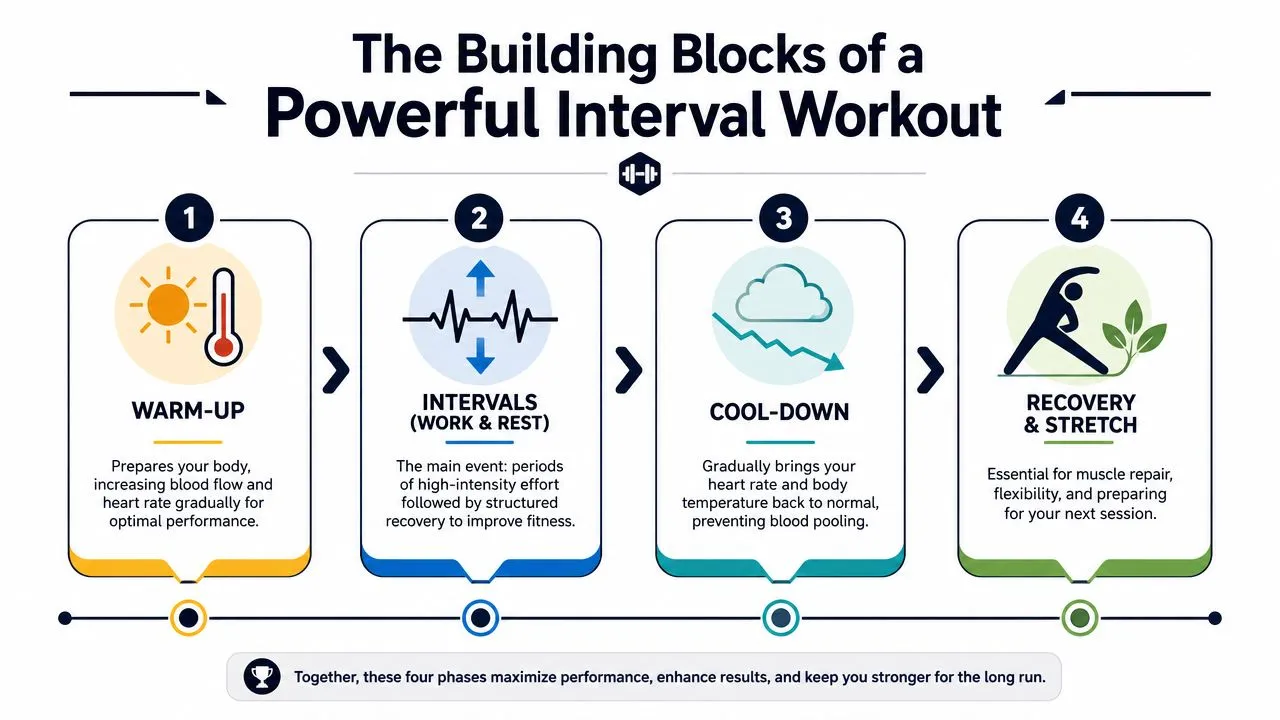
Warm-up, work, cool-down, recover
Every interval workout has four parts. Each one needs a job on paper.
- Warm-up. Prepare the legs, breathing, and cadence before the first hard rep. If the warm-up is too short, the first interval is half preparation and half training, which lowers the quality of the set.
- Main set. This is the part you are trying to improve. Work intervals and recovery intervals should be specified clearly enough that your device can prompt each change.
- Cool-down. Bring effort down gradually so the session ends under control instead of with an abrupt stop.
- Recovery after the workout. Fuel, sleep, and the next day’s load affect whether the workout creates fitness or just fatigue.
The main set deserves the most care because small writing errors become pacing errors on the road or trainer. “5 x 3 minutes hard” is incomplete. “5 x 3 minutes at 110 to 115% FTP with 3 minutes easy at 50% FTP between reps” is something a device can execute cleanly.
That difference matters.
Short intervals, long intervals, and threshold blocks all use the same basic structure. You set a duration, an intensity target, a recovery duration, and the number of repeats. Once those pieces are clear, turning the workout into a file becomes straightforward. If you want more examples of how these descriptions are written, the TextFit cycling training articles show the pattern well.
Tabata is a good example of how precise wording changes execution. “8 rounds of 20 seconds hard, 10 seconds easy” is usable. “Go hard for a few minutes” is not. Short sessions leave even less room for vague instructions because the transitions come fast and the quality drops quickly if the recoveries are off.
How to judge effort without guessing
You do not need every metric, but you do need one primary target and one backup. That keeps the session usable indoors, outdoors, and on days when one number is off.
| Metric | Best use | What it feels like | Limitation |
|---|---|---|---|
| RPE | Good for any rider, especially outdoors | A body-based effort scale that reflects breathing, muscle strain, and control | Less precise if pacing skills are still developing |
| Heart rate | Useful for steady efforts and post-ride review | Shows cardiovascular strain over time | Lags behind on short or punchy intervals |
| FTP and power | Best for structured bike intervals | Gives an immediate target at the pedals | Depends on a realistic FTP and a working power setup |
RPE is your internal check. Heart rate confirms whether the effort is trending too high or too low. Power gives the clearest pacing target during the interval itself.
My rule for riders is simple. Use power to ride the rep, heart rate to review the response, and RPE to decide whether the session matched the day you had.
That matters most in hard aerobic work. A set like 5 x 3 minutes above threshold should feel controlled for the opening minute, demanding in the middle, and close to the limit by the finish. If power is on target but RPE is far higher than expected by rep two, adjust before the session turns into survival riding.
If you’re new to writing workouts, include more than one cue in the note. For example: “3 minutes at 110 to 115% FTP, RPE 8 to 9, heart rate rising through the interval, 3 minutes easy between reps.” That is clear enough for a coach, clear enough for a device, and clear enough for you halfway through the session when your legs are no longer interested in making decisions.
Sample Bike Interval Workouts for Every Goal
A rider finishes a hard session, saves it as “4x4 hard,” then stares at Garmin Connect wondering what that means as a workout file. That gap matters. A useful interval session is not just a good idea on paper. It has to be specific enough that you can pace it on the bike and simple enough to build into your head unit without second-guessing every step.
A small set of repeatable workout types covers most needs. The trick is choosing the right one, then writing it in a way that survives the trip from training note to device screen.
Three templates that solve different problems
| Workout Goal | Session Structure Plain Language | Effort Targets RPE / %FTP / HR Zone |
|---|---|---|
| VO₂max | Warm up well, then ride 4 x 4 minutes at a hard but repeatable aerobic effort, with easy spinning between reps. Finish with a cool-down. | RPE: 8 to 9. %FTP: 110 to 115%. HR Zone: high aerobic to very hard, rising through the interval |
| Threshold | Warm up, then ride 3 x 15 minutes at a strong steady pace, with controlled recovery between blocks. Cool down easy. | RPE: comfortably hard. %FTP: 95 to 105%. HR Zone: hard but controlled, not spiking |
| Anaerobic capacity | After a full warm-up, repeat short near-max efforts with enough rest to keep each rep sharp. Stop before power and form fall apart. | RPE: near-max on work reps. %FTP: short maximal efforts can reach up to 150% FTP. HR Zone: less useful in the rep, better for recovery tracking |
Each of these can be written two ways. First as a coach’s note. Then as a device-ready workout.
For example, a threshold session might start as: “3 x 15 minutes at upper steady state, 5 minutes easy between reps.” To make that usable on a Garmin or Wahoo, tighten the language: “Warm-up 15 minutes. Ride 3 repeats of 15 minutes at 95 to 100% FTP with 5 minutes at easy endurance between repeats. Cool down 10 minutes.” That version leaves less room for guesswork, both for pacing and for setup.
What these sessions should feel like
A well-paced VO₂max session gets serious fast. The first rep should feel controlled for about a minute, then progressively harder. By the third rep, breathing is heavy and concentration narrows. You are working hard, but you are still riding the target rather than chasing it. If the final interval turns into a fade from the opening minute, the earlier pacing was too aggressive or recovery was too short for the day.
Threshold work is quieter. It rarely feels dramatic, and that is why riders often get it wrong. The sensation is sustained pressure in the legs and steady breathing that stays under control. If power jumps around because of surges, standing accelerations, or terrain changes, the workout starts drifting away from its job.
Anaerobic capacity sessions are blunt. The work reps should feel sharp and fast, with a clear drop-off if rest is cut too short. Heart rate is late to the party here, so judge these by power, cadence, and whether you can still produce a clean effort. Once reps become survival stomps, the useful part of the session is usually over.
If the workout goal is short power, keep the recovery easy enough to preserve the next hard rep.
These are adaptable templates rather than strict laws. Indoors, power targets are easier to hold and lap structure is simpler to program. Outdoors, terrain, stop signs, wind, and momentum all interfere. I usually write outdoor versions with wider targets and clearer effort cues for that reason.
If you want more examples of plain-language sessions that can be turned into device-ready workouts, the TextFit blog archive on bike workout building has more practical patterns to work from.
How to Progress Your Intervals and Build a Plan

A good interval plan solves a simple problem. It gives you enough stress to force adaptation, while leaving enough freshness to hit the next hard session properly.
Progression beats random suffering
Riders stall when every hard day looks the same on paper. The session may still feel difficult, but the training signal stops changing. Fitness responds to progression, not to repeating a favorite workout until it becomes a weekly ritual.
Use a small set of progression levers and change one at a time:
- Make the work interval longer. Example: move from 5 x 2 minutes to 4 x 3 minutes at the same system.
- Add one repeat. Keep the target and rest the same, then raise the total work.
- Shorten recovery a little. This raises the density of the session without forcing a bigger power jump.
- Raise the target only after the workout looks controlled. If execution is messy, more watts usually makes the session worse, not better.
On paper, these changes are small. On the bike, they are not.
A practical rule is to keep one variable stable for at least a week or two before changing another. If Tuesday was 6 x 3 minutes at VO2max with 3-minute recoveries, the next version might be 7 x 3 minutes or 6 x 3 minutes with 2:30 recovery. It should not become 7 reps, with less rest, at a higher target, all at once. That turns progression into a fitness test.
For device users, this matters even more because clear progression makes the workout easier to build and easier to repeat. “Add one rep” is a clean edit in Garmin Connect or Wahoo. “Kind of harder than last week” is how people end up with notes that make sense in a notebook but fall apart when they try to convert them into a repeat block.
A week that works in real life
Most riders do better with two quality days each week than with three mediocre ones. That spacing gives the hard sessions room to be hard and keeps endurance rides from turning into half-fatigued junk.
One reliable pattern looks like this:
- Tuesday: hard interval session
- Wednesday: easy endurance
- Thursday: easy endurance or rest
- Saturday: longer ride with structured work or steady endurance
- Other days: recovery, commuting, or complete rest based on fatigue
I like this layout because it is easy to manage both physically and digitally. You can write the week out in plain language first, then build only the two key workouts for your head unit. Everything else stays simple. That cuts down setup time and keeps your device calendar from becoming cluttered with sessions that never needed strict structure in the first place.
Signs to hold steady instead of progressing
Completing a workout once does not mean it is ready to progress. Keep the same version for another week if you see any of these:
- Power drops sharply in the final reps. The session is still on the edge of your current capacity.
- Cadence loses rhythm or gets choppy. That usually means force production is replacing good repeatable mechanics.
- Easy days start feeling flat. Fatigue is carrying over more than it should.
- You dread every hard session before it starts. Mental strain often shows up before a clear performance dip.
One more practical check helps here. Compare what you planned with what you could realistically program. If your note says, “Build each rep a touch, settle, then kick late if possible,” that may be a useful coaching cue, but it is not a clean structured interval for a bike computer. Write the progression in a way your device can execute: duration, target, recovery, repeats. Good training plans are easier to follow when the workout description and the file on the screen say the same thing.
Leave one good interval in reserve often enough to string solid weeks together.
From Your Notes to Your Bike Computer Screen
The design of the workout isn’t usually the hard part. The annoying part is turning a human sentence into something a bike computer can execute.
Why device builders feel harder than the workout
Garmin Connect and Wahoo systems can run excellent structured sessions, but building them manually often feels like bookkeeping. You type a simple note in seconds, then spend several minutes choosing duration fields, target types, repeat blocks, and recovery steps just to recreate what you already understood.
That friction gets worse if the workout came from a coach in plain language or from your own notebook. “4 by 4 minutes at VO₂max with equal easy spin” is obvious to a rider. To the builder, it becomes a sequence tree.

The language issue makes it worse. A 2025 study found that 68% of non-English speaking endurance athletes abandon structured training plans due to language barriers in digital workout builders, and the ability to parse multilingual natural language descriptions like “4 phút 200W, nghỉ 1 phút” was the #1 requested feature in athlete surveys according to this report on cycling workout workflow barriers. That’s a real coaching problem, not a niche software complaint.
A workout you can’t enter quickly is a workout many riders won’t use consistently.
How to write workouts so tech can understand them
You can reduce that friction right away by writing your workouts in a cleaner sentence format. Think like a coach writing for both a human and a device.
Use this order:
- Warm-up
- Main set with repeats
- Recovery details
- Cool-down
- Target type
Examples:
- Clear: Warm up 15 min easy, then 5 x 3 min at 110 to 115% FTP with 2 min easy between, cool down 10 min.
- Also clear: 20 min easy including 3 short openers, then 8 x 30 sec hard and 60 sec easy, finish with 15 min easy.
- Multilingual and still structured: 4 phút 200W, nghỉ 1 phút, lặp lại 5 lần, thả lỏng 10 phút.
Avoid fuzzy notes like:
- Too vague: hard hills for a while
- Too mixed: threshold then some sprints then tempo if feeling good
- Too human, not structured: ride spicy but don’t die
The cleaner your wording, the easier it is to review, edit, and send to a head unit without introducing mistakes. A rider should be able to read the sentence and know exactly what the screen will show at each step.
Start Building Speed and Confidence Today
Getting faster doesn’t require a giant training plan or a heroic weekly volume target. It requires a session with a purpose, targets you can hold, and enough recovery to come back ready for the next one.
That’s the practical value of a well-built interval training bike workout. You stop guessing. You know whether the day is for VO₂max, threshold, or short punchy power. You know what the first rep should feel like, and you know when the session has drifted off target.
The last piece is reducing friction between the plan in your head and the workout on your device. Riders stay more consistent when the process is simple. Write the session clearly. Keep the structure tight. Make it easy to execute whether you’re training indoors on a smart trainer or outside with a Garmin or Wahoo on the bars.
If you’ve been stuck at the same speed, don’t chase progress by adding random fatigue. Build one clean session. Repeat it well. Progress it with intent. That’s how confidence grows too. You stop hoping the workout was right because you can see, feel, and execute exactly what it asked for.
If you want the shortest path from note to head unit, type the workout into TextFit the way you’d write it, “5 x 3 min at 110% FTP with 2 min easy”, in any language. Review the structured workout it builds, then send it to your Garmin or Wahoo. Free to start, no sign-up needed.
Produced via Outrank tool