Interval Training Advantages: Fitter in Less Time

You’re training consistently. The long runs are done, the steady rides are on the calendar, and your weekly volume looks respectable. But race pace still feels stubborn, surges hurt more than they should, and the gap between “fit” and “fast” doesn’t seem to close.
That’s the point where many dedicated athletes start looking at interval training advantages more seriously. Not because intervals are trendy, but because they solve a specific problem. Steady work builds a foundation. Intervals sharpen that foundation into usable performance. They stress the systems that decide whether you can respond to a hill, hold threshold late in a race, or recover after a hard effort and go again.
The catch is that intervals only work when they’re programmed with purpose and executed with control. Random hard efforts don’t count as smart training. Good interval work is precise. It has a target, a recovery structure, and a reason for existing in your week.
Table of Contents
- What Are the Real Advantages of Interval Training
- How Intervals Remodel Your Body for Performance
- Get Fitter in Less Time The Top 5 Benefits
- When to Use Intervals and When to Go Long
- Sample Interval Workouts for Your Sport
- How to Easily Create and Sync Your Workouts
- Smart Interval Training Progression and Safety
What Are the Real Advantages of Interval Training
If you’ve been relying on steady-state training for months and your progress has flattened, intervals usually provide the missing stimulus. They ask your body to produce more power, more speed, or more controlled discomfort than daily aerobic work does. That demand forces adaptation.
The biggest advantage isn’t their difficulty alone. It’s that they’re targeted. A well-designed interval session can aim directly at VO2max, lactate tolerance, threshold durability, neuromuscular speed, or race-specific pacing. You stop training in a general way and start training the exact weakness that’s holding back your performance.
The difference between working hard and training well
Many athletes confuse interval training with suffering. Those aren’t the same thing. A sloppy session with the first rep too hard and the last few reps falling apart teaches poor pacing and poor mechanics. A disciplined session teaches repeatability.
That’s why intervals work best when you can answer three questions before you start:
- What system am I targeting
- What should the effort feel like
- What should still be true in the final rep
If you can’t answer those, the workout probably needs adjustment.
Practical rule: The best interval session is the one that keeps quality high from start to finish, not the one that leaves you most wrecked.
Why athletes keep coming back to intervals
Most dedicated endurance athletes value intervals for a few clear reasons:
- They break plateaus: Steady training often stops producing meaningful gains once your body adapts to it.
- They improve usable race fitness: You learn to handle changes in pace, terrain, and fatigue.
- They make limited training time count: You can create a strong stimulus without needing endless hours.
- They add structure: A clear work and recovery pattern makes execution measurable.
Intervals aren’t a replacement for endurance training. They’re the part of training that turns endurance into performance.
How Intervals Remodel Your Body for Performance
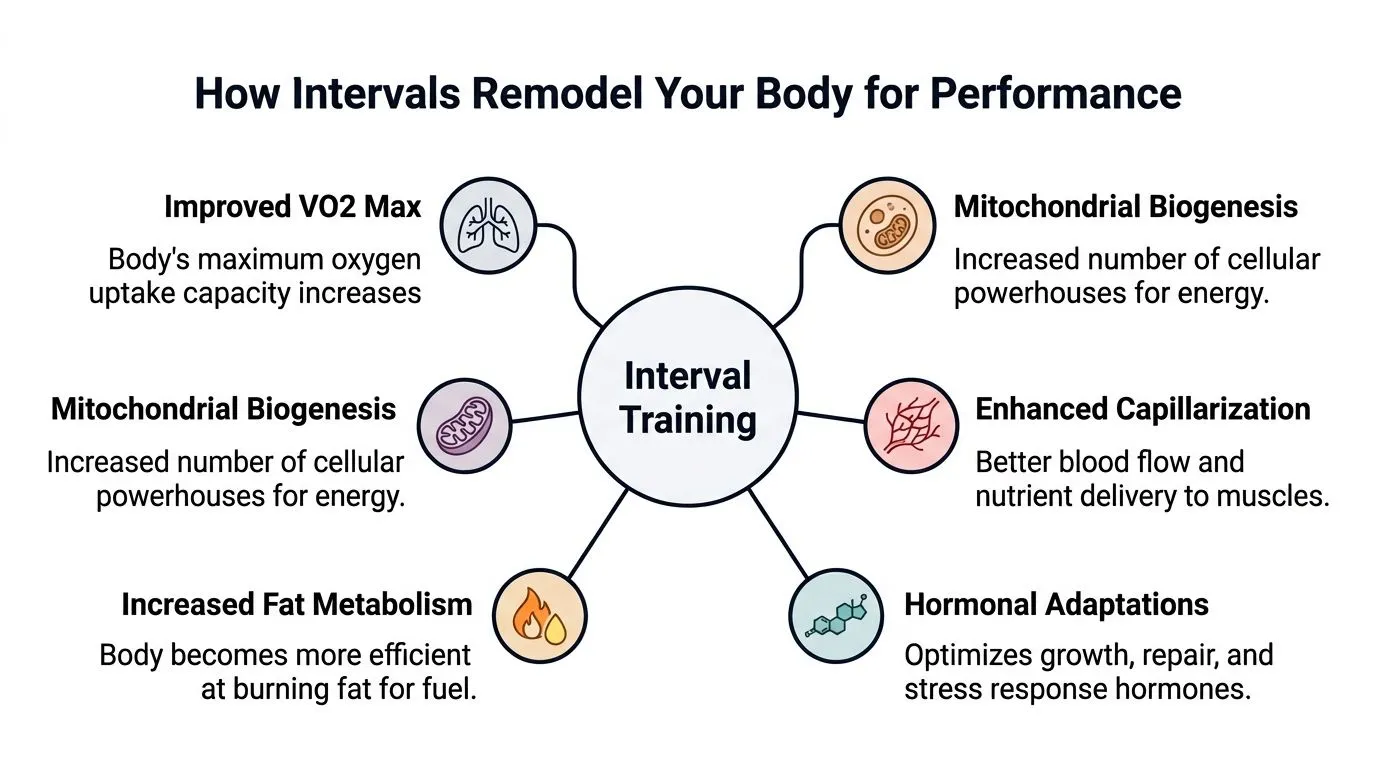
Your body doesn’t improve because a workout was difficult. It improves because the workout created a specific demand and you recovered from it. Intervals are effective because they create a concentrated demand on oxygen delivery, muscular energy production, and fatigue resistance all at once.
Since the seminal 2006 Gibala study demonstrated that Sprint Interval Training yields nearly the same skeletal muscle adaptations as Moderate Intensity Continuous Training with significantly less time, research has confirmed that interval protocols provide superior improvements in VO2max and mitochondrial capacity in a fraction of the time, as summarized by Stanford Lifestyle Medicine on interval training benefits.
Why hard efforts create different adaptations
Think of your aerobic engine like a car with multiple gears. Easy training keeps the engine running smoothly for a long time. Intervals force you to use the higher gears. That exposes limits in oxygen uptake, fuel use, and muscular efficiency that easy miles never fully challenge.
Short recoveries matter here. They do more than make the workout manageable. They keep oxygen demand high while allowing enough reset to repeat quality efforts. That repeated rise in demand is one reason intervals are so potent for endurance athletes.
A single hard session can also trigger mitochondrial biogenesis, which means your cells begin building more of the structures responsible for producing usable energy. In practical terms, you’re improving the machinery that powers sustained work.
What changes for endurance athletes
For athletes, the most meaningful changes show up in a few places:
- Higher VO2max: You can take in and use more oxygen during demanding efforts.
- Better mitochondrial capacity: Muscles become better at producing energy aerobically.
- Stronger cardiometabolic response: Interval protocols have been shown to improve markers such as insulin sensitivity and insulin resistance more effectively than moderate continuous training in the Stanford summary linked above.
- Greater efficiency under stress: You get better at maintaining form and output when effort rises.
Those adaptations matter because races rarely unfold at one smooth pace. There are climbs, corners, surges, tactical changes, and late-race fatigue. Intervals prepare you for the moments that decide outcomes.
Execution still matters. If you ride or run every rep too hard, you often turn a VO2max session into a survival session. If you go too easy, you miss the adaptation. That’s why many athletes benefit from using clear training zones and objective targets. If you’re setting bike workouts around threshold, a practical reference point is this FTP zone calculator for structured cycling targets.
Hard intervals should feel controlled early, demanding in the middle, and precise at the end. If they become chaotic, the prescription is off.
Get Fitter in Less Time The Top 5 Benefits
Some training methods look good on paper and fall apart in real life. Intervals hold up because the benefits translate directly to how athletes train and race.

Five practical benefits that matter
1. You create a strong stimulus without endless training time
This is the advantage most athletes notice first. Intervals let you target a specific adaptation inside a compact session. That makes them valuable for busy professionals, parents, and anyone whose weekly schedule doesn’t allow long aerobic blocks every day.
2. They improve body composition more effectively than many athletes expect
According to this HIIT discussion of EPOC and fat loss, high-intensity intervals reduce total body fat percentage and visceral fat more effectively than moderate-intensity exercise, largely through the afterburn effect, or Excess Post-Exercise Oxygen Consumption. For endurance athletes, that doesn’t mean chasing sweat for its own sake. It means well-placed hard sessions can support a leaner, more economical engine.
3. Intervals help break the steady-state plateau
A lot of athletes become decent at one pace and then stay there. Intervals disrupt that comfort zone. They expose your top-end limitations and improve your ability to operate near race intensity without falling apart.
This matters in every endurance sport. Runners need it for pace changes. Cyclists need it for climbs and attacks. Triathletes need it when transitions and terrain force rhythm changes.
To see how coaches cue interval sessions in real time, this walkthrough is useful:
4. They build confidence at uncomfortable intensities
Race day feels easier when you’ve rehearsed discomfort in training. Intervals teach you what hard but sustainable feels like. They also teach pacing discipline. That’s a real performance gain, because many athletes don’t fail from lack of fitness. They fail from poor effort control.
5. You can target different systems with precision
Not all interval sessions do the same job. Short repeats can emphasize speed and economy. Longer repeats can improve threshold durability. Over-under sessions can teach you to recover while still moving fast.
Key takeaway: One reason interval training advantages are so durable is that the format is flexible. You can change duration, recovery, density, and intensity without changing the basic structure.
That flexibility is why intervals remain useful through base building, race preparation, and sharpening phases.
When to Use Intervals and When to Go Long
Intervals are powerful, but they’re not the answer to every training problem. Athletes get into trouble when they treat every week like a highlight reel of hard sessions. Knowing when to push intensity and when to keep the work steady is the skill.
Choose the tool that matches the goal
Steady-state training still matters because it builds aerobic durability, supports recovery between hard days, and teaches your body to stay economical for long periods. Intervals add the higher-end stimulus. The two methods work best together, not in competition.
Here’s the simplest way to decide.
| Training Goal | Best Tool Interval | Best Tool Steady-State |
|---|---|---|
| Improve top-end aerobic power | Yes | Sometimes |
| Build long endurance for races | Sometimes | Yes |
| Practice race surges and pace changes | Yes | No |
| Recovery between hard sessions | No | Yes |
| Improve pacing discipline at moderate effort | Sometimes | Yes |
| Develop comfort with sustained discomfort | Yes | Sometimes |
A good weekly setup usually protects your easy work instead of sacrificing it. If every run becomes moderate and every ride drifts upward, recovery drops and interval quality suffers.
Where LIIT fits
There’s also a middle ground that doesn’t get enough attention. While most content focuses on HIIT, recent data shows that Low-Intensity Interval Training, or LIIT, effectively lowers blood pressure and cardiovascular disease risk, offering a safer alternative for beginners, older adults, and cardiac patients who may find high-intensity efforts unsustainable or risky, as described by Intermountain Health on low-intensity interval training.
That matters for more athletes than people realize. Not everyone needs sprint-style work. Some athletes need structure without excessive strain. LIIT can help someone re-enter training after inconsistency, build confidence, or add variety without taking on the recovery cost of harder sessions.
Use LIIT when:
- You’re returning from a layoff: Short controlled pickups are often better than one long uninterrupted effort.
- You need less orthopedic stress: Alternating gentle work and recovery can feel more manageable.
- You’re coaching older athletes: Structured variation keeps sessions engaging without forcing maximal output.
The right intensity is the one you can repeat consistently, recover from, and build on next week.
Sample Interval Workouts for Your Sport
The best interval workout is sport-specific and tied to a clear purpose. Don’t copy a session just because it looks hard. Choose one because it develops something your event demands.
Running sessions
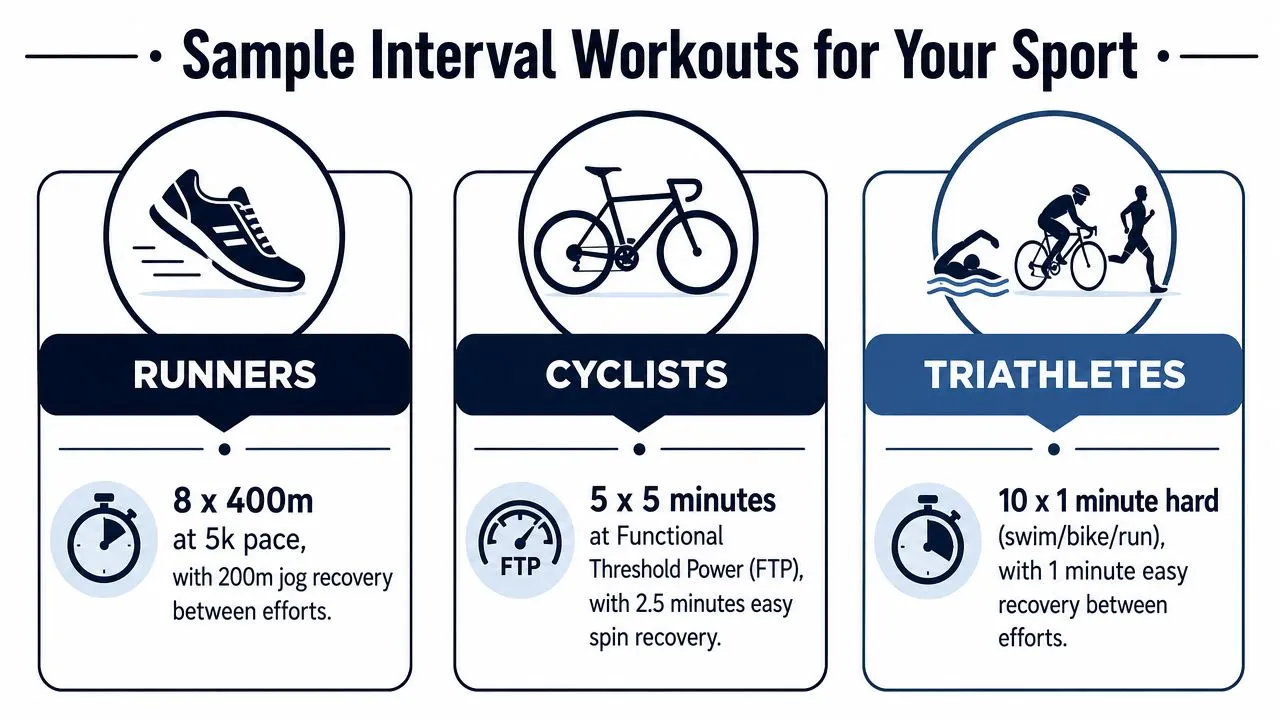
A classic session for runners is 8 x 400m at 5K pace with 200m jog recovery. This is a clean introduction to controlled speed work. It improves pace familiarity and economy without forcing the kind of breakdown that comes with all-out reps.
Another reliable option is a threshold set such as 3 x 8 minutes at comfortably hard effort with short easy jog recovery. That session is less flashy, but for many distance runners it’s more useful than short track work because it teaches sustained control near race effort.
For athletes who race rolling courses, hill intervals work well too. Short uphill reps build force production and reinforce posture. Keep them smooth. Sprinting the first rep usually ruins the quality.
Cycling sessions
For cyclists, 5 x 5 minutes at Functional Threshold Power with 2.5 minutes easy spin recovery is a productive session when the goal is to build high aerobic power. It’s hard enough to matter but structured enough to pace.
A second staple is 2 x 20 minutes near threshold. This workout doesn’t look exciting, yet it develops the ability to stay steady under load. Time trialists, climbers, and triathletes all benefit from that skill.
If you want more bike-specific ideas, this guide to an interval training bike workout for structured sessions gives practical formats you can adapt to indoor or outdoor riding.
Triathlon sessions
Triathletes have to manage intensity across three disciplines, so interval work should be selective. A simple, effective format is 10 x 1 minute hard with 1 minute easy in the pool, on the bike, or on the run. The value goes beyond fitness. You learn to change gears cleanly.
Another strong option is a brick with controlled intensity. For example, ride with several race-effort segments, then run off the bike with short pickups. That teaches your body to settle after transition stress and hold form under mixed fatigue.
Use these sessions well by keeping the purpose obvious:
- VO2max work: Shorter hard repetitions with enough recovery to preserve quality
- Threshold work: Longer repeats that sit just below all-out effort
- Speed or economy work: Brief fast strides, short hills, or cadence-focused reps
Good interval training isn’t random variety. It’s specific pressure applied at the right time.
How to Easily Create and Sync Your Workouts
Programming intervals on paper is simple. Executing them cleanly on a watch or bike computer is often where the friction starts. Athletes lose time dragging blocks around in workout builders, fixing repeat steps, or translating a coach’s shorthand into something Garmin or Wahoo can follow.
Why workout friction matters
That setup hassle sounds minor until it repeats every week. A session that should take seconds to describe can take far longer to build manually. Then you still need to check recoveries, targets, and repeats before sending it to a device.
This gets worse with more complex workouts. Pyramid sessions, over-unders, and mixed-sport intervals are easy to describe in normal language but annoying to assemble with block-based editors.

A faster way to go from idea to device
A text-first workflow solves that problem better than most athletes expect. Instead of building each step by hand, you describe the session the way you’d write it in a note or send it to an athlete in a message: “6 x 3 min hard with 2 min easy.” The system converts that into a structured workout with repeats, recoveries, and targets you can review and adjust.
That’s especially useful for coaches, training groups that write in more than one language, and athletes who think in sentences rather than software blocks. It cuts down ambiguity and removes one of the most annoying parts of structured training.
If you want to compare that approach with more traditional options, this overview of a workout plan builder for structured endurance sessions shows why text-based creation is faster for many interval formats.
The easier it is to turn a session idea into a device-ready workout, the more likely you are to train precisely instead of improvising.
Smart Interval Training Progression and Safety
Intervals reward restraint as much as effort. Athletes improve when they layer intensity onto a base, not when they jump from unstructured easy training into repeated maximal sessions.
Build forward without digging a hole
Start with enough aerobic support that hard work doesn’t wreck the rest of your week. Warm up thoroughly before any interval session, especially running and fast cycling work. The quality of the first repetition depends on what happened in the previous fifteen minutes.
Progress one variable at a time. Add a repetition, extend the work interval, shorten the recovery, or nudge the intensity. Don’t change all of them at once. That’s how solid training turns into fatigue you can’t absorb.
Use simple guardrails:
- Keep easy days easy: Hard sessions need recovery space around them.
- Watch form closely: If mechanics fall apart, the session has stopped doing its job.
- Finish wanting one more rep: That’s usually a sign the dosage was right.
- Respect consistency over hero days: A repeatable training month beats one spectacular workout.
Most athletes do well with a training model where easy work still makes up the majority of the week and interval sessions act as focused stress, not constant background intensity. Intervals are one of the best tools in endurance training. They’re not a shortcut around patience.
If you’d rather train than wrestle with workout builders, type the session into TextFit the way you’d write it in a note, “8 x 400m at 5K pace with 200m jog”, in any language. It builds the structured workout, you check the repeats and recoveries, and it lands on your Garmin, Wahoo, or Apple Watch. Free to start, no sign-up.