Interval Training for 10k: A Guide to Your Fastest Race

You’re probably here because your 10k training hasn’t matched your effort.
You run consistently. You add mileage when you can. You throw in the occasional hard session. Race day comes, and the result is familiar. You start at goal pace, hold it for a while, then the second half turns into damage control. The watch says you worked hard. The finish time says you didn’t get faster.
That pattern usually isn’t a toughness problem. It’s a specificity problem. A lot of runners train hard enough to get fitter, but not specifically enough to race a better 10k. They spend too much time in the grey middle, not enough time at actual 10k pace, and little time building the ability to hold that pace when fatigue starts to climb.
That’s where interval training for 10k makes the difference. Done well, it does more than make workouts feel sharper. It teaches your body what race effort feels like, improves your ability to sustain it, and gives structure to training that might otherwise be “run more and hope.”
This isn’t a random list of speed sessions. It’s a practical system. You’ll see why intervals work, how to choose the right paces, how to progress the workouts, how to avoid the mistakes that stall improvement, and how to get these sessions onto your GPS watch without turning workout setup into its own chore.
Table of Contents
- Introduction Why Your 10k Pace Has Stalled
- How Intervals Rewire Your Body for Speed
- Find Your Numbers Calculating Paces and Zones
- Your Progressive 10k Interval Workout Blueprint
- The Art of Recovery Tapering and Injury Prevention
- From Plan to Pavement Sending Workouts to Your GPS Watch
Introduction Why Your 10k Pace Has Stalled
A stalled 10k often looks the same from the outside. The runner is committed, usually consistent, and willing to work. But the training week gets filled with moderate runs, random hard efforts, and sessions that feel demanding without targeting the true demands of the race.
I see this most often in runners who can finish every workout but rarely finish one feeling controlled at race pace. They can grind through tempo work. They can survive a hard parkrun. But ask them to string together repeated efforts at actual 10k pace with short recovery, and the session falls apart halfway through. That tells you a lot.
The 10k punishes vague preparation. It’s short enough that you need speed, but long enough that pure speed won’t save you. If you train too slowly, race pace feels foreign. If you train too hard all the time, you carry fatigue into every key session and never build the specific endurance that matters late in the race.
Most 10k plateaus come from training that’s hard in a general sense and soft in a race-specific sense.
That’s why interval training for 10k works when steady running alone stops moving the needle. It lets you target the pace, the recovery pattern, and the sustained discomfort that define the event. It also gives you a way to progress logically instead of guessing whether another hard session will help.
A good plan doesn’t ask you to prove fitness in training. It builds it in layers. Early on, you learn to hit pace under control. Later, you hold that pace for longer reps. Eventually, you get to sessions that make race day feel familiar rather than chaotic.
If your pace has stalled, don’t assume you need more suffering. You probably need cleaner structure.
How Intervals Rewire Your Body for Speed
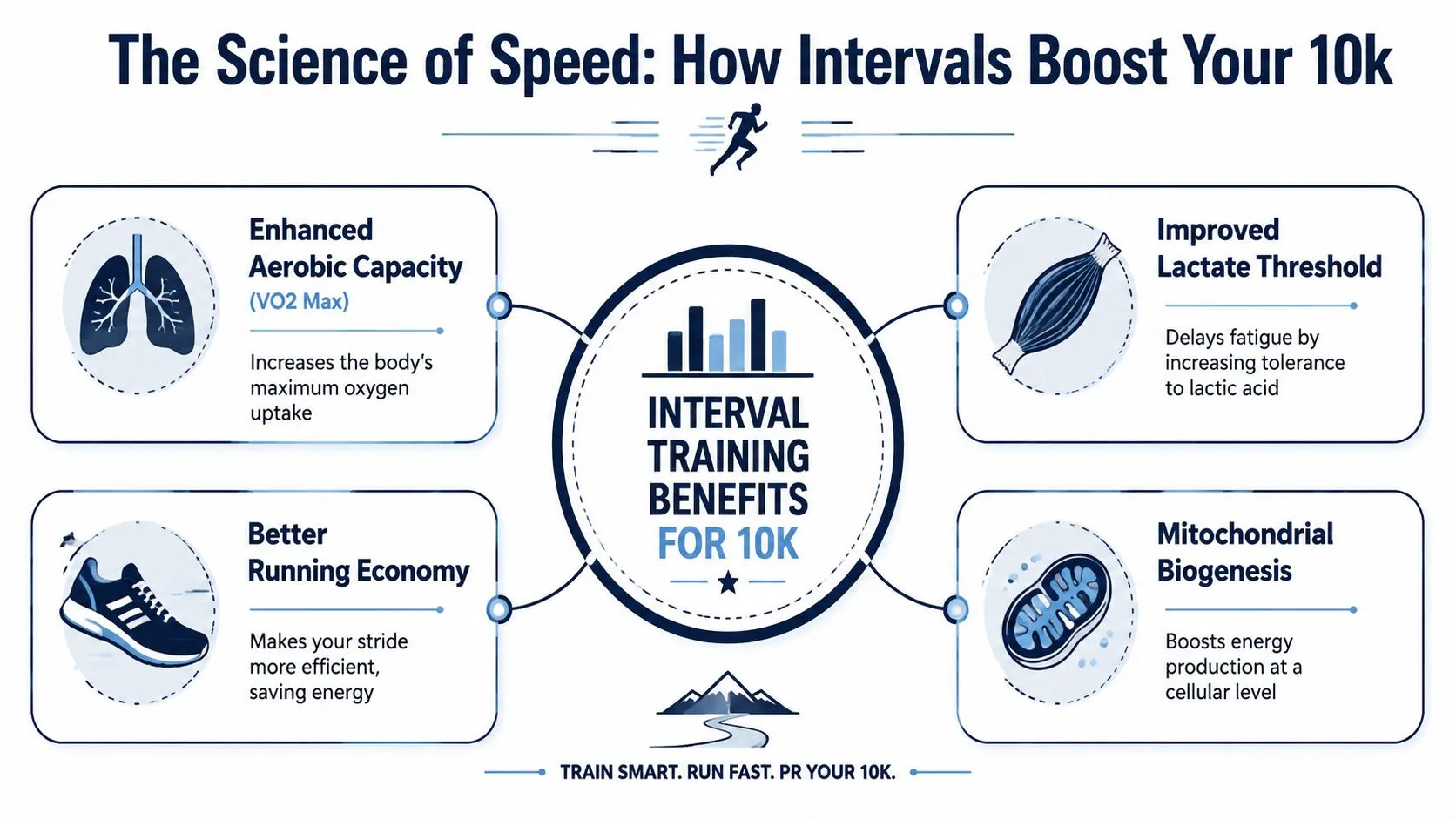
You feel it halfway through a 10k. The pace is still on paper, but your breathing gets ragged, your stride gets noisy, and every small rise starts to cost more than it should. Interval training helps before race day by changing the systems that fail in that moment.
Why the 10k demands more than general fitness
The 10k rewards runners who can do two things at once. You need a strong aerobic engine to keep producing energy efficiently, and you need the ability to stay composed close to your limit for long enough that pace does not fade late. General hard running helps, but it often misses that combination.
Well-built intervals solve a more specific problem. They raise oxygen uptake, improve lactate handling, and teach you to hold form while fatigue climbs. In practice, that means race pace stops feeling like a surge and starts feeling like a rhythm you can repeat.
One proven session is 4 x 5 minutes at 10k pace with 3 minutes of jogging recovery. Used in the right phase, it gives you twenty minutes of work right around race demand, which is enough to stress the aerobic system without turning the session into a race. Coaches at Runners Connect’s interval training guidance describe this type of session as a strong fit for 10k preparation.
The distinction is important. A runner can be fit in a general sense and still lack the pace control, economy, and repeatability that the 10k asks for.
What each interval type changes
Race pace intervals improve specificity first. They teach even pacing, better relaxation at goal speed, and the ability to recover enough before doing it again. This is the work that closes the gap between a goal written in a training log and a pace you can trust on race day.
Shorter, faster reps do a different job. They improve top-end oxygen use and make 10k pace feel mechanically lighter. I use them sparingly with 10k runners because they help, but they can also tempt people into running every hard session like a mile race.
Specific endurance intervals, usually a touch slower than 10k pace and a bit longer, build resistance to the slow unraveling that ruins the second half of the race. They are less dramatic than fast reps and often more productive.
Sprint work can support that mix in trained runners. A study in Frontiers in Physiology found that a short sprint interval block improved performance markers in well-trained distance runners. That does not make maximal sprinting a standard 10k workout. It shows that short, maximal efforts can complement aerobic work when the runner has the background, the mechanics, and the recovery capacity to handle them.
For newer runners, restraint works better than ambition. Start with short controlled reps, sometimes as little as 30 seconds, with generous recovery. Then extend the rep length over time. The goal is repeatable quality, not one impressive split followed by three ragged ones.
Practical rule: Use the longest rep you can complete at the right pace with stable form and controlled recovery.
That is why long intervals remain a staple for the 10k. They train the uncomfortable middle of the event, where you are working hard, thinking clearly, and trying to stay efficient while the cost of each kilometer rises. Later in this guide, that same logic carries into the progression of the workouts and into how you load them onto your watch so the structure is easy to follow when you are tired.
Find Your Numbers Calculating Paces and Zones
A 10k interval plan falls apart fast when the paces are guessed.
Run the reps too hard and the session turns into survival work that trashes the next few days. Run them too slow and you miss the exact stress that teaches the body to clear lactate, hold form, and stay economical near race effort. Good interval training starts with accurate numbers, then uses them with discipline.
Start with your goal pace
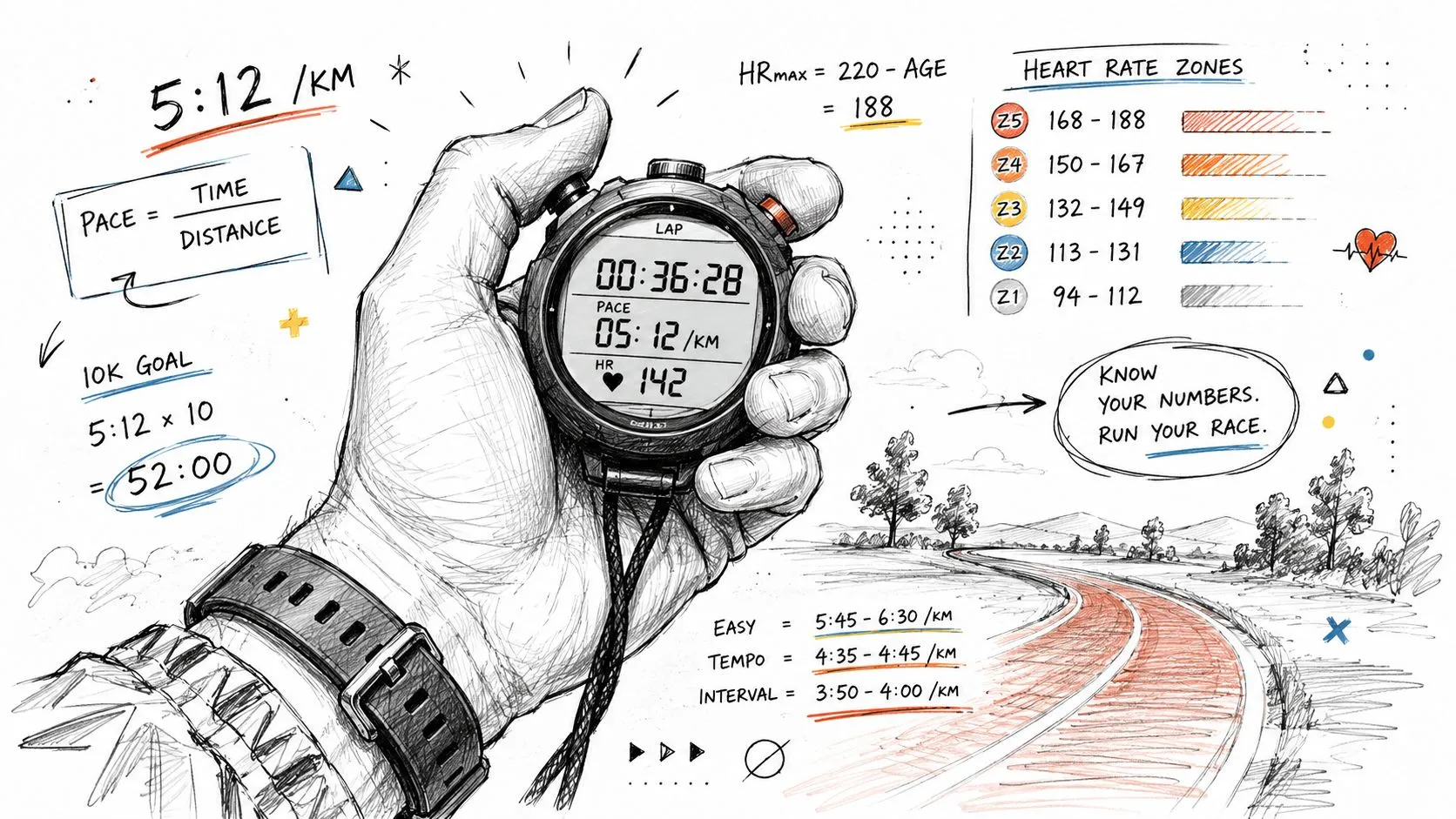
Use one anchor first. Target 10k pace.
If the goal is 50:00, the anchor pace is 5:00 per kilometer or 8:03 per mile. If the goal comes from a recent race, base your training on current fitness, not an old personal best. That sounds obvious, but it is one of the most common mistakes I see. Runners set workout splits from their best day, then wonder why every interval session feels like a test.
Once that pace is set, the rest of the week gets easier to organize. You can separate race-specific work from supportive work, and each workout has a clear job.
A practical setup looks like this:
| Session type | Effort target | Purpose |
|---|---|---|
| Race pace intervals | 100% of 10k pace | Build tolerance for exact race demand |
| Specific endurance | Slightly slower than race pace | Extend stamina and improve control |
| Recovery jog | Easy conversational effort | Restore enough to run the next rep well |
Separate race pace from specific endurance
These two paces are close, but they are not interchangeable.
Race pace intervals teach precision under stress. They are the sessions that let you rehearse the rhythm, breathing, and posture you want on race day. Specific endurance work sits a notch slower and gives you more total quality with less recovery cost. That slower work supports the aerobic side of the event, which matters because a 10k is not won by one fast kilometer. It is won by holding the line when the pace starts to feel expensive.
Use them differently:
- 100% of 10k pace for broken race simulation and pace control
- A little slower than 10k pace for longer repeats or steady work that builds staying power
- Easy running between reps to protect quality, not to prove toughness
That distinction matters on the watch too. If you build workouts with clear pace ranges instead of one vague “hard” target, execution gets much cleaner. The same principle shows up in other interval sports. Structured targets work better than feel alone in a bike interval workout with defined work and recovery blocks, and the logic carries over well to 10k training.
Race pace develops familiarity with the demand. Specific endurance gives you the reserve to keep meeting that demand late in the race.
Use heart rate as a guardrail not a dictator
Heart rate helps most when it confirms what the pace and effort are already saying.
For interval sessions, pace should lead. Heart rate lags, especially in shorter reps, on hot days, and during the first few minutes of work. If you chase a heart rate number too early, you often force the pace and turn a controlled session into a mess. If you ignore heart rate completely, you can miss signs that the day is off and keep pressing when the body is not responding well.
Use it as a guardrail. If the first rep is on pace but heart rate is climbing unusually fast, back off a touch and see whether the trend settles. If your recovery jog barely drops the heart rate before the next rep, that is useful information too. The problem may be pacing, fatigue, heat, or poor recovery from earlier in the week.
Coaching guidance from McMillan Running’s 10K training recommendations aligns well with this approach. Set training from current fitness, match workout paces to the purpose of the session, and resist the urge to force splits that do not fit the day.
Pick numbers you can repeat
The best training zones are the ones you can hit consistently for several weeks.
That means accepting trade-offs. A slightly conservative target lets you complete the planned volume with good form and come back for the next session ready to train again. An aggressive target may produce one impressive workout, then leave you flat for the rest of the block. For the 10k, consistency beats occasional heroics.
If you are between fitness levels, choose the slower end first. Let the sessions prove you are ready to move up. Your watch can help, but only if the pace targets inside it reflect reality.
Your Progressive 10k Interval Workout Blueprint
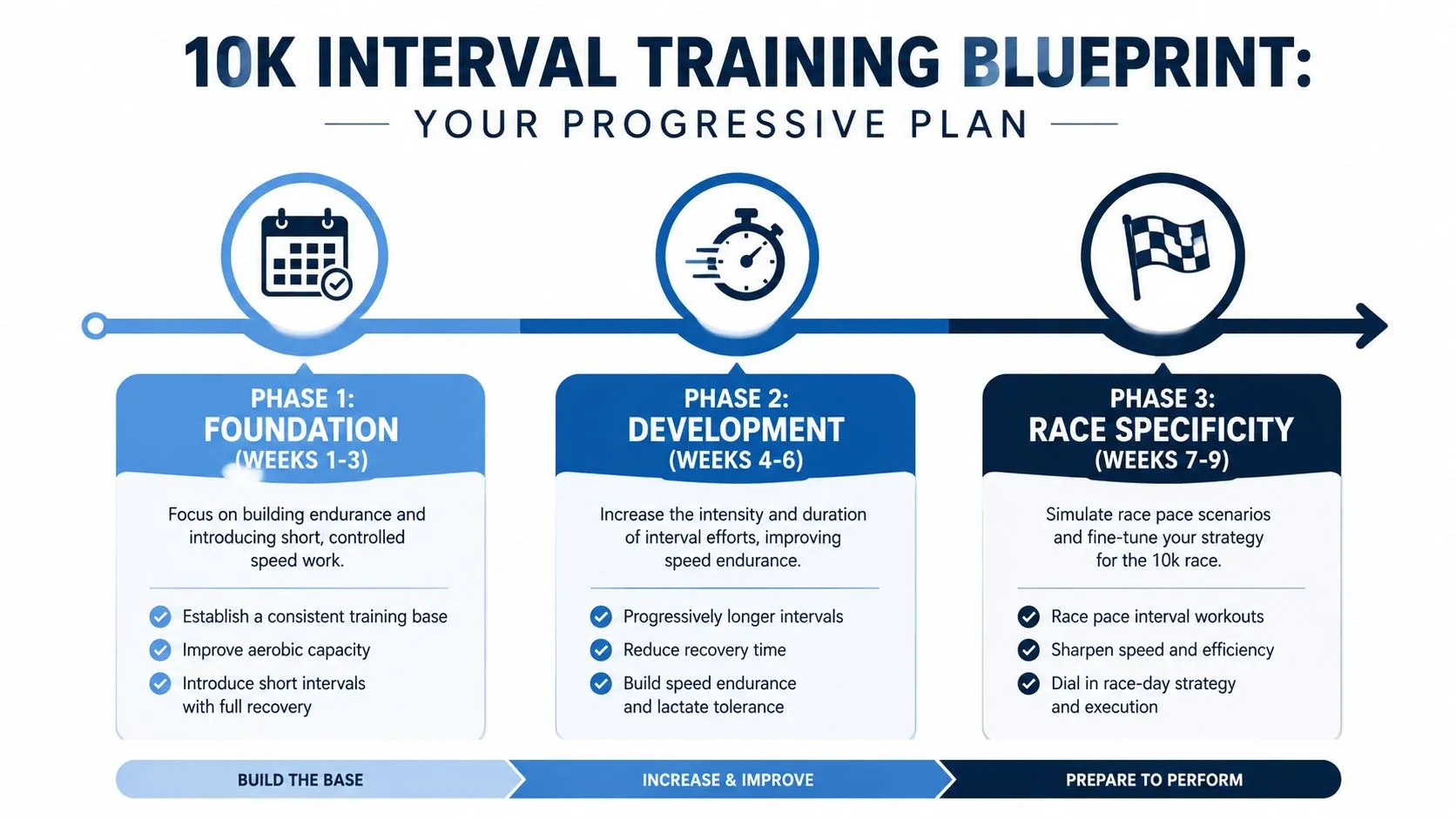
A strong 10k block isn’t built from endless variety. It’s built from a few sessions that progress logically and teach the exact abilities the race demands.
The core progression that builds race readiness
One of the clearest proven progressions for interval training for 10k is this sequence:
- 8 x 1km at target 10k pace with 60-second rest
- 5 x 1.6km at target 10k pace with 60-second rest
- 4 x 2km at target 10k pace with 60-second rest
That progression accumulates about 8km of work at 100% race intensity and builds toward race readiness directly, as outlined in this 10k workout methodology video.
The progression matters because each step changes the challenge without changing the central demand. The first workout teaches pace control and repetition. The second asks you to keep that control for longer. The third gets close enough to race demand that it becomes a true rehearsal of composure under stress.
A useful execution cue from that same methodology is that you should finish these sessions feeling like you could do one or two more reps if pushed. That’s the sweet spot. If you stagger through the last interval, the pace was wrong or the recovery between sessions was poor.
Here’s the coaching trade-off. Many runners love the first session because it feels tidy. They fear the later sessions because the reps are longer. But the longer reps are where the 10k gets built. They expose pacing errors, poor rhythm, and the habit of chasing splits instead of locking into effort.
This is a good point to watch a practical demonstration of interval structure and execution.
A weekly structure that works
You don’t need a week full of hard training. You need one high-quality interval session supported by running that lets it work.
A simple pattern looks like this:
| Day | Focus | How it should feel |
|---|---|---|
| Early week | Easy run | Relaxed, low stress |
| Midweek | Key interval session | Controlled but demanding |
| Later week | Easy run or steady run | Restorative or mildly supportive |
| Weekend | Long run | Comfortable aerobic work |
The common mistake is stuffing another hard day too close to the interval workout. That usually turns your best session into a survival exercise. If you want a second quality stimulus, make it clearly different and modest enough that it doesn’t sabotage race-pace work.
For runners who also cross-train, the same logic applies. Keep the hard day hard and the support work supportive. If you want ideas for how structured intervals are built in another endurance context, this example of an interval training bike workout is useful because the progression logic carries over even though the sport is different.
A first timers option
If you’re new to structured speedwork, don’t jump straight into kilometer repeats at goal pace. Start smaller and earn the bigger sessions.
REI’s guidance notes that intervals from 30 seconds to 4 minutes with equal or double-duration recovery jogs work well for new and intermediate runners in its 10k training plan article. A beginner-friendly setup can look like this:
- Short reps first. Start with 30-second efforts and longer recovery so pace stays consistent.
- Build rhythm before volume. Learn to hit the same pace repeatedly.
- Progress by extending work periods. Move toward longer reps only when the last one looks like the first one.
If the session gets slower and uglier with each rep, you’re not building 10k fitness. You’re rehearsing collapse.
The Art of Recovery Tapering and Injury Prevention
You finish a strong interval session, glance at the splits, and feel like the work is done. It is not. The adaptation you want from 10k training happens in the recovery window that follows. Handle that part badly and even a well-built interval plan stops working.
Protect the quality of the hard days
Warm-up and cooldown are part of the workout because they change how well you can execute the session and how well you come back from it.
Before faster running, spend a few minutes getting warm with easy jogging, then add dynamic movement that opens the stride. High knees, skips, leg swings, and a few relaxed pickups do the job. Static stretching has its place, but right before intervals it often leaves runners loose without feeling ready to apply force.
Keep the first rep controlled. I see many runners waste a session by turning rep one into a test of courage. If goal pace is 10k pace, hit 10k pace. Do not sprint the opening 200 meters and spend the rest of the workout trying to repair the damage.
After the last rep, keep moving. Jog or walk until breathing settles and the legs stop feeling snappy. That short transition helps the body shift out of work mode instead of going straight from hard running to standing still over the watch.
How to taper without going flat
The purpose of a taper is simple. Reduce fatigue while keeping the feel for race pace.
That means cutting volume first, not stripping out all intensity. A 10k runner who drops every faster segment in the final stretch often shows up rested but dull. A runner who keeps hammering full sessions right to race week usually shows up fit but tired. The useful middle ground is lower total work with one small reminder of race rhythm.
A practical taper usually looks like this:
- Trim overall volume in the final 7 to 14 days.
- Keep one light quality session with short reps at 10k pace or a touch quicker.
- Remove extra hard efforts that do not serve race day.
- Protect sleep, fueling, and routine so freshness appears.
The physiology matters here. Intervals build fitness by creating enough stress to force adaptation. The taper lets that adaptation show up on race day instead of staying buried under fatigue.
You can map that reduction cleanly in a training calendar. If you want a simple way to see how hard days, easy days, and your taper fit together, a workout planner calendar helps you spot overload before it turns into stale legs.
Catch injury signals early
Recovery is not only about feeling fresh. It is also how runners stay healthy enough to string good weeks together.
Normal training fatigue has a pattern. The legs feel heavy at first, then better once you warm up, and the soreness fades within a day or two. Injury risk usually looks different. Pain gets sharper instead of softer. One spot tightens every run. Your stride changes to protect it. The discomfort shows up earlier each time.
That is the point to adjust. Shorten the session. Swap the workout for easy running. Take an extra recovery day. Missing one interval day is frustrating. Missing three weeks because you pushed through a warning sign is worse.
Fresh and consistent beats brave and broken.
From Plan to Pavement Sending Workouts to Your GPS Watch
The last obstacle is often the least athletic one. You know the workout. You’re ready to run it. But getting a structured session onto a Garmin, Wahoo, or another training device can be surprisingly clumsy.

Why manual builders slow runners down
Most native workout builders ask you to drag blocks around, enter each step separately, and rebuild the same session structure every time you tweak pace or recovery. That’s manageable for a simple run. It gets tedious fast when you’re creating something like 8 x 1km with a precise warmup, recovery jog, and cooldown.
Time isn’t the only cost. Manual builders create room for small setup mistakes. Wrong recovery duration, missed repeat count, mismatched target. Those errors matter when the whole point of interval training for 10k is precision.
Here’s the side-by-side reality:
| Method | Typical friction | Best use case |
|---|---|---|
| Native drag-and-drop builder | Slow edits, repetitive step entry | Occasional simple sessions |
| Text-first structured workflow | Faster input, easier iteration | Frequent interval and coached workouts |
A faster way to turn coach notes into watch ready sessions
A text-first workflow fits the way runners and coaches already think. You write the session in normal language, something like “8 x 1km at 10k pace with 60s jog recovery,” review the parsed structure, make a small edit if needed, and send it to the device.
That approach is especially useful when you’re building several workouts in a training block or when a coach sends a session as plain text. It removes the translation step between training notes and executable watch prompts.
If you’ve been relying on screenshots, notebook scribbles, or clunky editors, it’s worth looking at a dedicated workout plan builder that’s designed around structured interval creation rather than generic block editing. The best tools cut setup friction without changing the workout itself.
That matters because good training systems break down on ordinary days, not ideal ones. The easier it is to get the right session onto your wrist, the more likely you are to run it as intended.
Try it with this week’s session. Type “8 x 1km at 10k pace with 60s jog” into TextFit, in any language you like, and review the structured workout it builds. It syncs to Garmin and Wahoo through your intervals.icu connection and schedules straight onto Apple Watch. Free to start, no sign-up needed.