Interval Training Half Marathon: Your 2026 Race Guide

You finish another half marathon, stop your watch, and feel two things at once. Relief first. Then that familiar second thought: I know I can run this faster.
That feeling usually doesn’t come from a lack of effort. It comes from a lack of precision. A lot of ambitious runners do plenty of running, stack decent long runs, and still plateau because every week looks the same. Moderate pace. Moderate fatigue. Moderate results.
That’s where interval training changes the picture.
For half marathon runners, intervals aren’t only “speed days.” They’re a way to teach your body to handle discomfort, clear fatigue better, hold form under pressure, and make race pace feel less dramatic. Done well, interval training half marathon prep can turn a vague goal into a structured build. Done badly, it can leave you flat, overcooked, or injured.
This is the practical version. No lab-coat jargon. No elite fantasy plan copied from a pro who runs far more than you do. What works, what usually fails, and how to turn written workouts into something you can execute.
Racing soon? Two free tools cover race-day logistics: the sweat rate calculator tells you how much to drink per hour, and the fueling calculator turns your goal pace into a carbs-per-hour target and the gels to carry.
Table of Contents
- Your Guide to a Faster Half Marathon Starts Here
- The Science of Speed Why Intervals Work
- Building Your Weekly Half Marathon Training Schedule
- Progressive Interval Workouts for Every Level
- Common Mistakes That Sabotage Your Progress
- From Text Plan to GPS Watch The Final Step
Your Guide to a Faster Half Marathon Starts Here
If your training has been mostly steady runs plus a weekend long run, you’re not alone. That approach can get you to the finish line. It can even get you through your first few races well. Then the clock stops improving.
At that point, many runners make one of two mistakes. They either add random hard sessions with no structure, or they avoid speedwork because it feels like something meant for track specialists. Both choices leave time on the table.
Interval training half marathon preparation works because it gives each hard session a job. One workout builds your ability to sustain pressure. Another improves your control at faster paces. Another teaches you to recover while still moving. The point isn’t to run fast for the sake of it. The point is to make race pace feel more familiar and more sustainable.
Practical rule: Intervals should sharpen your half marathon training, not take it over.
The runners who improve most don’t turn every week into a sufferfest. They keep most runs easy, place one key quality session carefully, and progress the work instead of guessing. That balance matters more than any single heroic workout.
A good plan also needs to survive real life. Work gets busy. Legs get heavy after long runs. Watch apps can make a simple session feel harder to build than to run. If the plan stays in a notes app or on a screenshot, it’s not doing much for you.
That’s why the useful version of this topic goes beyond theory. You need to know why intervals work, where they fit, what sessions to run at your level, and how to turn plain text into a workout you can follow on your wrist without fumbling through menus the night before.
The Science of Speed Why Intervals Work
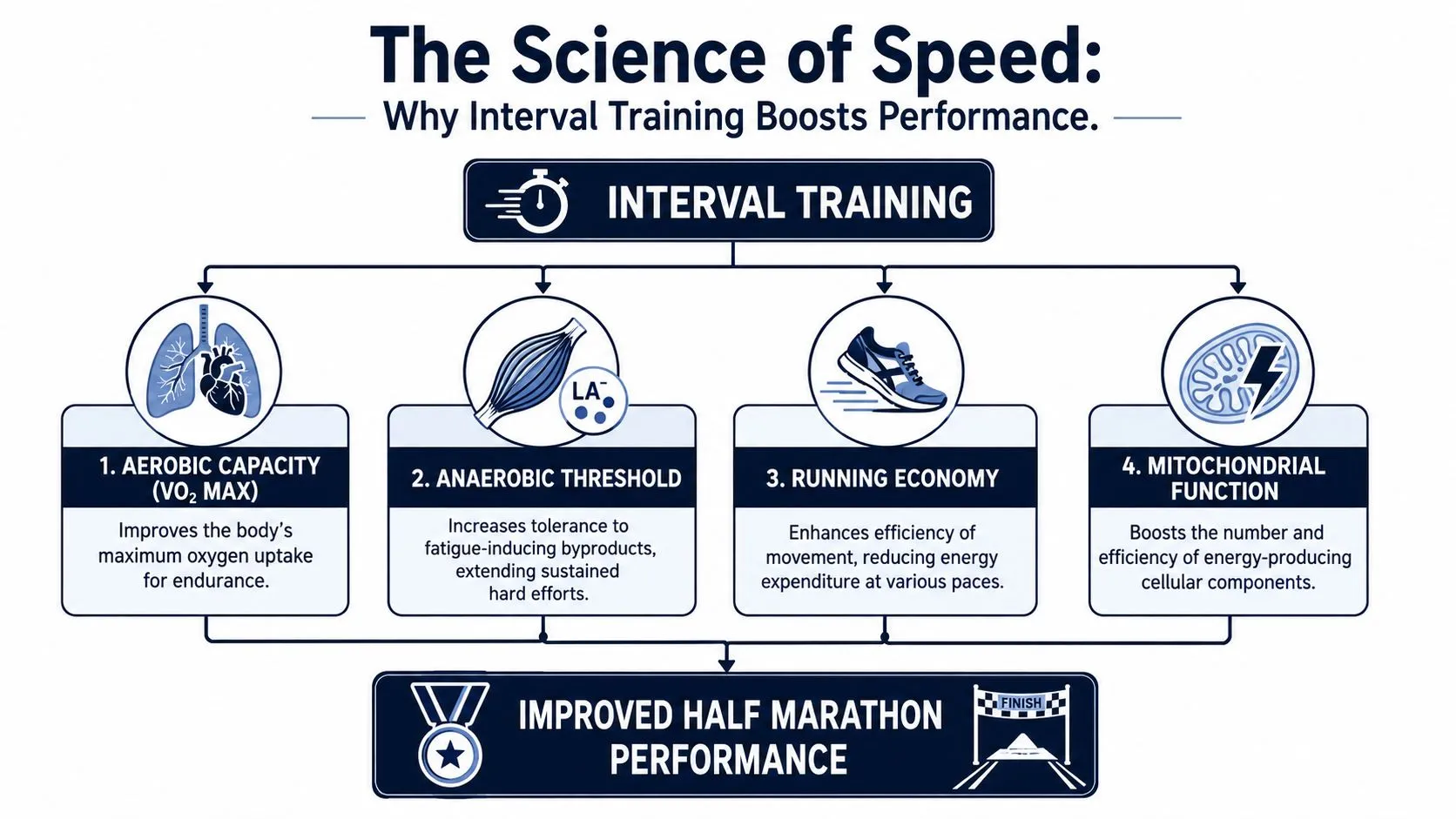
Half marathon speed is built on more than grit. It comes from a mix of aerobic power, threshold control, movement efficiency, and your ability to keep producing quality when you’re uncomfortable.
Three systems that matter
Think of VO2 max as the size of your engine. A bigger engine doesn’t guarantee a faster half marathon, but it gives you more ceiling to work with. Shorter, harder intervals help you spend time at a demanding aerobic effort that steady running can’t always reach.
Then there’s lactate threshold, which matters even more for this distance. I explain it to runners as your body’s waste-management system. The better you get at clearing and handling byproducts of hard running, the longer you can sit near that red line without fading badly. That’s why tempo work and longer controlled repeats matter so much in half marathon training.
The third piece is running economy. That’s your fuel efficiency. Two runners can have similar fitness, but the one who wastes less motion and handles pace changes better usually races stronger. Intervals improve this by exposing you to faster mechanics in controlled doses.
- VO2 max: Raises your top-end aerobic capacity.
- Threshold: Helps you hold a hard effort longer before it spirals.
- Economy: Makes a given pace cost less energy.
Why half marathon runners need controlled speed
This is where many runners go wrong. They hear “intervals” and think all-out track reps. That’s not the main job here.
For a race-specific phase, one elite-style approach uses workouts at 95–105% of half marathon pace, including 14–15 km of 2–3 km repeats at 100% HMP with 1 km float recoveries at 90% HMP, for about 20 km total according to Running Writings’ half marathon methodology. You do not need to copy that full session unless your background supports it. What matters is the principle: half marathon intervals often live near race pace, not wildly above it.
That’s also why recovery matters. Recovery in a half marathon session isn’t always a full reset. Sometimes it’s a float. Sometimes it’s a jog. The session teaches you to keep moving efficiently while under load.
If you want a broader primer on why structured speedwork works across endurance sports, this breakdown of interval training advantages is worth reading.
The best interval sessions don’t leave you feeling like a sprinter. They leave you feeling more in control of hard aerobic running.
Building Your Weekly Half Marathon Training Schedule
Tuesday night intervals. Wednesday legs feel heavy. Saturday’s long run turns into a grind because the week never gave you a real chance to absorb the work.
That pattern is common, and it usually has nothing to do with motivation. The schedule is the problem.
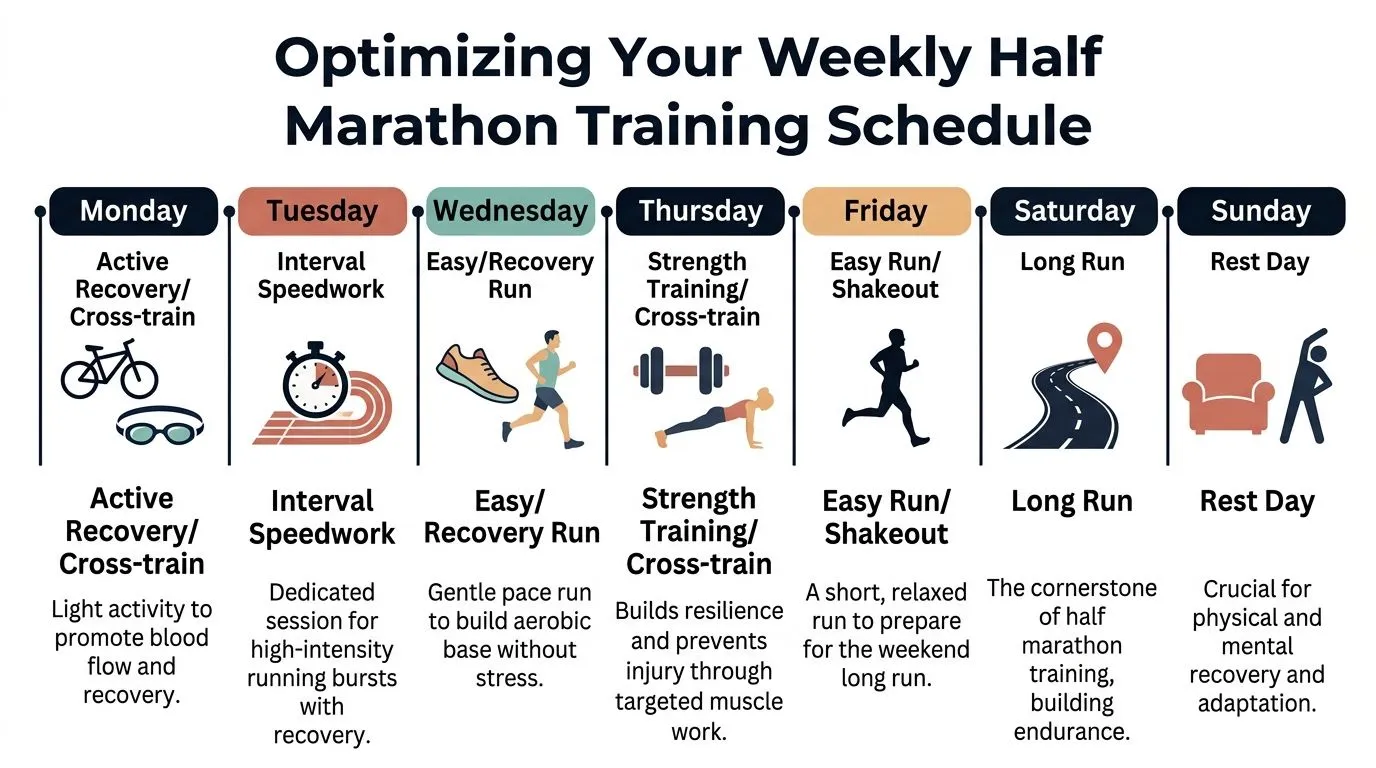
A good half marathon week protects two sessions above all others: your interval day and your long run. Everything else should support those sessions, not compete with them. For half marathon runners, that usually means keeping most running easy while limiting the share of hard work, as noted in MOTTIV’s half marathon guidance.
Ambitious runners often get this backward. They stack moderate effort on top of moderate effort, then wonder why race-pace work feels flat. Easy running is what lets quality stay high.
What a balanced week looks like
Start with a simple rule. Do not place your interval session and your long run so close together that one ruins the other. Most amateur runners handle one focused speed session per week well. A second hard session can work, but only after months of consistent training and only if recovery is holding up.
A reliable week usually includes:
- One interval session: The main quality workout.
- One long run: The aerobic anchor of the week.
- Several easy runs: Low-pressure mileage that builds capacity and helps you recover.
- One low-stress day: Full rest, mobility, or light cross-training.
Strength work fits best on an easy day or after intervals, not before them. That keeps your harder stress on the same day and preserves your true recovery days.
If you are coming up from shorter races, the structure is similar to a solid 10K interval training schedule for building speed and recovery, but the half marathon asks for more restraint between sessions and more respect for the long run.
Two weekly layouts that work
Your schedule does not need to look perfect on paper. It needs a rhythm you can repeat for months.
| Day | Layout A | Layout B |
|---|---|---|
| Monday | Rest or cross-train | Easy run |
| Tuesday | Intervals | Rest or cross-train |
| Wednesday | Easy run | Intervals |
| Thursday | Strength or easy run | Easy run |
| Friday | Easy run | Strength or light cross-train |
| Saturday | Long run | Easy run |
| Sunday | Rest | Long run |
Layout A works well for runners who want fresh legs for intervals and a small buffer before the long run.
Layout B suits runners whose early week is less predictable. The key trade-off is simple. A Wednesday workout can work well, but only if Friday stays controlled and Saturday does not turn into junk mileage.
Coach’s note: Hard days need intent. Easy days need patience.
I would rather see a runner skip one extra easy run than force a hard workout on tired legs. The workout only counts if you can hit the right effort, recover from it, and show up ready for the next key session.
One more practical point matters here. A written schedule is only half the job. Plenty of runners know what they want to do on Tuesday, then lose time fiddling with lap buttons, recovery timing, or pace targets once the session starts. The weekly plan works better when each workout is already structured and loaded onto your GPS watch. That removes friction, keeps recoveries honest, and makes the schedule easier to follow.
Progressive Interval Workouts for Every Level
Tuesday morning. You have 45 minutes, a half marathon goal, and a workout on the plan. The question is not which session looks toughest. The question is which session gives you the right stress today and still leaves you ready to train well again later in the week.
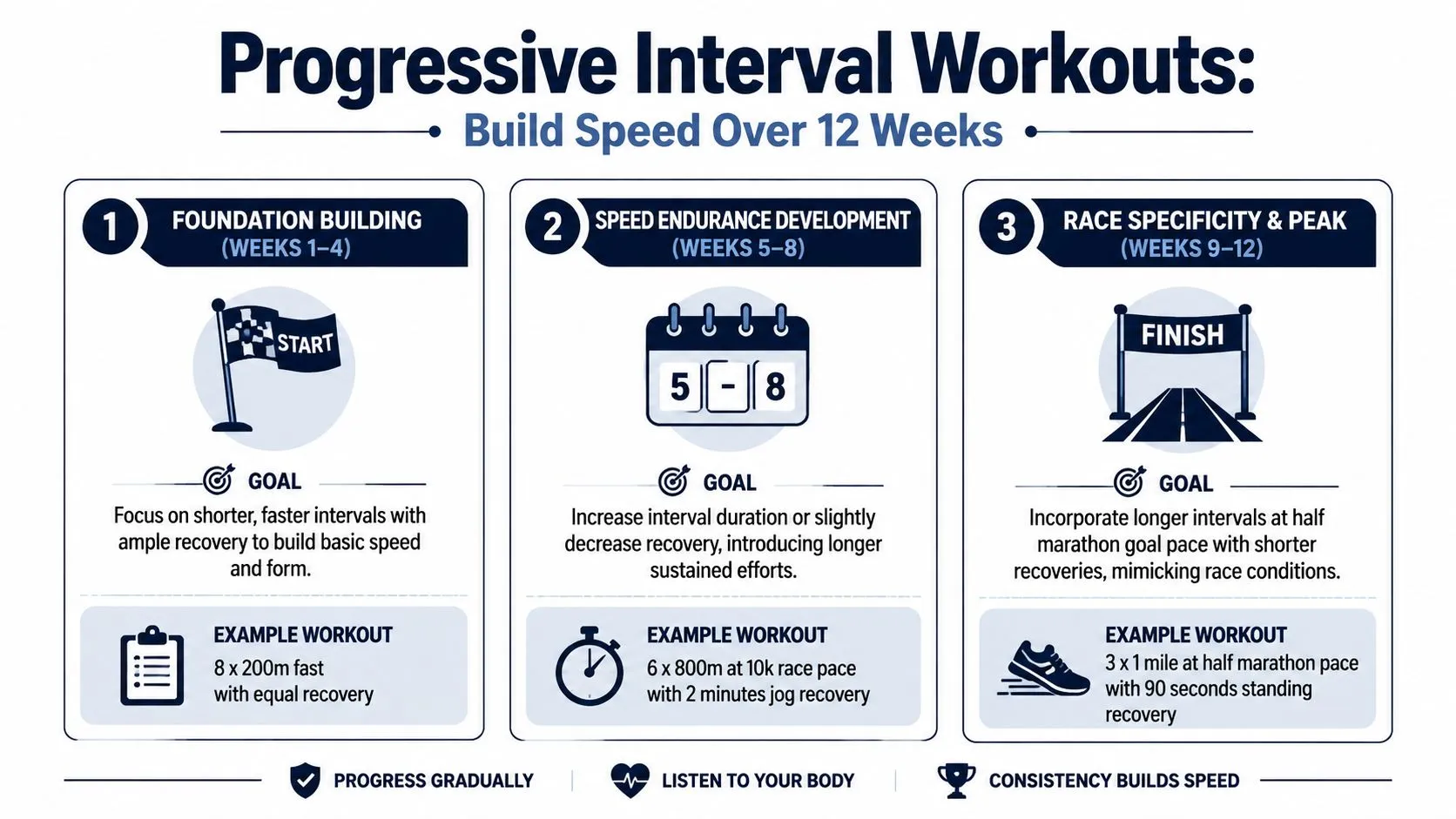
Progression works best when it is almost boring on paper. Early on, runners need repeatable structure. Later, they need more time at useful race-specific effort. The mistake is jumping to advanced sessions before the basics are stable.
I use a simple rule. Progress one variable at a time. Add a rep. Or lengthen the rep. Or tighten the recovery a little. Do not change everything at once.
Beginner progression
Newer runners usually need rhythm before they need speed. The first win is learning how the first rep should feel so the fifth one looks similar.
Start with sessions like these:
- Workout one: Warm up easily, then run short repeats at a controlled hard effort. Recover with easy jogging. Finish with a relaxed cool-down.
- Workout two: Repeat the same structure, but add one rep only if the first session felt smooth from start to finish.
- Workout three: Keep the number of reps the same and run them more evenly instead of forcing more volume.
That approach looks modest. It works.
A beginner training for a half marathon does not need fancy pace formulas right away. Good posture, controlled breathing, and even pacing matter more. If exact pace targets make you tense, use effort instead. Hard reps should feel strong and focused. Recoveries should bring your breathing back under control before the next rep starts.
Intermediate progression
Intermediate runners usually benefit from a cleaner build. Instead of inventing a new workout every week, use one repeat format for a block and nudge the load upward over time.
A common example is a 400-meter progression that starts with 5 reps, then gradually builds across the training cycle until you can handle 9 or 10 reps without tying up late. The value is not the number itself. The value is that you can compare week to week. Did the recoveries stay honest? Did pace stay steady? Did the final rep still look like running instead of surviving?
Here is a practical version:
- Early block: Warm up, then run 5 x 400 meters at a strong but controlled pace. Jog easily between reps. Cool down.
- Mid block: Build to 7 x 400 meters or 8 x 400 meters at the same effort, with the same discipline on recovery.
- Late block: Reach 9 x 400 meters or 10 x 400 meters only if pace stays controlled and the session does not compromise the rest of the week.
This is also the stage where workouts can get longer and more specific. Sessions such as 800-meter repeats, mile repeats, or time-based intervals help bridge the gap between pure speed and half marathon strength. Short reps teach rhythm. Longer reps teach pace judgment under accumulating fatigue.
For related progression ideas at shorter race distances, this guide to interval training for 10K shows how rep structure can build logically before you stretch it toward half marathon demands.
Example half marathon interval progression
| Week | Beginner Workout | Intermediate Workout |
|---|---|---|
| 1 | Short controlled repeats with full easy recovery | 5 x 400m at controlled hard effort |
| 2 | Repeat the session and aim for smoother pacing | Repeat 5 x 400m with better consistency |
| 3 | Add one repeat if recovery stays solid | 6 x 400m |
| 4 | Hold volume steady and run more evenly | 6 x 400m with stronger final rep control |
| 5 | Move to slightly longer repeats | 7 x 400m |
| 6 | Repeat with calmer pacing on rep one | 7 x 400m with smooth recoveries |
| 7 | Add a rep only if legs feel durable | 8 x 400m |
| 8 | Keep quality high and don’t race the workout | 8 x 400m |
| 9 | Shift toward race-feel efforts | 9 x 400m |
| 10 | Stay controlled, not desperate | 9 x 400m or 10 x 400m |
| 11 | Fresh legs matter more than hero splits | 10 x 400m |
| 12 | Taper and sharpen | Reduced session with race focus |
A useful visual example of interval structure is below.
Advanced progression
Advanced runners need accuracy. More suffering is not the goal. Better specificity is.
A strong advanced phase usually includes longer reps near half marathon pace, recoveries that keep the body working instead of fully resetting, and controlled changes around goal pace. One set might alternate slightly quicker segments with steadier race-pace running. Another might use float recoveries so the session teaches you to settle and regain control without fully switching off.
The trade-off is real. These workouts can be excellent for race preparation, but they are harder to recover from than classic stop-start reps. If your sleep, mileage, or life stress is shaky, a simpler session often gives you more benefit.
The practical test is clear. The workout should sharpen your sense of pace and leave you confident about race effort. If it leaves you crushed for three days, it was probably too much or placed at the wrong point in the week.
One final coaching point matters here. A written interval session is only useful if you can execute it cleanly once the watch starts. Progressive training works better when each rep, recovery, and pace target is already structured on your device, especially as sessions get more specific. That is often the difference between having a good plan and following one.
Common Mistakes That Sabotage Your Progress
Most failed interval blocks don’t fail because the runner lacks discipline. They fail because the runner applies discipline in the wrong place.
Running the wrong effort
The most common problem is starting too fast. Rep one feels amazing, so you press. By rep three, your form tightens. By the last rep, you’re hanging on and calling it toughness.
It isn’t toughness. It’s pacing error.
Do this instead:
- Start controlled: Your first rep should feel almost conservative.
- Watch the last third: If pace collapses late, the session was too aggressive.
- Match the workout to the goal: Half marathon intervals should often feel strong and sustainable, not explosive.
Another mistake is treating recovery as wasted time. In half marathon work, recovery keeps the session honest. If you slash it randomly, the workout changes. Sometimes that’s useful. Most of the time it makes the quality worse.
Placing workouts in the wrong spot
Runners often ask whether they can push intervals close to a long run when the week gets crowded. The honest answer is that there isn’t a perfect universal formula.
A training analysis on this topic notes that some coaches recommend 48–72 hours between intervals and tempo work, but there’s still limited guidance on whether Friday intervals before a Sunday long run help or hurt, especially for runners with lower mileage, as discussed in this video analysis of interval timing. That uncertainty matters. It means you shouldn’t assume a schedule is good only because it fits neatly on paper.
Here’s the practical version:
- If your long run is demanding: Keep intervals earlier in the week.
- If Friday is your only option: Reduce ambition. Run a lighter session, not your hardest one.
- If fatigue lingers into the long run: The placement is wrong for you, even if someone else tolerates it well.
If one workout consistently ruins the next two, it’s not productive training.
Ignoring what fatigue is telling you
There’s normal training fatigue, and then there’s the kind that turns every workout into a negotiation. Ambitious amateurs often blur the line because they don’t want to feel soft.
Signs you need to adjust:
- Paces feel forced: The effort is much higher than usual for ordinary splits.
- Recovery stays poor: Legs don’t come back between repeats.
- Form degrades early: You lose posture and rhythm well before the session should get hard.
The fix usually isn’t dramatic. Shorten the session. Keep the warm-up longer. Swap hard reps for a steady aerobic run. Preserving the next two weeks matters more than winning one Tuesday.
From Text Plan to GPS Watch The Final Step
You can have the right weekly structure, the right progression, and the right pace targets, and still lose momentum at the point of execution.
That’s the part most articles skip.
Where most runners lose momentum
A written workout looks simple on a page:
“Warm up, run 6 repeats at controlled hard effort, jog easy between reps, cool down.”
But then you try to build it inside Garmin Connect or another native workout builder. Now you’re clicking through warm-up blocks, repeat loops, recovery steps, target settings, and save screens. If you’re tired after work, it’s enough friction to postpone the session or run it loosely from memory.
That gap matters because structured interval training works best when the watch handles the structure for you. You shouldn’t have to memorize rep count, recovery length, and pace cues while also trying to run well.

The issue gets bigger once workouts become more specific. A basic 400-meter session is manageable. A race-specific workout with floats, pace targets, and nested repeats is where manual building becomes annoying enough that runners start cutting corners.
If you’ve ever searched for a faster way to turn plain-language training notes into something your watch can execute, that’s exactly the workflow problem covered in this article on a workout plan builder.
A simpler way to execute the plan
The practical answer is a text-first workflow. Instead of rebuilding every step manually in a drag-and-drop editor, you write the workout the way a coach or runner would naturally write it.
For example:
- Plain text version: Warm up easy. Then 6 x 800m at controlled hard effort with easy jog recovery. Cool down easy.
- Structured version on the watch: Warm-up, work interval, recovery interval, repeat count, cool-down, all queued correctly.
That matters because execution quality improves when the workout is already organized before you leave the door. You don’t drift. You don’t forget the count. You don’t guess whether you’re on rep five or six.
This is the handoff TextFit is built around. You type or paste the workout in any language, review the structured version, make small edits if needed, and send it to your watch instead of rebuilding it by hand in the native app.
For runners doing interval training half marathon prep, that last step is more important than it sounds. Smart training is not only choosing the right session. It’s removing friction so you run the session as intended.
Try it with your next session. Type “6 x 800m at controlled hard effort with easy jog recovery” into TextFit, in any language, and review the structured workout it builds. It syncs to Garmin and Wahoo through your intervals.icu connection and schedules straight onto Apple Watch. Free to start, no sign-up needed.