Structured Workout Plan: From Coach Note to Device
You have a workout in your notes app that makes perfect sense to you.
“20 min warm-up, then 3 x 8 min at threshold, 2 min easy, finish with 6 x 30 sec hard.”
Then you open Garmin Connect or a drag-and-drop workout builder and lose ten minutes translating a simple training idea into blocks, repeats, recoveries, and targets. If you coach multiple athletes, that frustration multiplies fast. If you train in more than one sport, it gets worse. What should be a quick planning task turns into admin.
A good structured workout plan fixes more than session quality. It creates a clean path from idea to execution. The best plans don’t live only in a spreadsheet or a coach’s head. They become device-ready workouts you can follow on the road, track, treadmill, or trainer.
Table of Contents
- Why a Structured Workout Plan Matters
- Defining Your Goal and Training Framework
- Designing Effective Intervals and Sessions
- From Coach Notes to Executable Text
- Converting, Reviewing, and Syncing Your Workout
- Pro Tips for a Structured Training Plan That Lasts
Why a Structured Workout Plan Matters
A coach texts, “3 x 10 minutes at threshold, 3 minutes easy, then 6 x 30 seconds hard.” The athlete understands the idea, but the session still is not ready to run on a watch or bike computer. Someone has to turn that note into exact work steps, recovery steps, targets, and cues. That gap is where good training plans often break down.
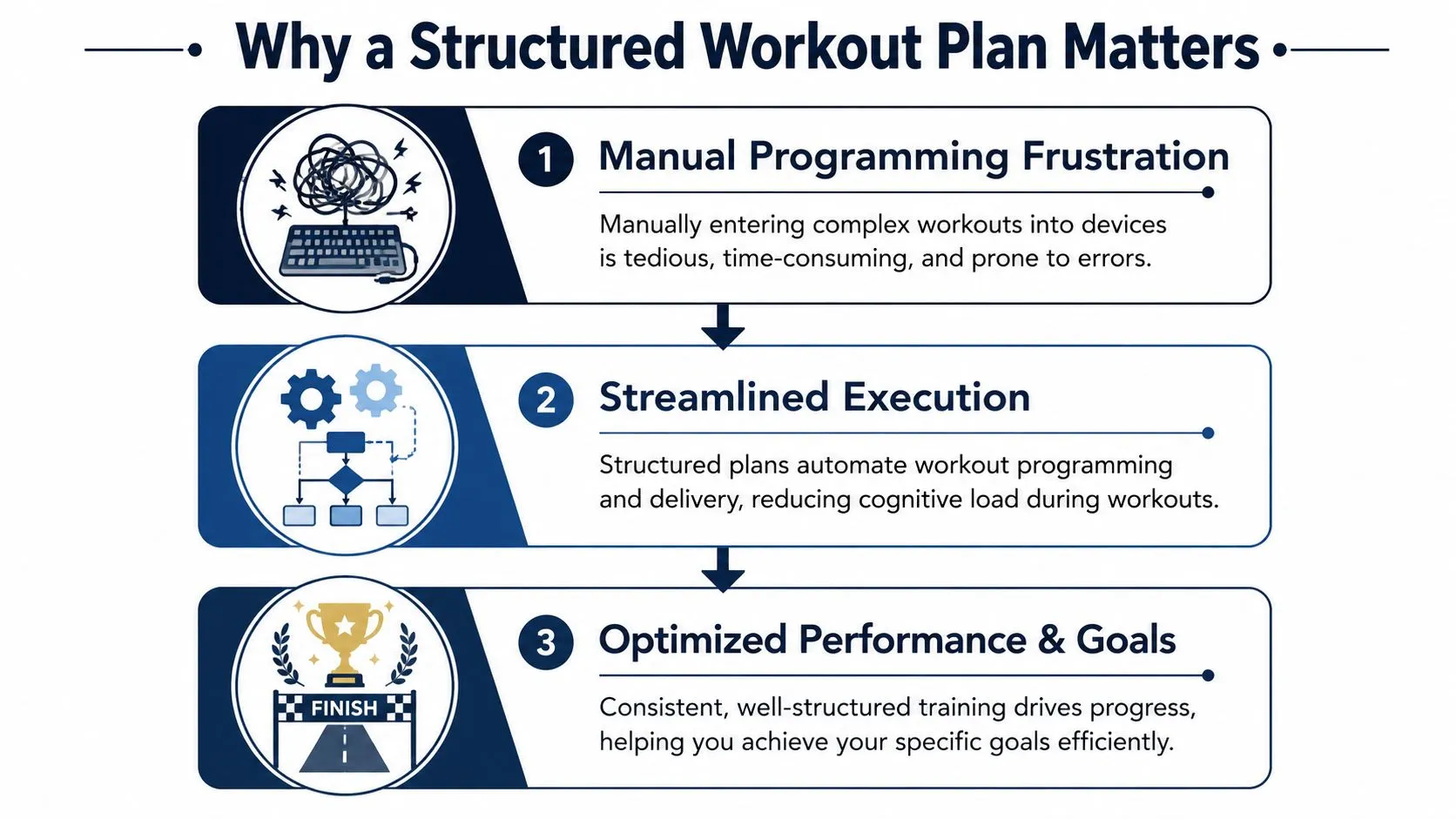
A structured workout plan matters because execution matters. Sessions done from memory drift. Rest intervals get shortened. Power targets creep up. An endurance ride turns into medium-hard junk because the device is not guiding the day.
Training works better when the plan starts high and moves down
A useful plan gives each session a clear job, then carries that job all the way into a format the athlete can follow under fatigue. That last part gets overlooked. Coaches may write excellent notes. Athletes may understand the intent. If the workout never becomes a clean, device-ready file, the session still depends on memory and discipline.
That creates predictable problems. Athletes skip warm-up progressions because they are hard to remember. They miss one recovery lap and spend the rest of the set off by a minute. They choose rough intensity targets instead of specific ones. If you train by zones, a cycling FTP zone calculator for setting usable workout targets helps turn broad instructions into numbers you can program.
Practical rule: If a workout cannot be explained clearly and executed step by step on a device, it is not finished yet.
This is not only about convenience. It is about preserving intent. The session your coach wrote and the session your device displays should match closely enough that pacing, duration, and recovery all stay intact.
Structure improves consistency, not only performance
The CDC explains that regular physical activity helps lower the risk of major chronic disease, improves mental health, and supports longer-term health outcomes (CDC physical activity benefits overview). Those benefits depend on repeated, sustainable training, not occasional heroic days.
Structure supports that consistency in practical ways. Athletes waste less energy deciding what to do. They make fewer in-session mistakes. They are more likely to start on time because the workout is already built and synced.
Three improvements usually show up first:
- Better session accuracy: Work and recovery intervals are defined before the workout starts.
- More appropriate intensity: Targets are attached to each step instead of guessed on the fly.
- Higher follow-through: A device-ready workout removes the small setup hassles that often lead to skipped sessions.
I see the same trade-off repeatedly. Writing structured workouts takes a little more effort up front, but it saves far more effort later. It cuts down on bad guesses, half-finished sessions, and the common problem of having a solid training idea that never becomes a session the athlete can execute.
A plan does not need to be complicated. It needs to be clear, specific, and ready to run.
Defining Your Goal and Training Framework
A coach texts, “tempo ride tomorrow, build through the middle, finish with a few hard minutes.” That is enough to understand the intent. It is not enough to build a workout your watch or bike computer can run correctly.
Before you write steps, targets, and recoveries, define what the session is supposed to do inside the larger plan. That decision shapes everything that follows, including how you translate plain-language notes into device-ready intervals without distorting the workout.
Pick one clear target
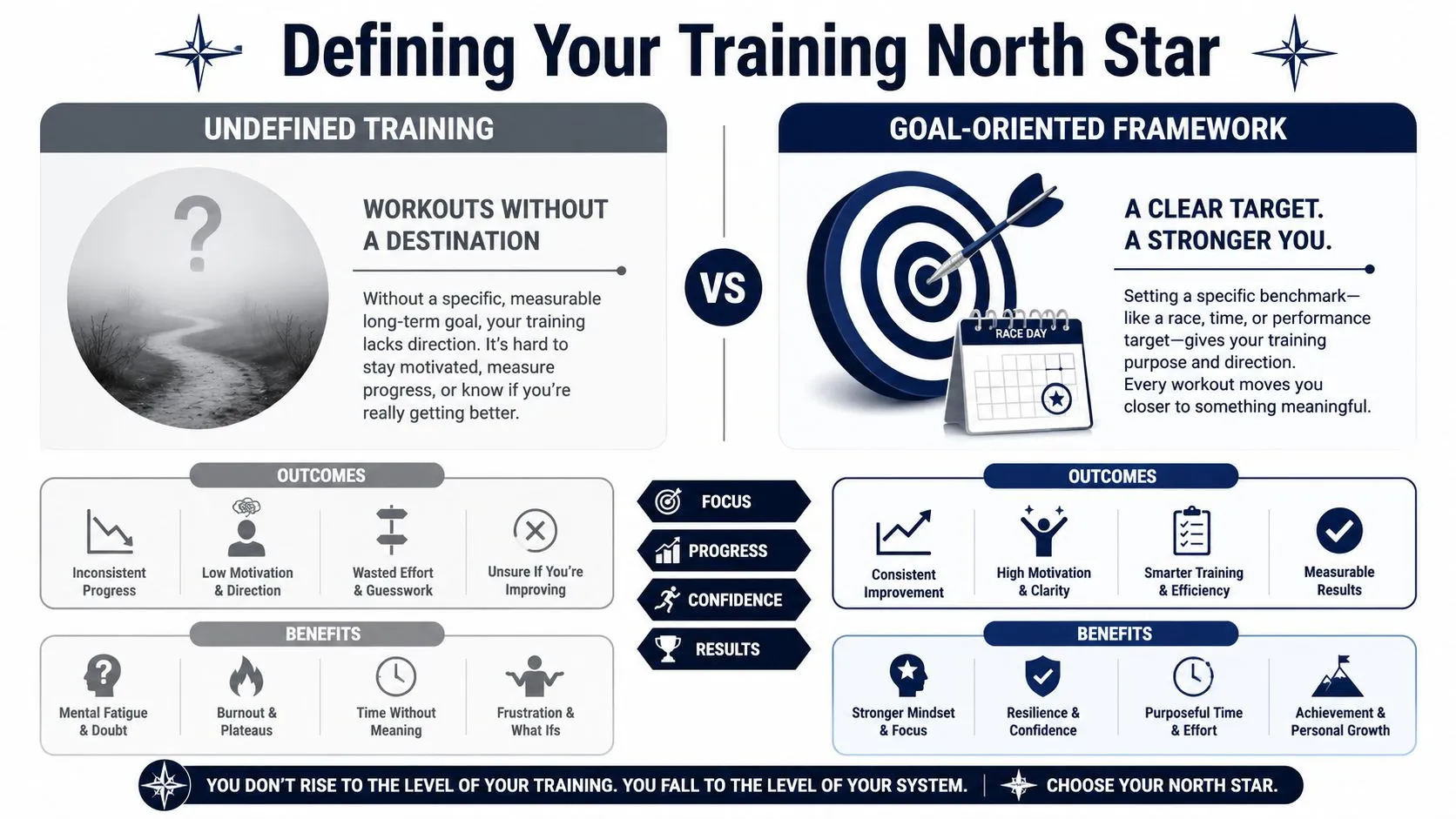
“Get fitter” creates too many options. A useful target narrows the plan fast.
Start with three decisions:
- Event or outcome: Marathon, gran fondo, time trial, triathlon, or a general fitness block with a clear purpose
- Primary demand: Aerobic durability, threshold repeatability, climbing power, race-pace control, or speed under fatigue
- Decision date: The date that fitness needs to show up
This is the point where vague coaching language starts becoming usable. If the goal is a hilly gran fondo, “steady tempo” usually means something different than it does for a short time trial block. If the goal is a marathon, “comfortably hard” has to map to pace control and durability, not only suffering.
For athletes training by bike power, set targets from current zones before writing the workout. A practical reference like this FTP zone calculator for cycling training helps assign realistic ranges instead of guessing.
Plans drift when the target stays fuzzy. Athletes often pile up medium-hard work because it feels productive, or keep changing session types because variety feels like progress. Both can leave you with tired legs and no clear adaptation.
Build the season in layers
A good structured workout plan is built top down. One workout should make sense inside the week, the week should make sense inside the block, and the block should support the event or outcome.
| Planning Layer | What it covers | Practical use |
|---|---|---|
| Macrocycle | The broad season or year | Sets the long-term target |
| Mesocycle | A focused block lasting several weeks to months | Develops one main adaptation |
| Microcycle | The training week | Balances hard, easy, and recovery days |
That hierarchy matters because workout design is full of trade-offs. A session that fits well in a threshold-focused block may be a poor choice in a recovery week. A strength-heavy microcycle can support a durable base phase and still interfere with key run sessions if you place it badly.
For endurance athletes, I usually want each block to have one clear job. Build aerobic range. Raise sustainable power or pace. Sharpen race-specific work. The weekly pattern then protects that job. Hard days need space around them, and recovery needs to be scheduled early, not added later after fatigue starts to leak into every session.
Turn big goals into session rules
This is where many plans falter. The athlete knows the goal. The coach note sounds reasonable. But nobody has turned the idea into rules a device can execute.
The fix is simple. Define the adaptation first, then write the session logic that serves it.
A practical framework looks like this:
- Name the adaptation. Threshold support, aerobic endurance, race-pace familiarity, leg strength
- Choose the limiter. Duration tolerance, pace control, power stability, recovery between reps
- Set the session form. Continuous work, long intervals, short repeats, progression set, or mixed set
- Protect the week. Make sure the session fits the load around it
That process closes the gap between planning and execution. A note like “5 x 1k around 10k pace” becomes much easier to structure once you know whether the primary goal is pace discipline, VO2 support, or late-race durability. The same words can produce different workouts on a device depending on the job you need that session to do.
Strength work inside an endurance plan needs the same clarity. Rep ranges, load, and placement in the week should match the objective. Max-strength work creates a different recovery cost than general muscular development, and that cost has to be accounted for before you export anything to a training platform.
Start by naming the adaptation. Then build the session that expresses it clearly enough for an athlete and a device to follow the same plan.
One more rule matters. Good workouts do not exist in isolation. A smart session placed in the wrong week is still bad programming.
Designing Effective Intervals and Sessions
You get a coach message at 6 p.m. for tomorrow’s key workout: “WU easy, drills, 5 x 1k around 10k pace, 90 sec jog, CD.” The athlete understands the session. A watch does not. The job here is to keep the training effect intact while turning that shorthand into steps a device can run without guesswork.
That takes more than copying the note into a builder. Sessions fail on devices when the written idea leaves too much open: how long the warm-up lasts, what “around 10k pace” means, whether recovery is standing, jogging, or easy spin, and what ends the set if the athlete is training by power, pace, heart rate, or RPE.
What coach notes often sound like
Running notes are usually compressed: “WU easy, drills, then 5 x 1k around 10k pace with 90 sec jog, CD.” Cycling notes often hide the key detail inside one phrase: “Build to threshold, 3 x 10 min steady, last minute of each rep a touch above, easy spin between.” Triathlon adds sport changes and transition friction: “Bike tempo into short transition run with fast pickups.”
Useful coaching language. Incomplete device language.
A structured session needs five fields made explicit every time:
- Warm-up structure
- Work duration
- Intensity target
- Recovery duration and type
- Cool-down or finish instructions
Miss one, and the athlete fills in the gap. Sometimes that is harmless. Sometimes it changes the point of the workout.
Sample interval descriptions
| Interval Type | Example Natural Language Description |
|---|---|
| Endurance run | 50 min easy with 6 x 20 sec quick strides, full easy jog between |
| Threshold bike | 15 min warm-up, then 3 x 8 min at threshold with 2 min easy spin, cool down 10 min |
| VO2 max run | Warm up well, then 6 x 2 min hard at 5k effort, 2 min jog recoveries |
| Tempo ride | 20 min easy, 2 x 20 min steady tempo, 5 min easy between, spin home |
| Brick session | 60 min bike with last 15 min moderate, quick change, then 15 min run with 4 short pickups |
| Hill session | Easy warm-up, 8 x uphill hard for 60 sec, walk or jog back down, easy cool-down |
For a broader look at why interval structure matters, see this guide on interval training advantages for endurance athletes.
Where good sessions usually break
The weak point is often not the headline interval. It is the prescription around it.
A threshold set can look fine on paper and still miss the target if the recoveries are too short, the warm-up is rushed, or the athlete gets only vague intensity language like “comfortably hard.” VO2 work has the same problem. If the recovery is too generous, the session turns into disconnected hard reps. If it is too short, power or pace falls off and the rep becomes moderate survival work.
Strength sessions inside an endurance week need the same discipline. As noted earlier, rep range, rest, and placement change the recovery cost of the session. If you write “heavy squats after intervals” without clarifying load, reps, and rest, the athlete may complete the work but carry the wrong fatigue into the next two days.
If the athlete cannot hold the intended quality late in the set, check the recovery prescription and the session context before blaming execution.
I usually pressure-test a session with one simple question: can two different athletes build the same workout from this note and end up with nearly identical step logic? If the answer is no, the session is still underwritten.
Good design is specific without becoming fussy. Give the device enough detail to run the session correctly, and no extra complexity that distracts from the purpose.
From Coach Notes to Executable Text
Your coach sends a message at 6:30 a.m. It says, “3 x 10 min at marathon effort, 2 min float, then 6 x 20 sec fast with full easy recovery.” You understand the session right away. Your watch does not.
That gap between a clear coaching note and a device-ready workout is where a lot of training friction starts. The session itself may be well designed, but if someone still has to translate shorthand, resolve vague terms, and rebuild the steps by hand, execution gets slower and errors creep in.
Text-first planning works because coaches and athletes do not think in button clicks. They think in sessions, cues, and race-specific language. That is the problem TextFit was built around. The hard part was never session design. It was the repeated admin work of turning readable notes into structured steps a Garmin, Wahoo, or Apple Watch can run.
The problem gets bigger in real coaching environments. Athletes use local pace terms, race references, abbreviations, and mixed languages. One runner writes “steady to MP.” Another says “controlado.” A cyclist says “sweet spot, high cadence, stay seated.” A good system should handle that input without forcing the coach to rewrite the whole session into a rigid template first.
I prefer a simple rule. Write the workout so a human can read it cleanly, then check that each step contains enough information for a device to execute it correctly.
That usually means four things are present:
- Order of steps: warm-up, main work, recoveries, finish, cool-down
- Target type: pace, power, heart rate, RPE, cadence, or a clear effort cue
- Recovery definition: easy jog, easy spin, walk, float, standing rest
- Special instructions: build each rep, last one strongest, stay seated, no sprinting
Here is the difference in practice.
A note like “usual warm-up, threshold ladder, then some fast stuff” may be enough for one experienced athlete who knows the coach well. It is weak input for a structured workout builder, and even weaker if you want to reuse that session later.
A note like “15 min easy, drills, 3 x 8 min at threshold with 2 min easy jog, then 4 x 20 sec fast with 60 sec walk, 10 min cool-down” converts cleanly because the logic is already there.
That is the standard to aim for if you are building a repeatable structured workout plan builder workflow. Human-readable first. Device-ready with only light cleanup, not a full rewrite.
A few examples that usually convert well:
- Cycling: “20 min easy, 5 x 4 min at 105 to 110% FTP with 3 min easy spin, 10 min cool-down.”
- Running: “15 min easy, 6 x 1 km at 10K pace with 90 sec jog, 4 x 15 sec strides, cool down.”
- Triathlon brick: “Bike 50 min with 4 x 5 min at tempo, 2 min easy, quick transition, then 12 min easy run with 4 x 30 sec quick cadence.”
The trade-off is straightforward. More shorthand is faster to type, but slower to convert and easier to misread. More explicit text takes a few extra seconds up front, but it preserves the session intent and makes the final build much cleaner. In practice, that saves time. It also reduces the chance that the athlete starts the right workout on the device and ends up doing the wrong session.
Converting, Reviewing, and Syncing Your Workout
You are in the parking lot before a morning session. The workout loaded to the watch, but one interval is off, the recoveries look wrong, and fixing it on a small screen takes longer than writing it properly in the first place. That is the gap most athletes and coaches run into. The session idea is fine. The execution file is not.
Once the workout is written in clear text, the last stage is build quality. Convert the note into structured steps, review what the parser created, then sync the final version to the right device profile. Small errors here change the session more than people expect. A threshold rep set with the wrong recovery, a pace target in the wrong unit, or an extra repeat can turn a good workout into the wrong stimulus.
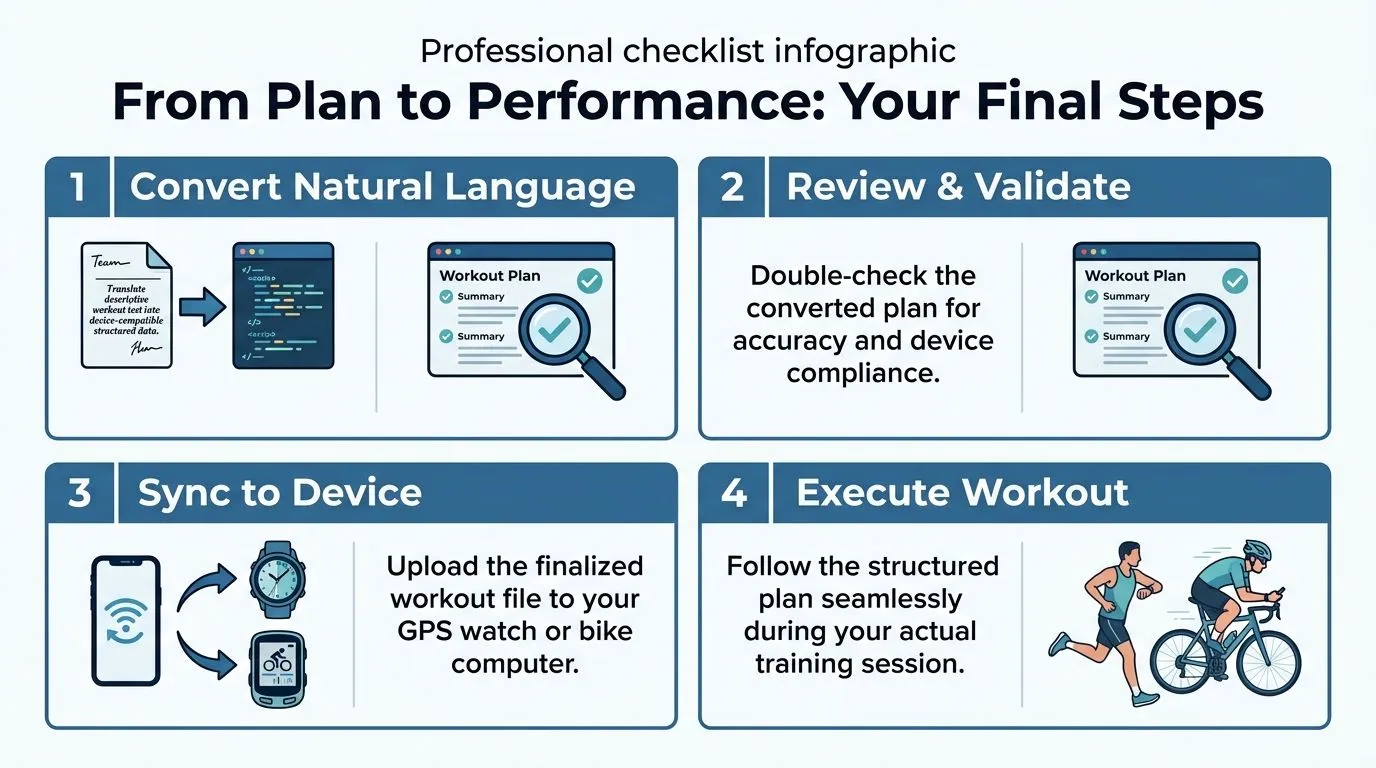
Review the built workout, not just the original note
By this point, the session design should already be settled, as noted earlier in the article. The job now is quality control. I treat this as a separate step because a workout can be well designed and still be badly built for the device.
The fastest way to catch problems is to review the structured version exactly as the athlete will see it. That means checking the step order, repeat logic, target fields, and labels on the actual workout file, not only the source text. If you are building sessions often, a structured workout plan builder workflow helps because it keeps the conversion close to the coach note instead of forcing a full rebuild inside a calendar or device app.
A short review pass should answer four questions:
- Are the durations correct? Check warm-up, work reps, recoveries, and cool-down.
- Are the targets correct? Confirm pace, power, heart rate, or effort labels match the session intent.
- Are the repeats correct? Make sure the device did not add or drop a round.
- Is the workout readable on the device? Long step names and cluttered instructions get hard to follow mid-session.
A practical pre-send checklist
Use the same check every time:
- Check units first: Minutes and seconds, kilometers and miles, min/km and min/mile, and percent of FTP versus raw watts are common failure points.
- Check recovery steps carefully: Errors usually hide in the easy segments. Jog, walk, easy spin, and full stop are not interchangeable.
- Read it top to bottom: If the session flow feels awkward in plain language, it will feel worse once the watch starts beeping through it.
- Confirm the sport profile: Run workouts, bike workouts, and brick sessions need to land in the right mode.
- Trim step labels: Short names display better and are easier to process while moving.
One more trade-off matters here. Detailed instructions help preserve intent, but too much text creates clutter on smaller screens. Keep the key action in the step name, then put any secondary cue in the description only if the device supports it cleanly.
The best sync process is predictable. Build from the coach note, review the structured file, send it to the correct device, and do one final open-and-check before training. That routine is not fancy, but it prevents the common failure point between planning a good workout and doing the right one.
Pro Tips for a Structured Training Plan That Lasts
Experienced coaches treat a structured workout plan as a living document. Not a static file. The athlete changes week to week, so the plan has to stay precise without becoming rigid.
Coach habits that keep plans usable
A few habits keep plans clean and effective over time:
- Review completed sessions for pattern, not drama: One bad workout doesn’t mean much. Repeated struggles with the same session type usually mean the target, recovery, or weekly placement is off.
- Adjust the week before you adjust the athlete: If someone keeps failing threshold work, don’t assume they’re weak at threshold. Look at sleep, life stress, travel, and stacking of hard days.
- Write sessions that survive real life: If a workout only works on a perfect day with ideal terrain and full focus, it’s too fragile.
- Keep language consistent: Use the same terms for effort, recoveries, and finishes so athletes learn the pattern and devices display familiar cues.
- Protect easy days: The plan only works if recovery days are lighter.
- Favor clarity over cleverness: Fancy sessions impress coaches more than athletes. Straightforward workouts get done better.
One more point matters in practice. Post-workout analysis should influence the next session, not only sit in a dashboard. If the athlete consistently starts too hard, write tighter opening instructions. If transitions are clumsy in brick sessions, make the text more explicit. If athletes misunderstand “steady,” replace it with a more concrete target.
That coach mindset is what turns planning into execution. The session isn’t finished when it’s written. It’s finished when the athlete can follow it cleanly on the device and produce the intended adaptation.
Try it on tomorrow’s session. Paste the coach note into TextFit as written, in any language: “15 min easy, 3 x 8 min at threshold with 2 min easy jog, 10 min cool-down.” AI turns it into a structured workout you review and edit, then it syncs to Garmin or Wahoo through intervals.icu, or schedules on Apple Watch. Free to start, and no sign-up required.