Connected Exercise Bike Explained: A 2026 Guide
You’re probably here because indoor riding has split into two different experiences.
One is the old version. You get on a basic bike, start pedaling, bump resistance when it feels too easy, and hope you did something useful by the end. The other is the modern setup, where the bike talks to apps, head units, sensors, and training platforms. Your workout loads automatically. Resistance changes on cue. The session gets recorded cleanly enough that you can learn from it later.
That gap is why the connected exercise bike matters. It’s more than a nicer stationary bike. It’s a training device that turns vague effort into repeatable work, which is what athletes need if they care about progression rather than sweat.
Table of Contents
- From Stationary to Smart Why Connected Bikes Are Taking Over
- The Core Tech Inside a Connected Exercise Bike
- Two Paths Home Training vs Coached Workflows
- The Workout Syncing Workflow From Text to Training
- Setup Tips and Troubleshooting Common Issues
- Conclusion Your Gateway to Smarter Training
From Stationary to Smart Why Connected Bikes Are Taking Over
A lot of riders know the feeling of a stale indoor session. You spin for an hour, maybe watch a show, maybe stare at a training app, and when you finish you can’t say exactly what you trained. The ride happened, but the workload is fuzzy. That’s fine for occasional exercise. It’s a poor setup for building fitness on purpose.
A connected exercise bike changes that experience in ways that matter immediately. Instead of guessing effort, you get a bike that responds to a workout target. Instead of manually turning a knob every few minutes, the resistance can track the session you planned. Instead of riding alone in a quiet room with no feedback, you can join guided classes, virtual roads, or structured intervals that keep you engaged.
That shift helps explain why adoption keeps rising. The global home exercise bike market is projected to grow from $1.57 billion in 2025 to $2.37 billion by 2030, driven by demand for on-demand and live-streaming workout programs that make solo training more engaging and community-driven, according to Research and Markets’ home exercise bike market report.
The old problem wasn’t just boredom
Indoor training used to fail in two predictable ways.
- Motivation dropped: Repeating the same ride setup made consistency harder than it needed to be.
- Effort drifted: Riders often rode too hard on easy days and too easy on hard days.
- Tracking stayed messy: Data lived in different apps, or didn’t exist at all.
That’s why connected bikes are more than a consumer trend. They solve a real training problem.
A good indoor setup does more than get you riding more. It helps you repeat the right work often enough to improve.
What actually makes them useful
For general fitness, the answer is engagement. Classes, leaderboards, and app-driven sessions make it easier to show up.
For performance-focused riders, the answer is precision. If you’re targeting threshold work, VO2 intervals, or cadence-specific drills, the bike’s value comes from repeatability. You want the same target to mean the same thing every time you do it.
That’s the difference between a piece of cardio equipment and a serious training tool.
The Core Tech Inside a Connected Exercise Bike
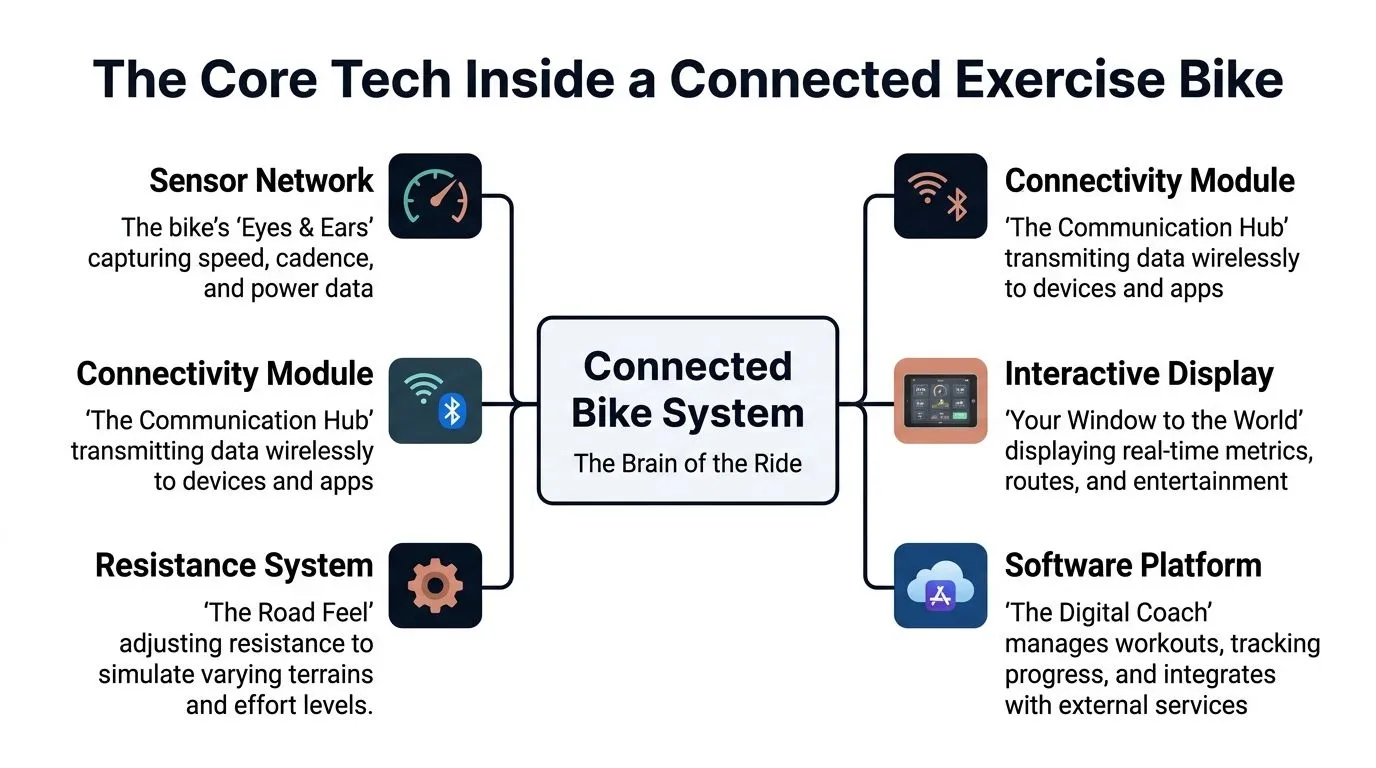
The fastest way to understand a connected exercise bike is to stop thinking about it as one machine. It’s a small system. One part measures your effort. One part controls resistance. One part sends data outward. One part receives instructions from an app or head unit.
What the bike is actually doing
The most important hardware piece is the resistance unit. On better connected bikes, that’s typically electromagnetic resistance, not a basic friction system. That matters because precise training depends on fast, accurate response. According to Cyclingnews’ guide to smart bikes, connected exercise bikes using electromagnetic resistance can deliver wattage accuracy within ±1.5%, and they can capture short power spikes with less than 50ms latency. For structured interval work, that’s a meaningful difference.
If you’ve ever done short repeats on a cheap spin bike, you’ve felt the opposite. You surge, the resistance lags, and the effort never quite matches the target. That’s more than annoying. It changes the workout.
The second key piece is connectivity. Bikes typically communicate through Bluetooth FTMS and sometimes ANT+. Think of those as the shared language that lets the bike, app, and external device exchange the same workout instructions and ride data.
If you’re still figuring out your training zones before using structured sessions, an FTP test guide for cyclists helps you set realistic targets.
ERG mode and SIM mode are not the same tool
Most confusion with smart bikes starts here.
| Mode | Best use | What it does | Where it can go wrong |
|---|---|---|---|
| ERG mode | Structured intervals | Holds a target power by adjusting resistance automatically | Feels unnatural if cadence drops too much |
| SIM mode | Virtual riding and free riding | Simulates terrain changes like flats and climbs | Requires more manual pacing discipline |
ERG mode is like cruise control for power. If the workout calls for a steady target, the bike adjusts resistance so your output stays near that number. For threshold blocks, tempo work, and many steady intervals, it’s excellent.
SIM mode behaves more like a road simulation. Resistance changes with terrain, gearing, and sometimes virtual speed. This is better when you want outdoor-like pacing, standing climbs, or race-style efforts.
Practical rule: Use ERG when the goal is compliance. Use SIM when the goal is pacing skill.
Three quick details matter more than spec-sheet noise:
- Power stability: Good bikes give you data you can trust from one workout to the next.
- Cadence responsiveness: You should feel changes quickly when you spin up or bog down.
- Control compatibility: If the bike won’t pair correctly with your app or head unit, the rest of the system doesn’t matter.
Riders often obsess over screens and built-in entertainment. Those can be nice. The training value sits in resistance quality, accurate data, and clean device communication.
Two Paths Home Training vs Coached Workflows
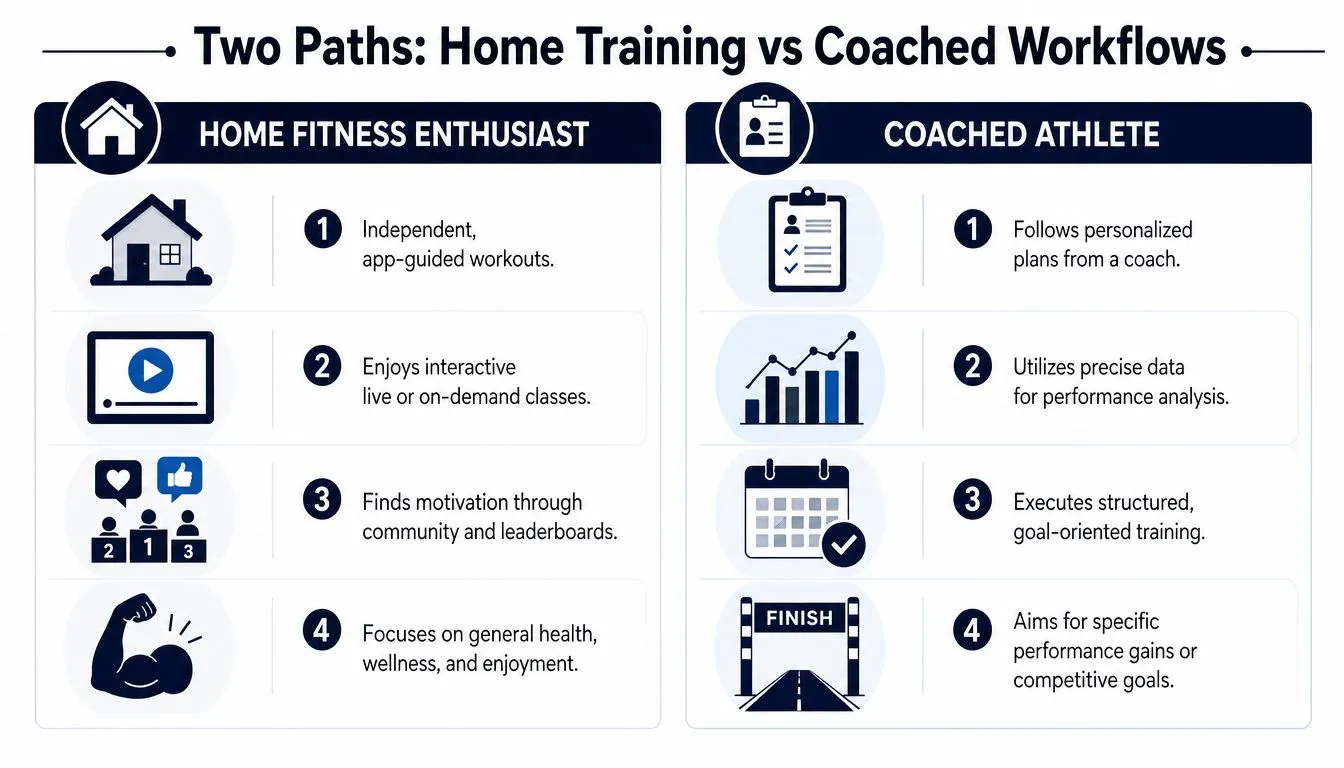
The connected exercise bike market is growing because it serves two different riders. In North America, the exercise bike market is projected to reach $528.6 million by 2034, with growth tied to sustained home fitness demand and interest in both engaging classes and data-driven training tools, according to IMARC Group’s North America exercise bike market overview.
Those riders may use similar hardware, but their workflows don’t look alike at all.
The home fitness rider
This rider wants a workout that starts fast and keeps attention. They’ll often choose a platform because the instructor is good, the interface is polished, or the class library feels fresh. If the session is fun enough to repeat, the product is doing its job.
That workflow usually looks like this:
- Open app
- Choose class or route
- Ride
- Save session and move on
There’s nothing wrong with that. For consistency and general health, it works well. If you’re shopping around, these Zwift alternatives show how different platforms approach motivation and structure.
The coached athlete
This rider has a different problem. Entertainment is secondary. The question is whether today’s workout gets executed exactly as intended.
A coach might prescribe something like progressive sweet spot, over-unders, high-cadence neuromuscular work, or a recovery ride with strict caps. The athlete doesn’t need novelty. They need the plan to move cleanly from coach notes to device to bike.
That creates friction in places casual users rarely notice:
- Workout translation: The plan may exist as text in TrainingPeaks notes, email, chat, or a spreadsheet.
- Device compatibility: The athlete may train with Garmin, Wahoo, or a bike-specific app depending on the day.
- Execution quality: One wrong target, missing interval, or pairing issue can ruin the point of the session.
Where the workflows split
The home fitness rider mostly asks, “What should I ride today?”
The coached athlete asks, “How do I get this exact session onto the device without wasting time?”
If you train for performance, the bike isn’t the bottleneck most days. The workflow is.
That’s where many connected bike setups still fall short. The hardware is smart. The process around workout creation and syncing often isn’t.
The Workout Syncing Workflow From Text to Training
For performance training, the bike is only one part of the chain. The useful question is simpler: how does a workout move from a written plan into a session your bike can control?
How the data path works
A modern connected setup often follows this path:
- Workout is created in a training platform, notes app, or coaching message.
- Workout reaches a head unit or app such as Garmin or Wahoo.
- The bike receives control commands over Bluetooth FTMS or ANT+.
- The resistance adjusts automatically during the interval set.
- Ride data flows back for review and storage.
That control loop is a major upgrade over old indoor setups. Advanced bikes using Bluetooth FTMS and ANT+ can support bidirectional data flow so a head unit can automatically adjust resistance to match workout targets, reducing manual intervention by 90% compared with adjusting resistance by hand, according to The New York Times Wirecutter’s exercise bike review guide.
That last part matters more than people think. Fewer manual adjustments means fewer missed intervals, less mental clutter, and much more consistent execution.
Why workout creation is still clunky
The hardware side has improved faster than the planning side.
A lot of athletes still deal with one of these messy processes:
- Drag-and-drop builders: You click blocks, stretch intervals, duplicate steps, and fix formatting issues for longer than you should.
- Manual file handling: A workout gets exported, renamed, transferred, and sometimes lost between devices.
- Coach note interpretation: The athlete reads shorthand and rebuilds the session by hand.
- Platform lock-in: A workout built in one place doesn’t move cleanly to the device you use.
The workflow breaks for many coached riders. The training prescription may be excellent, but if turning “3 x 12 minutes, build through the block, short recoveries” into a device-ready session takes too long, people cut corners.
A practical alternative is using a workout plan builder that starts from written instructions instead of forcing every session through a graphical editor.
What a smoother workflow looks like
The better approach is text first.
Coach writes the session the way coaches already write sessions. Athlete reviews it in plain language. The tool parses it into structured intervals. Then it syncs to the head unit or watch that will run the workout.
That workflow fixes a common mismatch in endurance training: plans are written like messages, but many tools still expect them to be rebuilt like diagrams.
The best workout builder is usually the one that gets out of the way and lets the athlete train.
Here’s the pattern that works well in practice:
| Step | Old workflow | Better workflow |
|---|---|---|
| Authoring | Rebuild intervals manually in a visual editor | Start with the coach’s text |
| Review | Zoom through blocks and nested repeats | Read the session as written, then verify structure |
| Delivery | Export or hand-transfer | Sync directly to the device you’ll use |
| Execution | Adjust resistance manually when needed | Let the bike follow the workout targets |
Once that path is clean, the connected exercise bike starts doing what it should. It becomes the execution layer for training, not another piece of software you have to wrestle with before you can ride.
A short demo helps if you want to see that kind of workflow in action.
Setup Tips and Troubleshooting Common Issues
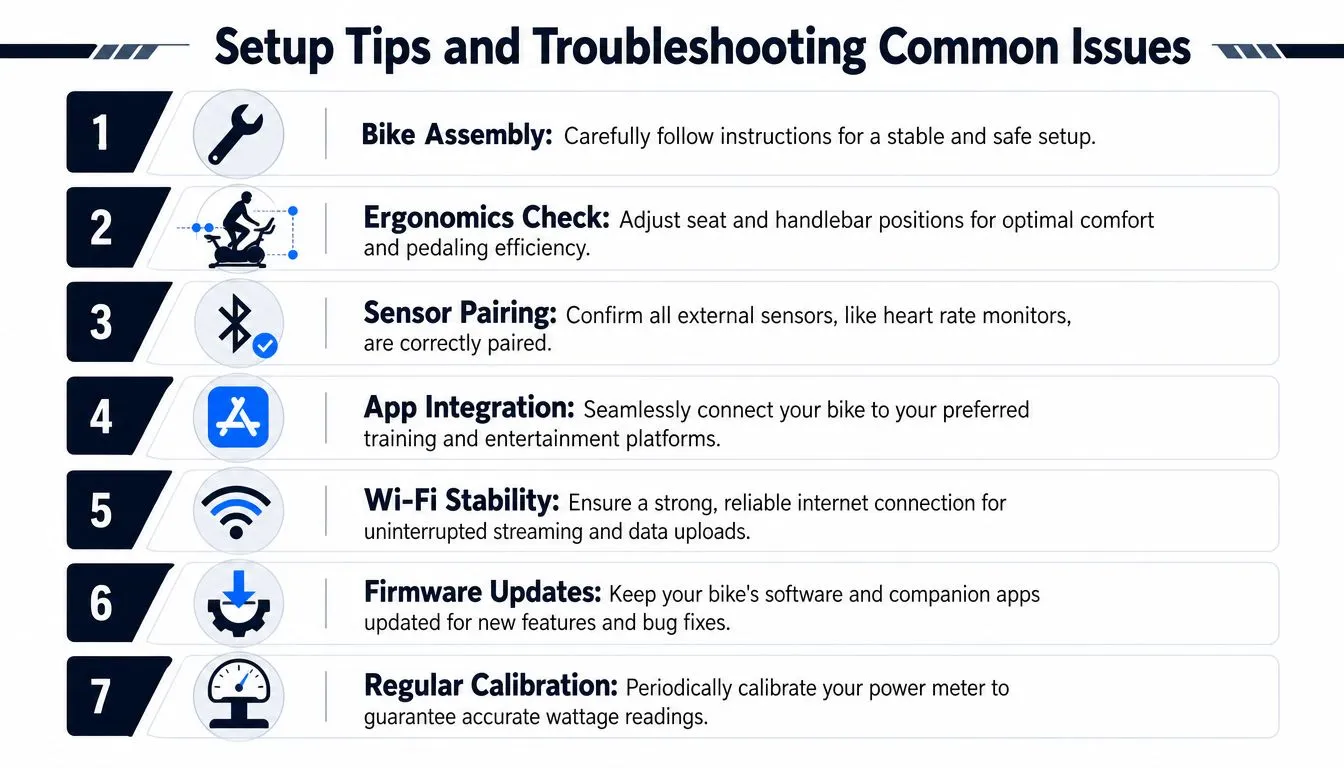
Most indoor tech problems aren’t caused by a bad bike. They come from pairing mistakes, stale firmware, poor fit, or confusion about which device is in control.
Get the pairing right first
The first setup decision affects everything after it. If your app or head unit needs to control resistance, pair the bike in the mode that exposes trainer or fitness-machine control, not only basic cadence or speed broadcasting.
A simple checklist helps:
- Confirm control pairing: Make sure the receiving device can both read data and control resistance.
- Update firmware: Bike firmware and app updates often fix pairing bugs and workout sync problems.
- Check fit before calibration: A poor saddle or bar position changes cadence and comfort, which can make ERG workouts feel worse than they should.
Fix power and ERG problems before blaming the bike
When riders say the bike feels “wrong,” three issues show up repeatedly.
The first is calibration drift. If the bike supports calibration, do it regularly and under the conditions the manufacturer recommends. If power suddenly feels off across several sessions, that’s the first thing to check.
The second is cadence collapse in ERG mode. Riders start an interval too hard, let cadence fall, then the system increases resistance to chase target power. That can create the familiar ERG spiral where pedaling gets harder and harder. The fix usually isn’t more force. It’s shifting early if applicable, settling cadence sooner, and starting the interval under control.
Don’t fight ERG with panic acceleration. Get cadence stable first, then let the bike meet you there.
The third issue is comparing numbers from different devices too aggressively. If your bike, head unit, and any external power source aren’t aligned in setup, the display can look inconsistent even when the workout itself is fine.
When syncing fails
Workout sync failures are usually boring, which is good news. Boring problems are fixable.
| Problem | Usual cause | Best first fix |
|---|---|---|
| Workout doesn’t appear | Wrong account, stale app session, delayed sync | Refresh login and trigger sync again |
| Workout appears but won’t control resistance | Paired as a sensor, not a controllable trainer | Re-pair with control enabled |
| Workout starts with wrong steps | Old version saved or duplicate session | Delete the duplicate and resend the current version |
If you want your setup to stay reliable, treat it like training equipment, not a toy.
- Do a pre-ride check: Open the workout before warm-up and verify the right session loaded.
- Keep one control source: Don’t let multiple apps compete for the same bike control.
- Test after changes: Any firmware, app, or device change deserves a short validation ride before a key workout.
That discipline saves far more frustration than any heroic mid-ride troubleshooting.
Conclusion Your Gateway to Smarter Training
A connected exercise bike is useful because it closes the gap between intent and execution.
The old indoor model asked you to manage everything yourself. Pick the effort. Change resistance. Track time. Guess whether the session matched the goal. The smart model does far more of that work for you. It measures, responds, records, and connects to the broader tools that shape training.
For casual riders, that means more engaging sessions and a better chance of staying consistent. For athletes, it means something more important. It means workouts become repeatable enough to trust.
That trust doesn’t come from hardware alone. It comes from the full workflow. You need a bike that communicates well, a device that can run the session cleanly, and a process for creating workouts that doesn’t turn a simple prescription into admin work.
That’s where the next improvement is happening. The best setups aren’t only adding better screens or more classes. They’re removing friction between the written plan and the actual ride. When that part gets easier, more athletes can train with the kind of structure that used to require a much more complicated stack.
If you’re building an indoor setup for real performance, that’s the standard worth chasing. Not only a bike that feels smart, but a system that makes smart training easier to do every day.
If you’d rather write workouts than rebuild them block by block, type the session into TextFit: “3 x 12 min, build through the block, short recoveries”, in any language. You get a structured workout to review and tweak, then it syncs to Garmin and Wahoo through your intervals.icu connection or schedules on your Apple Watch. It’s free to start, and there’s no sign-up.