Training Plans for Cycling: 7 Top Picks for 2026

You’re staring at three tabs right now, maybe a Garmin workout builder, a Wahoo calendar, and one more browser window filled with half-finished plan ideas. The ride is supposed to happen tomorrow, but the core problem is the one every cyclist runs into eventually: the plan lives in one place and the workout device lives in another. Modern training plans for cycling are supposed to close that gap, not add more clicks.
Today’s best tools do more than hand you a PDF. They adapt to your FTP, your available time, and your schedule changes, then push the session to a head unit or indoor app so you can start riding instead of rebuilding intervals by hand. That matters because structured cycling has become a software category as much as a coaching one, with the training app market valued at $1.2 billion in 2025 and projected to reach $2.6 billion by 2034 in a report that also says cloud-based deployment holds 78.5% of the market and personal use accounts for 64.2% of revenue (market report).
Table of Contents
- 1. TextFit
- 2. TrainerRoad
- 3. TrainingPeaks Training Plans Marketplace
- 4. Zwift Training Plans
- 5. Wahoo SYSTM
- 6. FasCat Coaching
- 7. JOIN
- Top 7 Cycling Training Plans Comparison
- From Plan to Performance: Sync Your Next Workout
1. TextFit
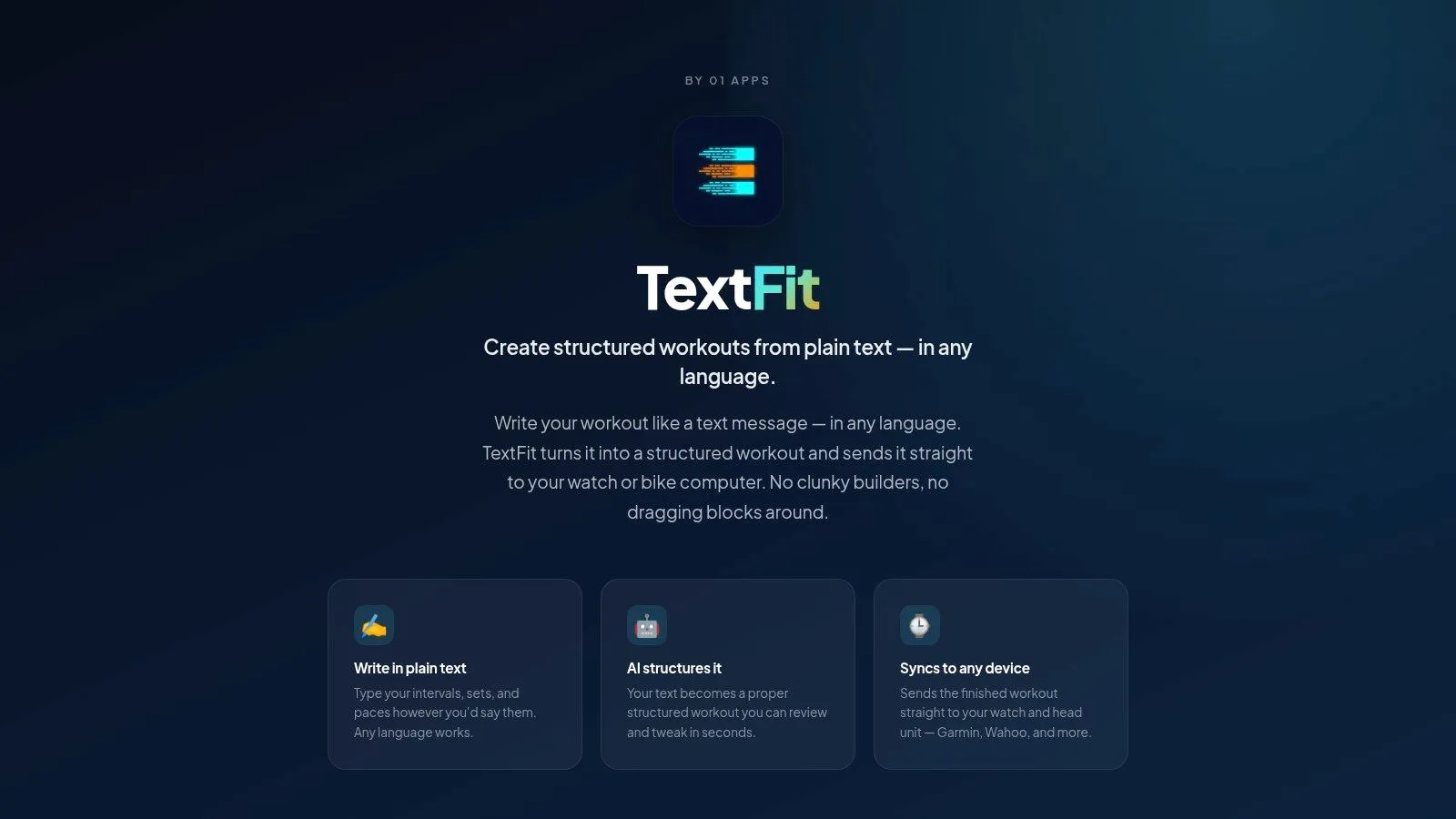
TextFit solves the messiest part of cycling plan execution, turning coach notes or your own plain-language workout idea into a structured session you can ride. Instead of dragging blocks around in a builder, you type the workout the way you’d explain it to a training partner, then AI parses the steps, durations, repeats, and power targets into a session you preview and sync to Garmin or Wahoo through intervals.icu, or schedule on Apple Watch. The direct value is simple. Less admin, fewer errors, and no last-minute file juggling before a hard session.
The best part is how little friction it adds. TextFit accepts input in any language and normalizes units and targets, so the workout can move from a message thread to a head unit without a detour through a complicated editor. For coaches managing different athletes, that multilingual layer matters because it keeps the intent of the session intact instead of forcing everyone into one drafting language. For riders, it means the workout can be written in seconds and still land as a properly structured interval set.
Practical rule: If your current system depends on copying text into a calendar, exporting a file, then importing it into a device app, TextFit removes the slowest step.
Where TextFit fits best
TextFit is strongest for athletes and coaches who already know what they want to ride and need a fast way to make it executable. It is especially useful when the week changes late, because the format is lightweight enough to edit quickly without rebuilding the whole plan. It’s free to start, with a Pro subscription for higher limits. The main trade-off is scope: TextFit turns the workouts you already have into device-ready sessions, and the season plan still comes from you or your coach.
A few reasons it stands out in this field:
- Text-first creation: Write the workout naturally, then let the system structure the intervals for you.
- Device delivery: Sync sessions to Garmin and Wahoo through intervals.icu, or schedule them on Apple Watch, with no manual file transfer.
- Fast edits: When the week changes, change one line of text instead of rebuilding the session.
- Coach efficiency: Reduce back-and-forth when athletes interpret notes differently.
That makes TextFit a strong fit for the last mile of training, the exact point where the plan stops being theory and becomes a session on your screen.
2. TrainerRoad
TrainerRoad has built its reputation on power-based structure, and that still matters if your main goal is to ride faster without babysitting the plan. The platform’s Adaptive Training engine changes workout difficulty and future sessions based on how you performed and how you rated the effort, which is a cleaner experience than staring at a static calendar and guessing what to do next. It also offers one-click outdoor workouts that send sessions to Garmin, Wahoo, and Hammerhead devices, which is where a lot of training tools fall apart in real life.
FTP testing guidance matters here because TrainerRoad’s value is tightly linked to setting the right training zones. If your threshold number is off, every workout built around it inherits the error. Once the baseline is solid, the platform’s progressive workout library does the heavy lifting, and the adaptations keep the load moving in the right direction without forcing you to manually edit every block.
Strong structure, little friction
TrainerRoad is a good match for riders who want a disciplined plan and don’t want to think too hard about session design. It is cycling-first, so it doesn’t try to be a broad wellness app, and that focus helps when you’re trying to progress time in zone with less noise. The main limitation is also the main virtue, because the platform assumes you have the hardware to make power-based training worthwhile, which means a power meter or smart trainer is close to essential.
Hard sessions work best when the plan, the device, and the feedback loop all agree. TrainerRoad keeps those pieces connected.
For riders who split time between indoors and outdoors, that smooth delivery is the difference between following the plan and drifting off it. The platform does more than recommend a workout: it makes it easy to execute in the same format on the head unit you already use.
3. TrainingPeaks Training Plans Marketplace
TrainingPeaks is less a single plan and more a marketplace of coaching styles, which is exactly why it stays relevant. You can filter for duration, volume, and goal, then choose from a wide range of coach-built plans covering base, build, race prep, gran fondo, gravel, and time trial work. That breadth is the big advantage. If you know your event and want a human-authored plan instead of an algorithmic feed, this is one of the deepest catalogs available.
The platform also handles the device side well, with structured workouts that sync to Garmin and Wahoo through the calendar workflow. That matters because the best plan on paper still fails if the workout never reaches the head unit. TrainingPeaks solves the delivery problem better than most marketplaces, but the quality of the actual plan still depends on the coach behind it, so the buyer has to read carefully.
Buyer beware, in the useful sense
This is the place to shop if you want choice. It’s also the place where choice can become confusion if you don’t vet the seller’s style, progression logic, and fit for your time budget. Some plans are highly specific, some are more generic, and not all of them will adapt if your week gets messy. The platform delivers the structure, but not every plan inside it behaves like a living coach.
A good TrainingPeaks purchase usually comes down to three questions:
- Does the plan match your event? Gran fondo riders, gravel racers, and time trialists need different stress patterns.
- Does the weekly load fit your actual life? A great plan that assumes more time than you have becomes dead weight.
- Does the author update or support the plan? Without that, you’re locked into the original script.
For riders who want a coach’s blueprint with Garmin and Wahoo delivery built in, TrainingPeaks remains one of the most practical marketplaces in cycling.
4. Zwift Training Plans
Zwift works because it makes interval work feel less like homework. The platform’s training plans, including Build Me Up, Gran Fondo, and Crit Crusher, run inside its virtual worlds and scale to your FTP, so the sessions feel aligned to your current fitness instead of a one-size-fits-all template. For riders who struggle with boredom during structured work, that game layer can be the difference between skipping intervals and finishing them.
The app also organizes workouts by available time, which is useful when your week is split between family, work, and weather constraints. That said, Zwift plans are relatively rigid, so they’re better for riders who want a clearly defined on-ramp than for athletes who need heavy customization. If you already use TrainingPeaks, the integration can bring scheduled workouts into Zwift, which helps keep indoor execution tied to an outside plan rather than turning it into a separate hobby.
Best for motivation, not total freedom
Zwift is strongest when the hardest part of training is psychological, not mechanical. The visual environment can make threshold and VO2 work more tolerable, and the plan enrollment flow is straightforward enough that newer riders don’t get buried in setup. The trade-off is that rigid plans don’t always fit irregular schedules, so a missed day can feel more disruptive here than on an adaptive platform.
Workout building inside Zwift becomes a lot easier if you think of it as an execution layer rather than the place where every detail of the plan must originate. That’s the right mindset for riders who want structured work with more engagement and less blank-screen fatigue.
For amateurs trying to get consistent indoors, that matters. A plan you enjoy is often a plan you repeat.
5. Wahoo SYSTM
Wahoo SYSTM sits in a useful middle ground between pure cycling structure and broader athletic support. It offers base, tempo, FTP, MAP, and AC-NM blocks, but it also layers in strength, yoga, pilates, and mental training, which makes sense for riders who know they need more than bike-only volume. The platform’s Training Plan Wizard and daily recommended workouts add a degree of adaptation based on training history, and planned workouts can move outdoors onto Wahoo ELEMNT head units.
That outdoor integration is a practical advantage. Too many apps are polished indoors but awkward on the road, and SYSTM’s device connection helps close that gap. It also supports a more complete week, where an easier cycling day can pair with mobility or strength instead of more saddle time.
A broader training week, not just harder intervals
SYSTM is a better fit for riders who treat cycling as part of a wider performance routine. If you’re coming back from a layoff, trying to stay durable through a long season, or want one app to cover multiple kinds of work, the cross-training content earns its place. The trade-off is that pricing can vary by store and region, so you’ll want to confirm the checkout details instead of assuming the in-app number is final.
Building a workout plan inside SYSTM makes more sense when you know how the app fits your whole week, not only your hardest session. A rider with limited time may prefer a simpler tool, but someone who wants strength and cycling in one ecosystem gets a lot of value here.
If your weak link is durability, not motivation, a training app that includes non-bike work can be the smarter long-term choice.
6. FasCat Coaching
FasCat Coaching has long leaned into Sweet Spot structure, and that identity shows up clearly in both its plan library and the CoachCat app. The lineup includes off-season base, race-specific work, gravel, MTB, cyclocross, and interval blocks, while the AI-assisted planning layer can adapt recommendations around your inputs. For riders who want a time-efficient approach without abandoning coaching logic, that combination is appealing.
The app also brings auto-FTP detection and recovery analysis into the mix, and higher coaching tiers add TrainingPeaks integration and more human review. That tiered setup lets riders choose between a more self-directed app experience and a higher-touch coaching relationship, which is useful if your needs change over a season. The main drawback is cost and feature access, because the premium capabilities sit behind paid tiers rather than being fully open to every user.
Good for riders who want clear progression
FasCat’s appeal is that it doesn’t pretend every cyclist needs the same thing. Sweet Spot work can be highly efficient for time-crunched riders, and the plan library reflects that without losing event specificity. If you’re the kind of rider who wants a recognizable progression and doesn’t mind working inside a coach-developed framework, FasCat makes sense.
The strongest fit is probably someone who wants structure first and customization second. The app can help steer the week, but the best results still come when the athlete respects the plan and the recovery it demands. That’s true of most training plans for cycling, but especially true when the intensity sits close to the middle of the effort spectrum and the schedule can drift too hard, too often.
7. JOIN
JOIN is built for riders whose calendar never stays still. The app continuously rebuilds your plan around your goals, fitness, and available time, then exports the workout of the day to Garmin, Wahoo, Zwift, and Hammerhead while back-syncing completed activities for analysis. That makes it one of the cleanest options for cyclists who need a plan that changes when life changes.
The setup is minimal, which is a big deal. A lot of adaptive tools still ask for too much manual configuration up front, but JOIN is designed to reduce that friction and keep the plan moving without constant intervention. It also integrates with Garmin, Wahoo, Zwift, and Strava, so it fits comfortably into mixed hardware setups instead of forcing you onto one device ecosystem.
The best adaptive option for messy weeks
JOIN makes the most sense for riders who miss sessions for real reasons, not laziness. If your schedule shifts often, the value is not that the app is clever, it’s that the plan stays usable after the week changes. The downside is familiar in consumer software, pricing can be region or app-store dependent, and sync delays can happen during updates.
The smartest plan is the one that still works after a canceled meeting, a late commute, or bad weather.
That’s why JOIN stands out in a list like this. It does more than prescribe workouts: it reorders the week so the plan survives contact with reality.
Top 7 Cycling Training Plans Comparison
| Item | Implementation complexity (🔄) | Resource requirements (⚡) | Expected outcomes (⭐) | Ideal use cases (💡) | Key advantages (📊) |
|---|---|---|---|---|---|
| TextFit | Low 🔄, text-first, minimal UI | Low ⚡, phone app; Free to start; Pro subscription | ⭐⭐⭐, rapid, executable interval sessions; occasional manual tweaks | 💡 Coaches/athletes who want fast text → workout conversion | 📊 Natural-language parsing in any language; Garmin/Wahoo sync via intervals.icu; Apple Watch |
| TrainerRoad | Medium 🔄🔄, setup plans & adaptive engine | High ⚡⚡, subscription + power meter or smart trainer | ⭐⭐⭐, proven progressive FTP gains with adaptive adjustments | 💡 Time-crunched cyclists seeking structured, power-based progression | 📊 Large library; Adaptive Training; smooth indoor/outdoor execution |
| TrainingPeaks Marketplace | Medium 🔄🔄, select and vet coach plans | Medium ⚡⚡, plan purchase, device sync; varied coach quality | ⭐⭐, outcomes vary by coach and plan quality | 💡 Riders wanting coach-authored plans across levels and goals | 📊 Massive plan diversity; calendar delivery; coach-authored content |
| Zwift Training Plans | Low-Medium 🔄🔄, enroll and follow in-app | High ⚡⚡⚡, smart trainer + Zwift subscription + device | ⭐⭐, engaging and motivating; plans are rigid but FTP-scaled | 💡 Indoor riders who value gamification and motivation for intervals | 📊 Gamified environment; easy FTP scaling; time-based collections |
| Wahoo SYSTM (Wahoo X) | Medium 🔄🔄, plan wizard + multi-discipline content | Medium ⚡⚡, subscription; ELEMNT for best outdoor integration; gear for strength | ⭐⭐⭐, comprehensive fitness gains with cross-training support | 💡 Cyclists wanting science-based plans plus strength/yoga add-ons | 📊 Broad content mix; Training Plan Wizard; strong ELEMNT integration |
| FasCat Coaching (CoachCat) | Medium-High 🔄🔄🔄, app + optional human coach workflows | High ⚡⚡⚡, paid tiers for human review; TrainingPeaks integration optional | ⭐⭐⭐, reputation for time-efficient, sweet-spot progressions | 💡 Riders seeking coach-designed sweet-spot plans or hybrid AI+coach support | 📊 AI-assisted custom plans; auto-FTP detection; app or 1:1 coaching paths |
| JOIN (Adaptive Training App) | Low 🔄, minimal setup, continuous rebuilding | Medium ⚡⚡, subscription; device/app integrations | ⭐⭐⭐, flexible, always-updating plans that fit life changes | 💡 Athletes needing low-friction adaptive daily plans and exports | 📊 Dynamic event-aware planning; direct push to head units; back-syncing |
From Plan to Performance: Sync Your Next Workout
The best training plans for cycling are the ones you can complete on a messy Tuesday, not only admire on a clean Monday. If you want structure, TrainerRoad and FasCat give you clear progression. If you want variety and coach-authored choice, TrainingPeaks is still hard to beat. If motivation is your bottleneck, Zwift makes the work easier to start, while Wahoo SYSTM gives you more than cycling alone.
The device question matters as much as the plan logic. A good plan should land on your Garmin, Wahoo, Zwift setup, or head unit without forcing you into file exports and manual reconstruction. That is where the newer tools are moving the market, toward delivery, adaptation, and low-friction execution rather than better-looking calendars.
For riders who need a more direct bridge from words to workouts, TextFit is built around exactly that problem. It turns plain-language interval notes into structured sessions you can preview and sync to your device, which makes it a strong fit for coaches, self-coached riders, and anyone who wants less admin before the ride. Choose the platform that matches your schedule, sync the next workout, and make the plan easier to follow than to ignore.
If you like the idea of typing a workout the way you’d explain it to a coach, open TextFit and try it on tomorrow’s ride, in any language: “20 min easy, 5 x 4 min at 105 to 110% FTP with 3 min easy spin, 10 min cool-down.” AI turns it into a structured session you review and tweak, then it syncs to your Garmin or Wahoo through intervals.icu. Free to start, no sign-up required.