Interval Training for Marathon Runners: A Practical Guide
You’ve probably been here. The weekly mileage is solid, the long run is getting done, and the training log looks disciplined. But your marathon pace hasn’t moved much. Race day still turns into the same pattern: feel smooth early, grind in the middle, hang on late.
That’s usually the point where runners add more volume, push easy runs too hard, or throw in random speed sessions that don’t fit the rest of the week. None of those fixes works well for long. Marathon training responds better to precision than panic.
Interval training for marathon performance isn’t about turning a marathoner into a miler. It’s about using one well-placed session to improve the systems that make your race pace feel more controlled, your form hold together later, and your aerobic work pay off. The hard part usually isn’t understanding that intervals matter. It’s choosing the right session, putting it in the right place, and then getting that workout from a coach note or phone note onto your watch without messing up the steps.
Racing soon? Two free tools cover race-day logistics: the sweat rate calculator tells you how much to drink per hour, and the fueling calculator turns your goal pace into a carbs-per-hour target and the gels to carry.
Table of Contents
- Beyond the Long Run Why Your Marathon Needs Intervals
- The Science of Speed for Endurance Runners
- Your Marathon Interval Training Toolkit
- Scheduling Intervals in Your Marathon Plan
- Sample Sessions and Syncing Them to Your Watch
- The Modern Way to Program and Execute Workouts
Beyond the Long Run Why Your Marathon Needs Intervals
A lot of marathon runners train as if endurance and speed live in separate worlds. They don’t. If you only run easy and long, you build durability, but you also leave a gap between your aerobic base and the pace control you need when the race starts getting expensive.
That gap shows up late in the marathon. Your breathing may still be manageable, but your stride loses shape, your cadence drops, and race pace starts to feel oddly mechanical. Intervals help close that gap. They teach you to run efficiently under controlled stress instead of surviving slow fatigue.
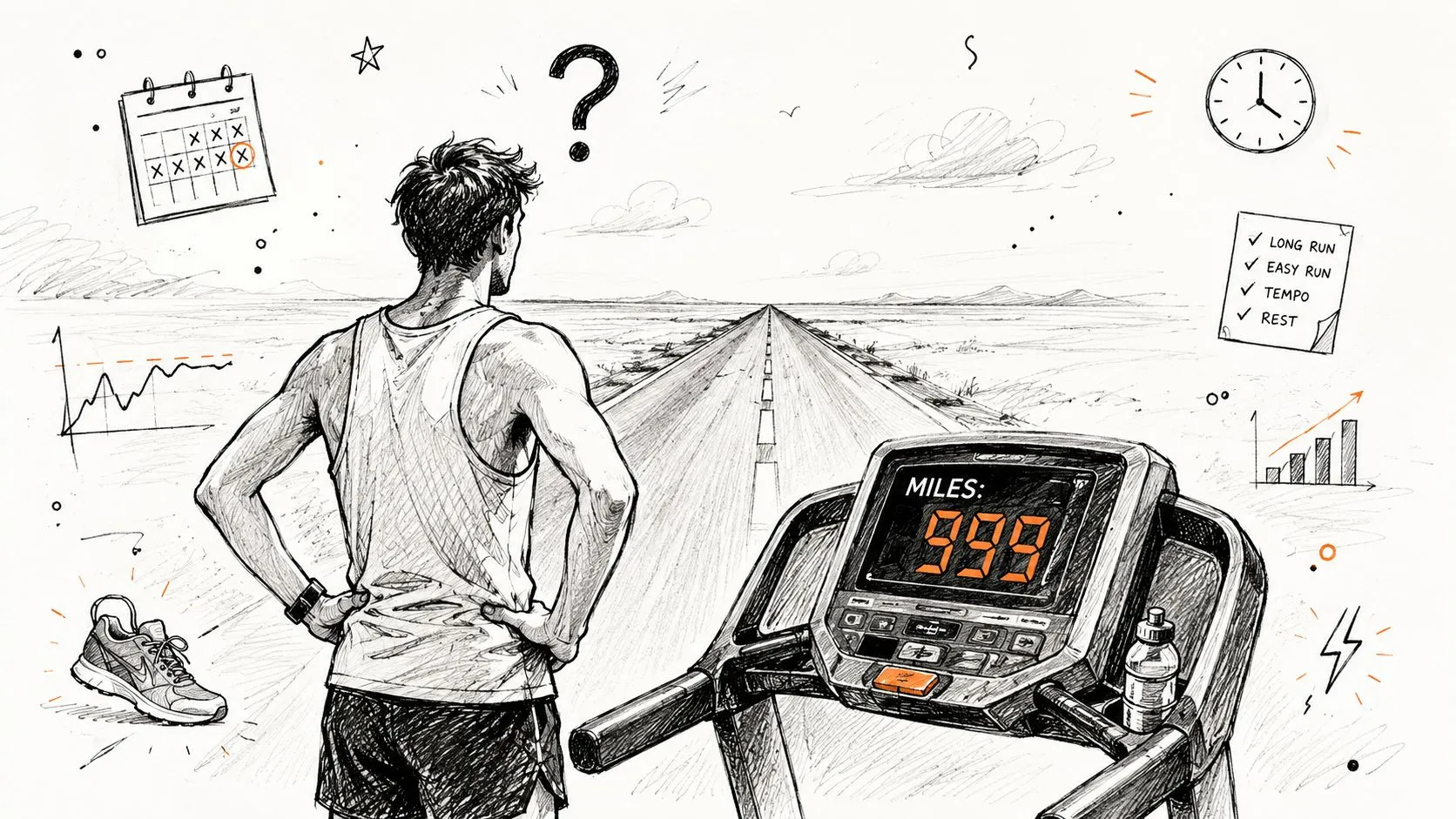
A smart interval session also keeps marathon training honest. It exposes whether you’re carrying too much fatigue, whether your goal pace is realistic, and whether your easy days are easy. That’s one reason I like using intervals as a calibration tool, not only a fitness tool.
What intervals do that long runs don’t
Long runs build staying power. Intervals add qualities long runs can’t develop as efficiently.
- They sharpen pace control: You learn what controlled discomfort feels like instead of guessing.
- They improve mechanics under load: Shorter repeats let you practice good form at faster paces.
- They break the monotony of endless aerobic work: That matters more than runners admit during a long block.
- They give structure to hard effort: That’s more useful than random surges in a steady run.
If you want a broader look at why structured faster running helps endurance athletes, this breakdown of interval training advantages is a useful companion.
Practical rule: Marathoners usually don’t need more hard days. They need one better hard day.
The real trade-off
Intervals aren’t free fitness. Every faster session costs recovery, and marathon training already carries a lot of fatigue from long runs and volume. That’s why good interval training for marathon success looks restrained on paper. You want enough intensity to create adaptation, but not so much that it wrecks the rest of the week.
The runners who benefit most are rarely the ones chasing heroic splits on Tuesday. They’re the ones who can hit the workout, recover, and still run well on Sunday.
The Science of Speed for Endurance Runners
Tuesday morning is a common failure point in marathon training. The coach sends “5 x 1K at 10K effort, 2:00 jog” in a text, the runner tries to remember the details at the track or on a dark road, and the workout drifts. Rep three goes too fast. Recovery gets cut short. The session still feels hard, but it no longer does the job it was supposed to do.
That matters because interval work in marathon prep is precise work. The goal is not to pile on suffering. The goal is to improve specific systems without stealing too much from your long run, your steady mileage, or your next quality day.
For most marathoners, one interval session per week is enough. Early in the cycle, shorter reps can build speed and sharpen mechanics. In the final 8 to 10 weeks, the work usually shifts toward moderate to moderately hard efforts that support marathon-specific fitness. Laura Norris notes in her guide to marathon interval training that the total volume of faster running in these sessions often lands around 2 to 4 miles. That range works for a reason. It gives you enough quality to matter, without turning the workout into a recovery problem.
Why one session works
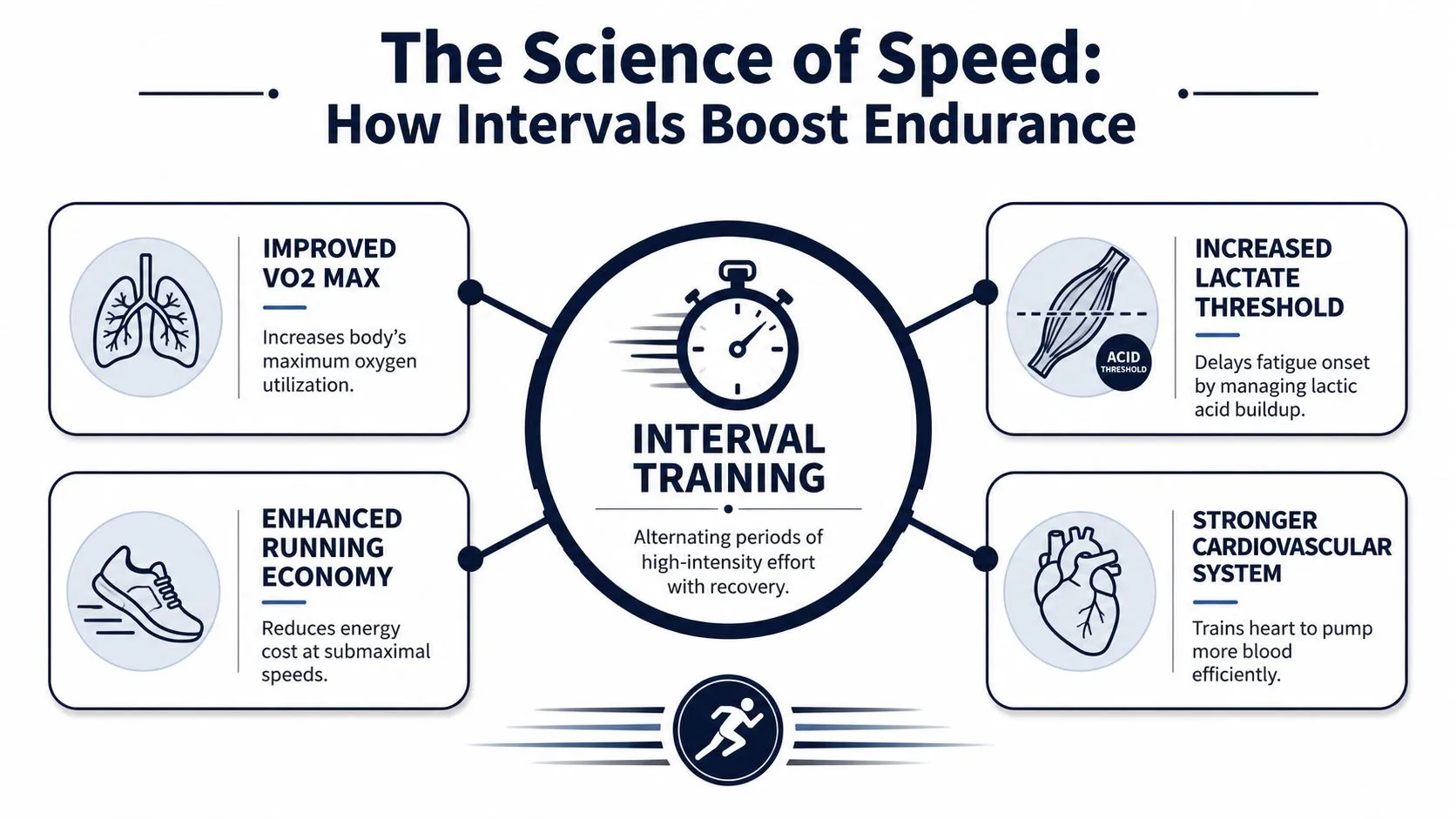
Marathon training already asks a lot from the aerobic system. Long runs, medium-long runs, and volume do most of the heavy lifting. Intervals fill a narrower role, but a useful one. They raise your ceiling enough that marathon pace takes a smaller percentage of your total capacity, and they keep some rhythm and coordination in your stride that can get stale during high-mileage blocks.
One well-placed session can support several adaptations at once:
- VO2 max: A higher aerobic ceiling gives marathon pace more room underneath it.
- Running economy: Better mechanics at faster speeds can reduce wasted motion at slower race pace.
- Anaerobic reserve: You will not race 26.2 miles anaerobically, but a small reserve helps on hills, surges, and rough patches late in the race.
- Neuromuscular coordination: Faster running reminds the body how to turn over efficiently instead of settling into one gear all block.
The primary trade-off is recovery. A workout that looks good on paper can still be the wrong call if it leaves you flat for three days or compromises the weekend long run.
Why race pace starts to feel easier
Intervals help marathon performance indirectly. That is one reason runners sometimes underrate them. The benefit is not only faster 400s or cleaner 800s. The bigger payoff is that steady running starts to cost less.
You usually notice it in small ways first. Marathon pace feels less forced. Threshold work stops drifting late in the session. A moderate climb no longer pushes you over the line. Those are useful signals because they show the workout is carrying over to the efforts that matter most.
Marathon pace should feel controlled enough to repeat, not like the fastest pace you can barely hold together.
This is also where execution matters. If the session lives only in your notes app, many runners guess the recoveries, miss the rep count, or start each interval a few seconds late while checking the screen. Programming the workout into the watch fixes that last-mile problem. The structure becomes harder to fudge, which is exactly what you want when the aim is controlled adaptation rather than random hard running.
Where runners get this wrong
The common mistake is using marathon intervals like 5K training and racing every rep. The other mistake is avoiding intervals because they look risky on paper.
A good marathon interval session sits in the middle. It is controlled, repeatable, and matched to the phase of training. If you cannot recover from it and train well again within the next couple of days, the session was too aggressive, no matter how strong the splits looked.
Your Marathon Interval Training Toolkit
A marathon interval plan fails in practice when the workout type is vague on paper and harder to execute on the watch. “6 x 1K threshold” sounds simple until you have to remember the warm-up, lap the recoveries correctly, and keep the rep count straight while tired. A good toolkit solves both problems. It tells you what each session is for, and it makes the structure clear enough to program and run cleanly.
VO2 max sessions
VO2 max work gives marathoners a dose of controlled speed that improves aerobic power and keeps mechanics sharp. I use it earlier in a training block, or in the middle of one when a runner has gone flat from too much steady work.
Marathon Handbook’s marathon interval training guide notes that VO2 max intervals should last 3 to 6 minutes at roughly a pace you could hold for about 15 minutes all-out. That points you toward reps that are hard, repeatable, and short enough to keep form intact.
Common options include:
- 5 to 6 x 800m
- 4 to 6 x 1000m
- 4 to 5 x 1200m
- 5 x 4 minutes hard with controlled jog recovery
The trade-off is straightforward. These sessions can make you faster, but they also create more neuromuscular stress than threshold work. If a marathoner is already carrying fatigue from long runs, I would rather trim one rep than force the full set and lose the next two days.
Threshold intervals
Threshold intervals usually give marathoners the best return. They sit close enough to race demands to matter, but they are still controlled enough to recover from if the volume is sensible.
The review in PMC on anaerobic threshold interval training for marathoners describes threshold intervals as 3 to 10 minutes at half-marathon pace or slightly faster, with recovery around 1 minute of easy jogging per 5 minutes of running. It also describes structures such as 8 to 12 x 800 to 1000m with 1-minute recovery or 4 to 8 x 1500 to 2000m with 1 to 2 minute recovery, building to 25 to 40 minutes of quality running.
That does not mean every marathoner should copy elite volume.
Use the pattern, not the ego. A strong session for many runners is 5 x 6 minutes at threshold with 75 seconds jog, or 4 x 2K at controlled effort with 90 seconds recovery. Those are long enough to teach rhythm and restraint, and simple enough to build into a watch without creating a messy ladder of steps. If you also race shorter events, this half marathon interval training guide shows how threshold work shifts when the goal asks for more sustained speed and less overall fatigue management.
Yasso 800s
Yasso 800s are useful because they are simple, memorable, and easy to repeat as a check-in. They are also easy to overrate.
Treat them as a benchmark workout. If you hit even 800s with equal-time recovery, you learn something about pacing discipline and aerobic support. You do not get a full picture of marathon readiness. Plenty of runners can survive Yassos and still struggle late in the race because their threshold work, long run durability, or fueling is weak.
That matters when you build the workout on your watch. A benchmark session should stay clean and boring. Warm up, run the repeats evenly, jog the set recoveries, cool down. No extra fast finish, no improvised rep because you felt good, no guessing whether that last split “basically counts.”
| Workout Type | Primary Goal | Typical Session | Effort/Pace Target |
|---|---|---|---|
| VO2 max intervals | Raise aerobic power | 5 to 6 reps of 3 to 5 minutes with easy recovery | Pace you could hold for about 15 minutes all-out |
| Threshold intervals | Improve sustained fast endurance | 4 to 6 longer reps with short jog recovery | Half-marathon pace or slightly faster |
| Yasso 800s | Benchmark pacing and strength | 8 to 10 x 800m with equal time recovery | Even 800m repeats matched to marathon time goal |
Match the session to the job. Then make the watch reflect the plan exactly, so the workout you meant to run is the workout you run.
Scheduling Intervals in Your Marathon Plan
Wednesday morning. Your coach wrote “5 x 1K at threshold, 60 sec jog” in a text, your long run is still in your legs, and your watch is blank. That is where good marathon plans often break down. The session itself is fine. The placement, recovery around it, and whether you can execute the steps cleanly matter just as much.
For most marathoners, intervals fit best in the middle of the week. That gives enough distance from the weekend long run and leaves room for an easy day after the workout. It also reduces the common mistake of turning Tuesday into a second long-run recovery day and Thursday into a forced quality run on tired legs.
A weekly pattern like this works for a lot of runners:
- Monday: Rest or very easy running
- Tuesday or Wednesday: Interval session
- Next day: Easy run
- Friday or Saturday: Steady aerobic or marathon-pace work, if your plan calls for it
- Weekend: Long run
That structure is simple on purpose. Hard days need space around them. If you stack intervals too close to the long run, one of the two sessions usually gets compromised.
If you race shorter distances alongside the marathon, scheduling shifts a bit. A half marathon interval training schedule usually tolerates slightly more frequent quality because the total fatigue load is lower.
How to progress without digging a hole
Progression should stay controlled. Marathon training rewards repeatable work, not heroic Tuesdays.
Change one variable at a time. Add one rep. Extend the rep by a minute. Trim recovery a little. Then hold that version for a week or two before changing anything else. Runners who increase volume, pace, and density all at once usually end up turning a useful workout into a race.
The bigger problem is pacing the first rep like a test instead of a set. A PMC review of HIIT running protocols supports a practical rule coaches use every week: start at a pace you can hold for the full session, and keep the set even enough that the last rep matches the first in quality. If you cannot do that, the session was set too hard, started too fast, or landed on the wrong day.
If rep one is your fastest by a wide margin, you are not building fitness well. You are spending it early.
A few rules keep marathon intervals useful:
- Protect the next day: You should still be able to run easy without limping through it.
- Keep the reps even: Smooth splits beat one great rep followed by a fade.
- Match the training block: Earlier phases can carry more pure speed. Later phases usually need more marathon-specific control.
- Stop before mechanics fall apart: One less rep is better than practicing bad form.
I use one final filter with athletes. If the interval session makes the whole week better, keep it. If it ruins the long run, forces extra recovery days, or creates confusion when you try to build it on your watch, simplify it. A clean, executable workout usually beats a clever one that lives only in the training notes.
Sample Sessions and Syncing Them to Your Watch
Coaches rarely write workouts in perfect builder format. They write them the way people speak. “Warm up 15, then 5 x 1K at threshold with 1 minute jog.” That’s normal. The problem starts when you need to turn that note into a structured session on a Garmin or Wahoo device.

That last step is where a lot of good interval training for marathon prep falls apart. A review of the issue in Runner’s Blueprint’s interval FAQ context points to a common gap: athletes often have to translate natural language into device-ready steps manually, and that leads to workouts being 10–15% too hard or too easy when recovery or pace targets get misread.
Four marathon ready interval sessions
Here are four sessions written the way a coach might send them.
Session 1 Warm up 15 min easy, then 6 x 800m at 5K effort with 400m jog recovery, then cool down 10 min.
Best use: early build, leg turnover, aerobic power.
Session 2 Warm up 15 min, then 5 x 5 min at controlled hard effort with 90 sec easy jog, then cool down 10 to 15 min.
Best use: moving toward marathon-specific strength without locking into track splits.
Session 3 Warm up 20 min, then 4 x 2K at half-marathon pace or slightly faster with 2 min easy jog, then cool down.
Best use: threshold development and pace stability.
Session 4 Warm up 15 min, then 8 x 800m with equal time recovery. Keep every rep even. Cool down 10 min.
Best use: benchmarking and pacing discipline.
These sessions are simple to read. They’re less simple to build correctly if your watch platform wants every repetition, target, and recovery segment entered by hand. If you’re still relying on a drag-and-drop editor, this workout plan builder overview shows why text-first workflows are easier to work with than block-by-block setup.
Why watch setup is where good plans go wrong
Manual workout builders create small mistakes that matter. A runner enters distance instead of time. Recovery gets set as standing rest when it should be easy jog. The alert target ends up too narrow. The workout on the screen no longer matches the workout the coach intended.
That’s especially annoying on mixed sessions where the note itself is informal. “4-minute chunks at race pace with 2-minute floats” sounds obvious until you try to define every step precisely for a watch.
This short demo shows the kind of friction athletes are trying to avoid:
A good rule is simple. If building the workout takes almost as much mental energy as running it, the setup is too clumsy.
The Modern Way to Program and Execute Workouts
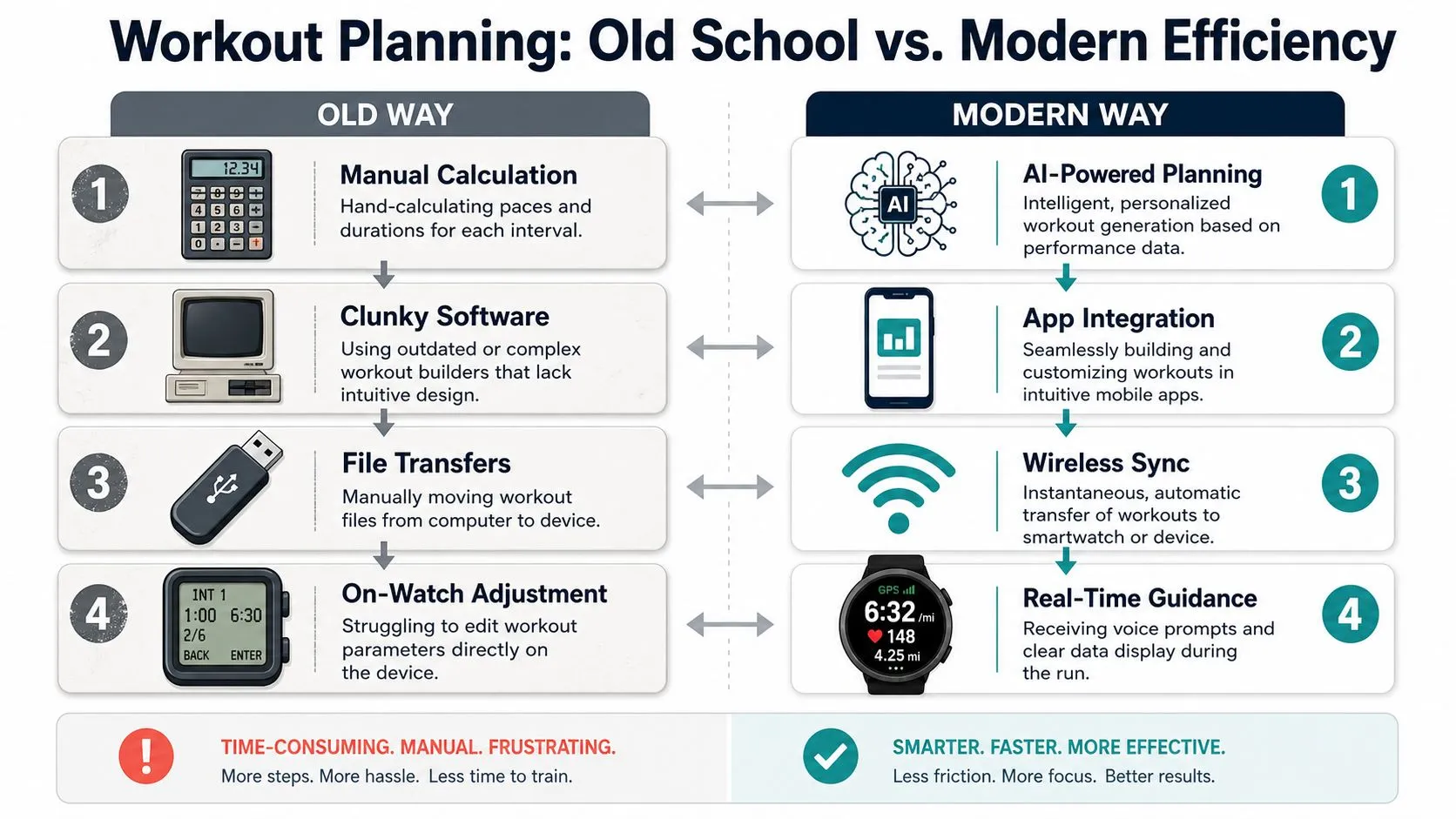
The old workflow for structured training is still hanging around. Write the session in notes. Rebuild it in a workout tool. Double-check units. Push it to the device. Hope the watch displays what you meant.
That’s manageable if every athlete uses the same language, the same units, and the same hardware. Real training rarely looks like that.
Old friction that still wastes training time
A 2024 analysis cited in this YouTube source on multilingual workout planning issues says 60% of non-US runners struggle with English-only track protocols, and emerging 2025 data in the same source indicates 45% of international runners miss interval targets because of unit conversion errors.
That fits what coaches already see in practice. Not all confusion comes from fitness. Some of it comes from translation. “Tempo” can mean different things. Distance and time cues get swapped. A road-based runner gets a track-style workout with no clear conversion. Multilingual teams spend extra time rewriting sessions into English before they can even load them.
The workout isn’t useful if the athlete has to interpret it twice before the warm-up starts.
What a better workflow looks like
The better model is text first and device ready. Write the workout naturally. Let the system turn it into structured steps. Review it quickly. Sync it directly.
That approach solves several practical problems at once:
- Language barriers: The athlete or coach can write in their normal training language.
- Unit confusion: Minutes, meters, kilometers, and pace targets get normalized before execution.
- Builder fatigue: No more dragging blocks around to create a straightforward session.
- Last-minute errors: The workout on the watch matches the note you intended to send.
For marathon runners, that matters because interval sessions are usually the most precise workout of the week. Easy mileage can tolerate a little fuzziness. Intervals can’t. If the recovery is wrong, the pace target is wrong, or the rep count is wrong, the session changes.
The goal is simple. Spend your attention on training decisions, not on software chores.
If you’re tired of rewriting interval sessions so they’ll work on your watch, type the next one into TextFit exactly as your coach sent it, in any language: “5 x 1K at threshold, 60 sec jog.” Review the structured workout, then sync it to Garmin or Wahoo through your intervals.icu connection or schedule it on Apple Watch. Free to start, no sign-up needed.