Lactate Threshold Workouts: Zones, Sessions, Progression
You’re staring at a workout on your watch that looks right on paper, but the reps drift, the pace jumps, and by the last interval you’re either undercooking it or hanging on too hard. That’s the trap with lactate threshold workouts: simple in concept, easy to get wrong in execution. Get them right, though, and you build the kind of sustainable speed that shows up in race pace, late-race control, and the ability to hold form when others fade.
Table of Contents
- Why Lactate Threshold Is Your Key to a New PR
- How to Find Your Training Zones Without a Lab
- Building Your Core Lactate Threshold Workouts
- Smart Progression and Periodization
- Execute Perfect Workouts with Natural Language
- Avoiding Common Pitfalls in Threshold Training
Why Lactate Threshold Is Your Key to a New PR
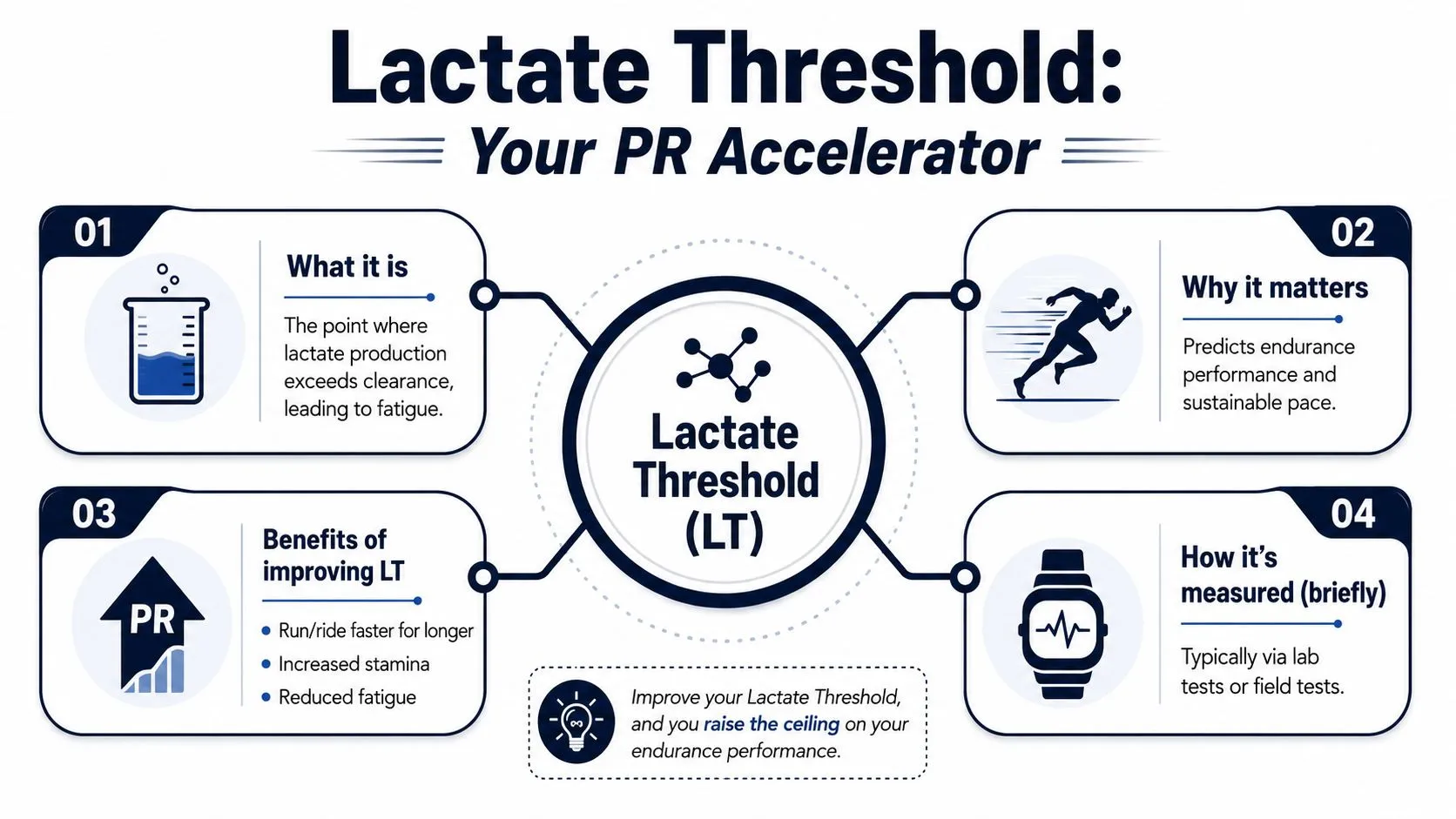
Lactate threshold marks the point where sustainable effort starts to break down. At that intensity, you are still moving well, but fatigue begins to rise faster than you can ignore it. For endurance athletes, that is the line that separates steady pace from the pace that starts costing too much.
What lactate threshold means
Lactate threshold is the point where lactate production starts outpacing clearance fast enough that fatigue rises quickly. In training terms, it is the upper boundary of work you can hold with control before the effort starts to feel sticky and expensive. A structured model in the literature places threshold work in a band of 2 to 4.5 mmol/L and uses repeated sessions to keep the body training near that useful edge, not far above it (Polar on lactate threshold).
That is why threshold work is more than “tempo” or “hard running.” It is a controlled intensity zone built to raise the speed or power you can hold without tipping into a pace that drains you too fast. In some high-volume endurance programs, athletes may stack several lactate-guided threshold sessions across the week along with a VO2max session, but that only works when recovery and total workload are matched carefully. Push threshold too hard and it stops being threshold work.
Practical rule: if threshold work leaves you wrecked for the next session, you did too much intensity.
Why improving it changes race outcomes
The payoff is simple. You can hold a faster pace, or higher power, for longer before fatigue forces the brakes on. That matters whether you run, ride, or race both in a triathlon. Once threshold rises, old “comfortably hard” paces stop feeling like the edge and become repeatable training speeds.
That is also why a useful threshold anchor matters more than guesswork. The heart rate zones calculator gives you a practical starting point for organizing effort, but threshold training still works best when you connect that estimate to what you can sustain in workouts. Athletes and coaches who use lactate threshold well focus on repeatable testing, consistent effort, and honest feedback from pace, power, heart rate, and breathing. The point is not to chase a heroic session. The point is to train at a level you can recover from and repeat.
Why this is the best place to focus
For most endurance athletes, threshold is the most useful trainable speed because it sits close enough to racing to matter, but far enough below maximal effort that you can repeat the work often. It is the sweet spot between too easy to change much and too hard to recover from cleanly. That is why better threshold work often beats random hard sessions.
The key is control. Keep the effort in the right band, and threshold sessions teach your body to clear and tolerate lactate better while holding form under pressure. That is the foundation for new PRs, not hype, not grit alone, but repeatable work at the right intensity.
How to Find Your Training Zones Without a Lab
A lab test helps, but you do not need one to train well. You need a field method that gives you a repeatable threshold anchor for pace, power, and heart rate, then the discipline to stop turning every hard effort into a race. The cleanest practical setup is a step test with 3-minute stages, because that timing gives a steadier read on where the curve starts to bend upward than a ramp test does (NSCA on lactate threshold data).
Use a step test if you want cleaner data
In cycling, a common field or lab setup starts around 100 to 125 W and increases by about 25 W every 3 minutes, while recording RPE, heart rate, and blood lactate in the last 60 to 30 seconds of each stage. That protocol matters because the test measures how your body responds as workload rises, not only how tough you feel on a given day.
The same logic applies to runners, even if you do not have blood sampling. Use a steady progression and keep each stage long enough to settle in. If pace, breathing, and heart rate all begin to rise in a way that no longer feels steady, you are getting close to threshold territory. The goal is a reliable anchor you can repeat, not a perfect lab number.
Turn the test into usable zones
Once you have a threshold pace or power, use it as the center of your workout targets. Heart rate helps, but it lags, so treat it as a check rather than the only governor. Use this heart rate zones calculator as a starting point, then confirm the zones by feel in the field.
For cyclists, power is usually the cleanest execution metric. For runners, pace is often the first metric, with heart rate and RPE as cross-checks. The workout should feel controlled early, then steady, then slightly demanding, without drifting into a full grind.
A simple way to interpret the outcome
Use this logic after the test:
- Pace or power at threshold: this becomes the anchor for threshold reps and steady-state work.
- Heart rate near threshold: use it as a ceiling check once the workout settles in.
- RPE: if it feels like a race effort, it is too hard for threshold.
The best threshold zones are not the ones that look impressive on paper. They are the ones you can repeat in a workout, on a tired Tuesday, without wrecking the rest of the week.
Building Your Core Lactate Threshold Workouts
The best threshold sessions feel plain on purpose. They are structured, repeatable, and hard enough to drive adaptation without turning into a race. Two formats do most of the work, steady-state threshold and cruise intervals, and both show up across running and cycling plans for a reason. They let you spend enough time near threshold to matter, while keeping fatigue under control.
A good session starts with a clear target, then asks you to hold it without forcing the pace. That matters more than chasing a perfect number. In real training, the workout has to fit the day, the terrain, and the athlete’s current fatigue.
Steady-state and cruise intervals
Threshold intervals usually build from shorter repeats toward longer sustained efforts, with recovery kept short enough to preserve the stimulus. In practice, that means you might start with work bouts that are easier to hold cleanly, then extend them as control improves. For runners, 4 × 5 minutes at threshold with 1 minute of jogging recovery, or 2 × 10 minutes with 2 to 4 minutes of recovery, are straightforward examples of the same idea.
For cyclists, power gives you the cleanest way to execute the session. For runners, pace usually leads, while heart rate lags and works best as a check rather than the main governor. The rep should feel strong but contained. You should finish knowing you could complete another interval if the session called for it, but you should not feel fresh.
Classic Lactate Threshold Workout Formats
| Workout Type | Typical Structure | Intensity (RPE) | Primary Benefit |
|---|---|---|---|
| Steady-state threshold | 20 to 30 minutes continuous | Controlled, comfortably hard | Builds mental toughness and muscular endurance |
| Cruise intervals | 4 × 5 minutes, 2 × 10 minutes, or similar | Steady and repeatable | Lets you accumulate more total time at threshold |
| Longer threshold intervals | 5 to 20 minutes per rep | Hard but settled | Improves sustainable speed with less drift |
| Shorter threshold repeats | 800-meter style work or similar | Strong, never frantic | Trains rhythm and control under fatigue |
The difference between steady-state work and cruise intervals is practical. Steady-state sessions teach you to settle into discomfort and stay there without drifting. Cruise intervals let you collect more total time near threshold because the short recoveries keep the quality high without fully clearing the effort.
Coach’s note: if the recovery is so long that the next rep feels like a brand-new workout, the session has moved away from threshold and into something else.
For cyclists, a cycling FTP calculator can help turn field results into repeatable power targets. Used well, it keeps the workout honest. Used poorly, it becomes another way to chase numbers that do not match the day.
Smart Progression and Periodization
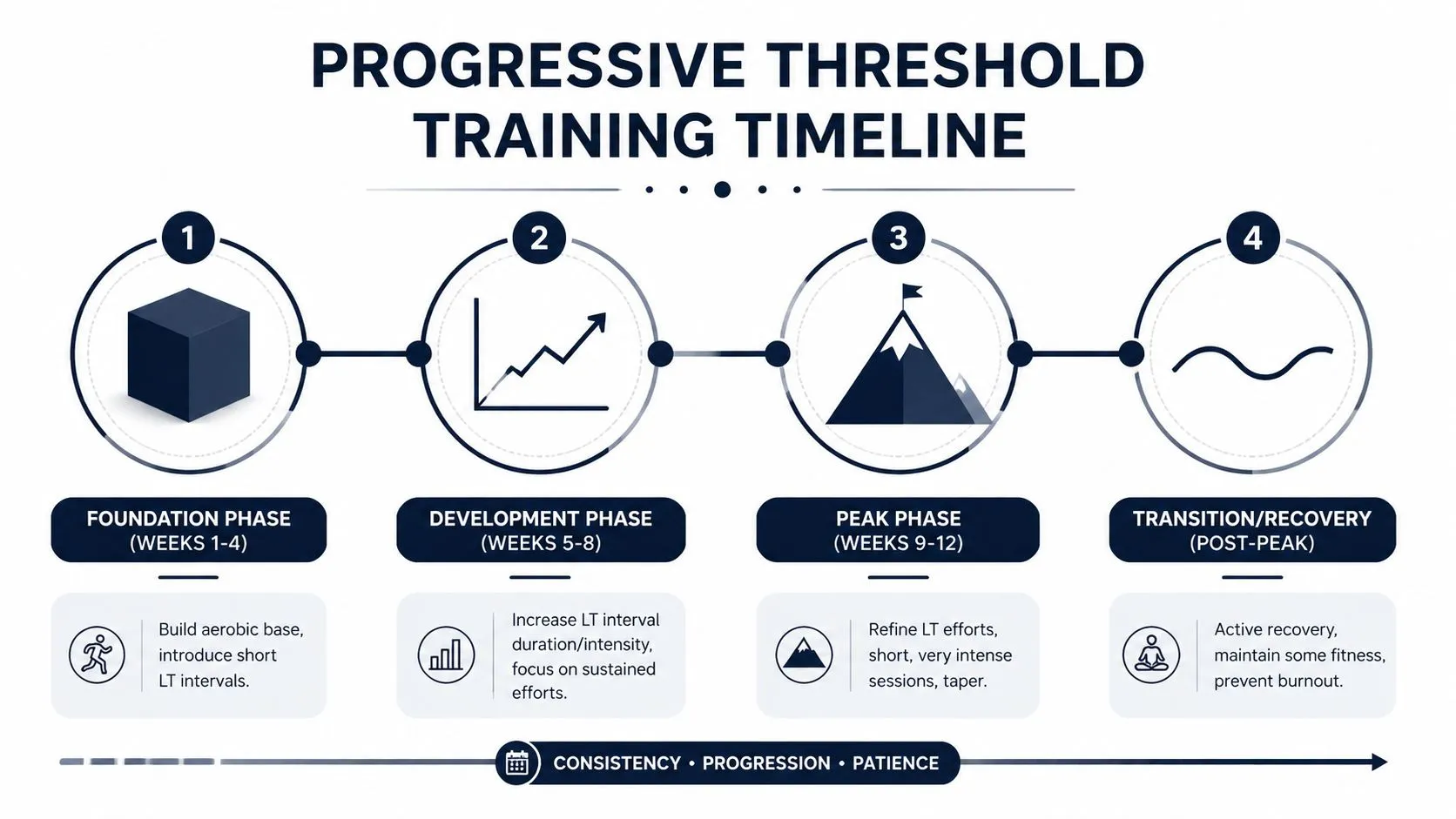
Threshold work stops paying off when it turns into the same session on repeat. The fix is not to force harder reps. Progress comes from changing the stimulus with intention, by extending rep duration, adding reps, or trimming recovery. Those are the three levers that matter most.
How to progress without breaking the workout
A practical coaching rule is to build weekly volume gradually, keeping changes modest rather than piling on stress all at once (ACE Fitness on lactate threshold training). That warning applies to threshold work too. If you raise duration and frequency in the same block, the workout can lose its edge fast. The athlete feels sharp for a week, then flat for the next two.
The cleaner progression is straightforward.
- Start with shorter repeats: keep the reps manageable and technically sound.
- Add duration next: move from 5-minute work toward longer sustained efforts.
- Trim recovery last: only when you are holding the pace or power cleanly.
- Keep easy days easy: if recovery days drift hard, the threshold signal gets muddy.
That last point matters more than many athletes realize. A lot of amateurs turn easy days into moderate days, then wonder why threshold work never lands well. The quality session does not need help from extra gray-zone fatigue. It needs contrast.
A good way to structure that progression is to keep the session simple while the block gets harder. If you want a practical framework for building and adjusting sessions, the running interval training app guide shows how to translate a workout plan into clean, repeatable interval steps without making the setup itself a distraction.
Where threshold fits in a training week
Threshold belongs where you can absorb it. Put it too close to other hard aerobic work and you lose the crispness that makes it useful. Leave it completely isolated from the rest of the week and you may still improve, but not as efficiently.
For most athletes, one to two threshold sessions per week is the practical middle ground. The exact placement depends on race phase, recovery ability, and total workload. Higher-volume endurance plans can use threshold more often, but those setups depend on much more training load and much tighter control than most age-group athletes can handle. That is the trade-off. More threshold can work, but only when the whole system is built for it.
The timeline video below is useful because progression is not one workout getting harder. It is the whole block changing shape over time.
Execute Perfect Workouts with Natural Language
The workout itself can be sound, and still fall apart at the device stage. Drag-and-drop builders waste time, invite mistakes, and make it harder to translate a coach’s note into a session you can trust once you’re standing on the line. A text-first workflow solves that problem because it lets you describe the session the way you’d say it, then turns that into the structured steps your watch or bike computer needs.
Why text beats clunky builders
The main advantage is speed with less friction. Instead of clicking through nested menus, you write the workout in plain language, review the structure, and send it. That matters when you’re preparing threshold work, because the workout only helps if you can execute it exactly as planned.
A text-first workflow is also better for clarity. You can include warm-up, reps, recoveries, and cool-down in one line of notes, which reduces the chance of forgetting the small pieces that make threshold sessions work. That’s especially useful for runners and cyclists who want the same plan to show up cleanly on Garmin or Wahoo hardware.
A simple execution workflow
A practical flow looks like this:
- Write the workout in plain language. Keep the session description short, direct, and specific.
- Check the structure before training. Make sure the repeats, rests, and targets match the plan.
- Sync to the device. Get the structured session onto the watch or head unit before you leave.
- Run the session by the screen. Let the device manage the interval changes so you can focus on execution.
- Review after the workout. Compare what you planned with what you held.
That last step matters because threshold training lives or dies on precision. If the workout keeps drifting, you want to know whether the problem was the target, the day, or the execution.
For a related look at how interval training can be handled in a fast, text-based flow, see this running interval training app walkthrough. The useful idea isn’t novelty. It’s removing the admin drag that slows athletes down before a quality session.
You shouldn’t need a 10-minute workout-builder detour before a 45-minute training session.
Avoiding Common Pitfalls in Threshold Training
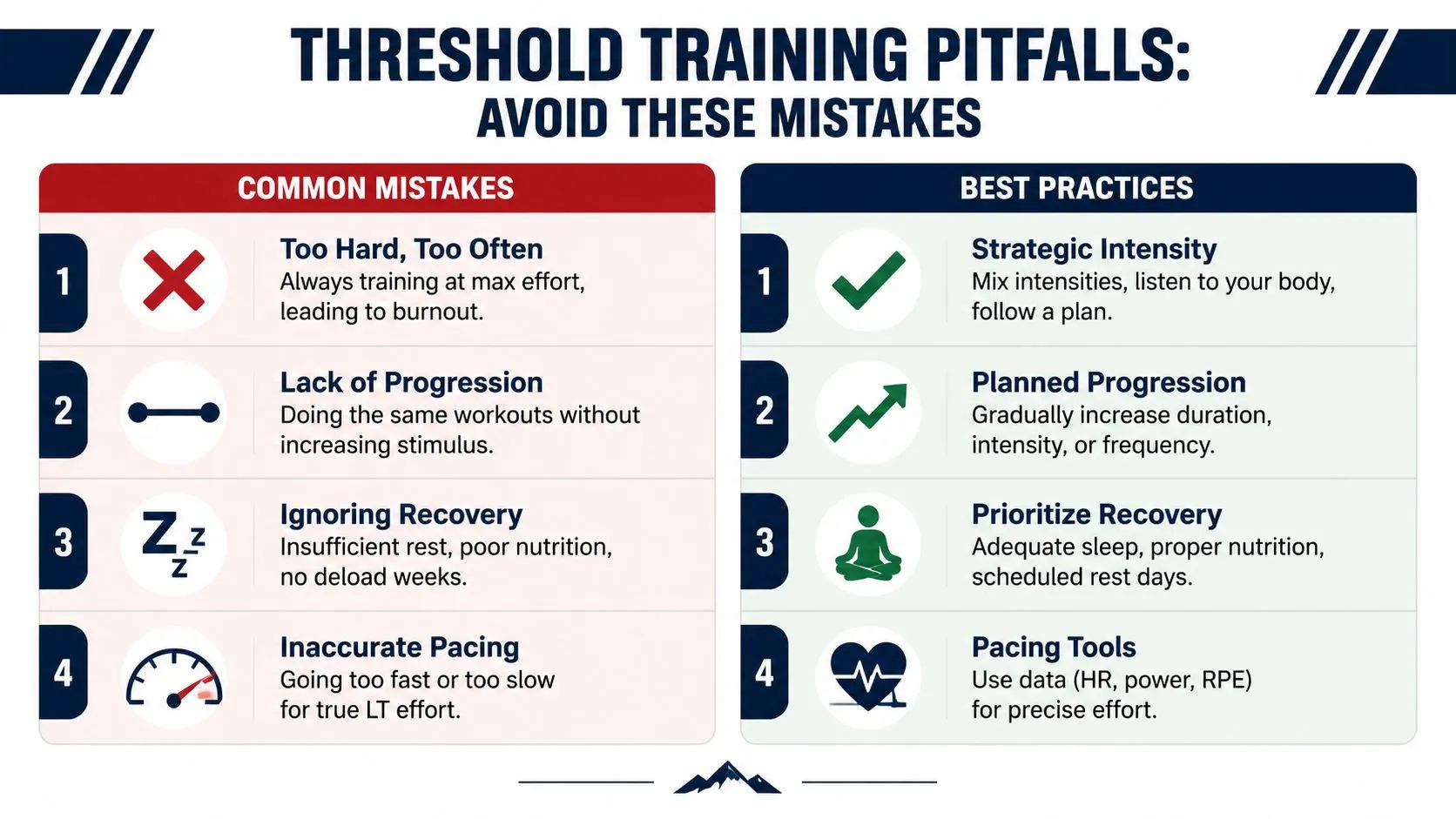
The biggest mistake in threshold training is treating every rep like a test. That turns a controlled workout into a survival effort, and once that happens, the session stops serving the purpose of threshold work. The point isn’t to prove fitness. It’s to stack repeatable work that leaves enough in reserve to come back again.
What goes wrong in real training
Going too hard is the classic error. It usually starts with one rep that feels great, then creeps into the next one, and by the end the workout has become a different session entirely. That’s how threshold turns into VO2max work without you meaning to.
Recovery gets mishandled just as often. High-volume endurance models can use 3 to 4 lactate-guided threshold sessions per week plus 1 VO2max session, with weekly running volume reaching 150 to 180 km and target blood lactate of 2 to 4.5 mmol/L (Polar on lactate threshold). Those numbers show how controlled elite threshold training is, not how reckless it should be in amateur training. If your easy days aren’t easy, you’re not building that kind of control.
Common Mistakes vs Best Practices
| Common Mistakes | Best Practices |
|---|---|
| Too hard, too often | Keep intensity strategic and repeatable |
| No progression | Increase duration, repeats, or density gradually |
| Ignoring recovery | Protect easy days, sleep, and fueling |
| Inaccurate pacing | Use pace, power, heart rate, and RPE together |
Fueling matters too, especially when threshold work sits inside a bigger week. If you start underfed, the workout may still feel hard, but the quality tends to slip earlier than expected. The fix is simple: arrive ready, stay honest about the pace, and stop pretending a sloppy session is a useful one.
The best threshold athletes don’t chase the hardest possible day. They protect the quality of the work, recover well, and come back often enough for the adaptation to stick.
To get your next threshold session onto your device without the builder detour, type it into TextFit in any language: “4 x 5 min at threshold with 1 min jog.” Review the structured workout, then sync it to Garmin or Wahoo through your intervals.icu connection or schedule it on Apple Watch. Free to start, no sign-up needed.