Running Watts Calculator: Estimate Power for Training
You know the feeling. Your watch says you’re on target pace, but the run doesn’t feel remotely the same as it did last week. A small climb turns controlled effort into a grind. A headwind makes a steady tempo feel like a race. Heart rate helps, but it drifts, lags, and reacts after the work has already changed.
That’s where a running watts calculator becomes useful. It gives you a way to estimate the effort behind the pace, not only the speed printed on the screen. Used well, it helps with pacing on hills, structuring intervals, and comparing effort across sessions that would otherwise look messy.
Most runners stop at the formula. That’s only half the job. Full value comes from understanding what the number means, when to trust it, and how to turn it into training decisions that improve your workouts.
Table of Contents
- Beyond Pace and Heart Rate: What is Running Power?
- The Core Formula for Calculating Running Watts
- A Practical Walkthrough with Worked Examples
- Applying Running Power to Your Training
- Common Pitfalls and How to Validate Your Numbers
- The Future of Effort-Based Training
Beyond Pace and Heart Rate: What is Running Power?
Pace is useful, but it’s fragile. The same pace can feel smooth on flat ground and punishing on a climb. Wind changes the cost of the run without changing the target on your watch. Heart rate adds context, but it doesn’t respond instantly, especially when you’re changing gears in intervals.
Running power tries to solve that problem by expressing effort in watts. Instead of asking only how fast you’re moving, it asks how much work your body is doing to produce that movement. That matters because runners rarely train in perfect, repeatable conditions.

Why power changes the conversation
Power is most useful when pace and effort stop lining up. On hilly routes, a pace target often pushes runners too hard uphill and holds them back downhill. In windy conditions, the same thing happens. A power target gives you a steadier ceiling for effort.
That’s why many coaches like it for:
- Hill pacing: You can keep the effort controlled instead of forcing flat-ground pace on a climb.
- Intervals: Short reps work better when the target responds quickly.
- Race management: You can avoid early surges that feel harmless at first but cost you later.
Running power is best treated as an effort governor, not a magic number.
What it is and what it isn’t
A running watts calculator doesn’t measure electricity. It isn’t the same idea as appliance wattage. In training, watts are a way to convert biomechanical and metabolic demand into a single output number that you can use much like cyclists use power.
That makes power especially attractive for athletes who already train across sports. It gives them one language for intensity, even when the motion changes.
Here’s the practical distinction:
| Metric | What it tells you | Main weakness |
|---|---|---|
| Pace | Speed over ground | Doesn’t account well for hills or wind |
| Heart rate | Physiological response | Lags behind sudden effort changes |
| Power | Current workload | Depends on model quality and calibration |
Used alone, every metric has blind spots. Used together, they become much more useful. In practice, power works best when you pair it with pace, terrain, and perceived effort instead of treating it as the only truth.
The Core Formula for Calculating Running Watts
A useful running watts calculator starts with one job. Estimate how much work the runner is doing at a given speed and body mass.
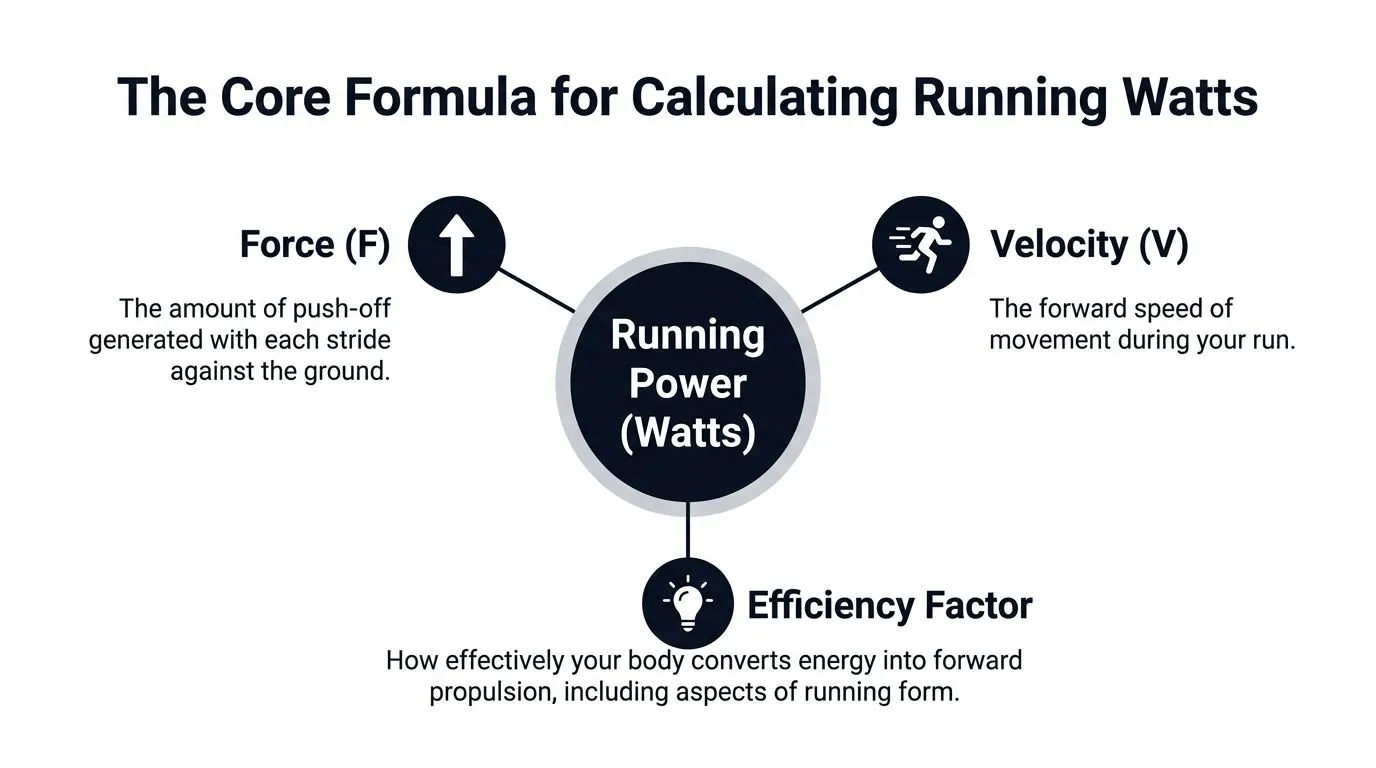
A common baseline uses the ACSM-style approach summarized by Topend Sports on running power calculation: Power (watts) = velocity (m/s) × ECOR × body mass (kg).
In practical terms, that formula gives you a flat-ground estimate. It is not a full description of every stride, every hill, or every device algorithm. It gives you a starting number you can calculate by hand, then compare with what your watch or pod reports in training.
The three inputs that matter most
The formula is simple, but each input changes how useful the result will be.
-
Body mass
More mass usually means more watts at the same speed. That does not mean the heavier runner is working harder relative to fitness. It means the absolute work required to move that body is higher. -
Velocity
Power rises as speed rises. For calculation, pace has to be converted into meters per second. That step matters because a small pace error can shift the final watt estimate more than runners expect. -
Running cost
ECOR, or Energy Cost of Running, represents the energetic cost of moving one kilogram of body mass over one kilometer on flat ground. For steady running on level terrain, calculators often use 1.04 kJ/kg/km as a working value.
This explains a mistake I see often. Runners copy a friend’s target wattage the way they might copy a split chart. Power does not transfer that cleanly between athletes because body mass and running economy change the number.
What the formula looks like in practice
Take a 70 kg runner at 5:00 per kilometer. That pace converts to 3.33 m/s. Plug that into the flat-ground formula and you get roughly 242 watts from 3.33 × 1.04 × 70.
The value of that calculation is not the single number by itself. The value is knowing what drives it. If the same runner speeds up, power goes up. If the same runner carries more body mass, power goes up. If pace backs off, watts fall with it.
That is why I treat the formula as a planning tool first. Before a workout, it helps estimate what a tempo pace or marathon pace should cost. During the session, device power can then confirm whether the runner is staying near the intended effort or drifting too high.
Practical rule: Use the hand calculation for a baseline. Use device power to manage the session in real conditions.
Where the formula holds up, and where it starts to miss
The flat formula works best for level running in stable conditions. Once the route tilts upward, turns technical, or adds strong wind, the estimate becomes less complete.
That limitation matters in workouts. A runner doing uphill threshold reps may see a power number from a watch that sits well above the flat calculation, even at a slower pace. That does not mean the watch is wrong. It usually means the device is accounting for costs the baseline formula leaves out.
So use the core equation for what it does well. It gives you a clear reference point, helps you sense-check calculator outputs, and makes the logic behind running watts easier to trust. Then use field data to decide how that number should guide pacing, intervals, and race execution.
A Practical Walkthrough with Worked Examples
Let’s make the calculator real. Say Alex weighs 75 kg and wants to run at 4:30 per kilometer. The first step is turning that pace into velocity. A 4:30 kilometer pace equals 270 seconds per kilometer, which means Alex is covering 1000 meters in 270 seconds.
That gives a velocity of roughly 3.70 m/s. Once you have that, the flat-ground estimate is simple: multiply velocity by ECOR and body mass. Using the flat-ground model from the earlier section, Alex’s estimated running power is roughly 3.70 × 1.04 × 75, or about 289 watts.
Flat-ground estimate
You don’t need a special tool to understand the logic. The steps are:
- Convert pace to seconds per kilometer.
- Divide 1000 by that number to get meters per second.
- Multiply by 1.04.
- Multiply by body mass in kilograms.
That gives Alex a flat-ground estimate in watts. If you’re building workouts manually, this is often enough to understand whether a planned pace is likely to be aerobic, steady, or hard relative to your own history.
What changes on an incline
Now put Alex on a 3% incline. The flat formula no longer tells the whole story. The cost of running uphill rises because more of the work goes into lifting body mass against gravity, not only moving horizontally.
In coaching terms, pace often gets people into trouble. A runner tries to hold the same split uphill, the actual effort jumps, and the workout stops being what it was meant to be. Power is useful here because it encourages you to cap effort and accept that pace will slow.
For practical training, the move isn’t to chase perfect hand calculations on every hill. It’s to use the flat estimate as a base, then treat uphill sections as requiring more watts for the same pace and downhill sections as requiring fewer.
Downhill and headwind edge cases
A downhill section creates the opposite problem. Pace becomes easier to maintain, but the metabolic cost doesn’t rise the same way it would on flat ground. If you pace only by watts on a steep descent, some runners end up over-braking or running awkwardly. The better choice is to use power as a guide, then let form and control matter more on sharper descents.
Wind is another edge case. The aerodynamic drag term can be modeled as 0.5 × air_density × drag_coefficient × frontal_area × velocity² × speed, which is noted in the Hashiri explanation of running power errors and drag. You don’t need to solve that by hand on the sidewalk. You do need to respect the implication. A strong headwind can make the same pace cost meaningfully more energy than the flat model suggests.
If your run into a headwind feels harder than the displayed pace says it should, trust the effort problem you’re feeling. The environment changed the cost.
A running watts calculator is most valuable when you use it to improve decisions, not when you expect it to produce laboratory perfection on every road and trail.
Applying Running Power to Your Training
A watch can show 320 watts on the first hill of a workout, but that number only matters if it changes what you do next. Good power training starts there. Use the number to control effort, not to collect another metric.
Most runners will not calculate watts by hand before a session. They will train from a foot pod or watch estimate, then compare that number against the goal of the day. Used well, running power fills the gap between theory and execution. It gives you a target that usually travels better than pace when the route rolls, the wind shifts, or fatigue starts to distort split times.
The biggest payoff is in sessions where pace gets noisy. Intervals on mixed terrain, progression runs, long marathon workouts, and hilly race pacing all become easier to coach with power because the target stays tied to output rather than raw speed.

Set a personal anchor before using zones
Generic power zones are not much use. A threshold-based system works only when the threshold belongs to the runner wearing the watch.
Once that anchor is set, the number becomes practical fast. I use it most often for sessions like these:
- Steady intervals: hold a narrow power band across reps instead of chasing exact splits
- Hill reps: keep the effort hard enough to do the job without letting the first rep turn into a sprint
- Long runs: stop gentle climbs and false flats from pushing an aerobic run into threshold territory
- Race pacing: avoid early spikes that feel manageable for five minutes and cost you in the final 10K
Where multisport athletes get extra value
Power is especially useful for athletes who train on the bike and run in the same week. The language carries over. Alan Couzens’ discussion of run power equivalence is a good example of why coaches like a shared framework across both sports.
The numbers are not interchangeable, and treating them that way is a mistake. Bike power is measured at the crank or pedal. Run power is estimated from motion and environment. Still, the habit of pacing by output instead of by speed transfers well, especially for triathletes managing fatigue across disciplines. If you also train on the bike, it helps to understand how power-to-weight ratio in cycling affects pacing and intensity on the other side of your week.
How to structure workouts with power
Start with the purpose of the session. Then assign the power range.
That order matters because power is a tool for delivering the right stress, not a reason to force the same number into every workout. A threshold session needs control. A short hill session needs restraint early and repeatability late. A long run with fast finish work needs a clear rise in output near the end, not random surges every time the terrain changes.
A practical setup might look like this:
- Cruise intervals: choose a controlled threshold range and keep each rep inside it
- Short uphill reps: let pace slow on steep sections, but cap power so the session stays repeatable
- Progression long run: raise watts through the final block instead of forcing arbitrary mile splits
I see one mistake often. Runners get a new power number, then start chasing it as if every workout is a test. That usually leads to sessions that are too hard on good days and strangely frustrating on tired days. The better use is narrower and more disciplined. Use power to keep easy work easy, quality work specific, and race effort under control in the early miles.
For racing, power helps most before fatigue clouds judgment. On the first climb, into the first headwind, or during the opening 20 minutes when adrenaline pushes pace too high, a watt target can keep you honest. Later in the race, power still has value, but perceived effort and form deserve more weight because the sustainable number changes as the body fades.
Common Pitfalls and How to Validate Your Numbers
You finish a tempo run, check the file, and the watts look clean. The problem is that clean data can still be wrong. A running watts calculator gives you an estimate of external output, and that estimate only helps if the baseline behind it matches your current fitness and the conditions of the run.
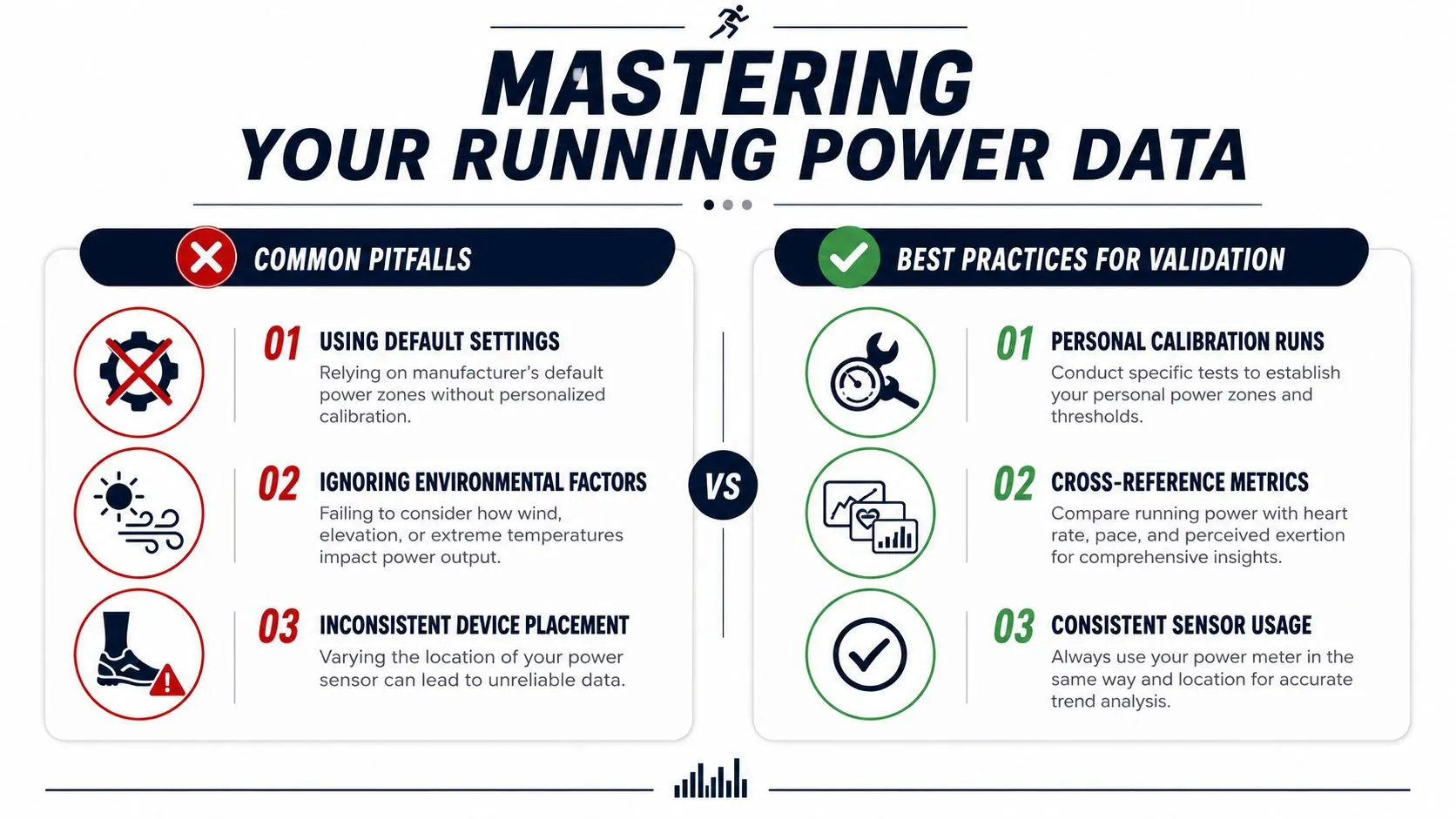
The first mistake is simple. Runners accept the first threshold number their watch or platform suggests, build zones from it, and start training as if those zones are settled. As noted earlier in the Hashiri guide to running power estimation, threshold values such as rFTPw or critical power need calibration and periodic retesting. If that anchor is off, the workout prescription is off too.
The errors I see most often
Three patterns show up again and again in real training files:
- Default zones with no check: The device assigns ranges, and the runner never tests whether threshold work feels like threshold work.
- No context for terrain or weather: A watt target from a calm flat route gets copied onto hills, soft ground, or a windy day without adjustment.
- Too much faith in exactness: The runner treats 3 to 5 watts as decisive when the bigger question is whether the effort was controlled, sustainable, and repeatable.
Wind is a good example. On a blustery day, the same pace can cost much more than it did on a sheltered route. Treadmills create a different issue. Some runners see lower or smoother power indoors and assume fitness changed, when the actual difference is the environment and the way the device estimates motion.
How to build trust in the metric
Validation works best as a coaching check, not a math exercise. Compare power against sessions you already understand well.
| Check | What you want to see |
|---|---|
| Easy run | Power lines up with relaxed breathing and an effort you could hold for a long time |
| Threshold session | The target feels hard but controlled, and the last rep looks similar to the first rather than collapsing |
| Hilly route | Power stays more stable than pace, especially on climbs and descents |
| Windy day | Higher watts explain why a familiar pace suddenly feels expensive |
One good session does not validate the metric. A pattern does.
I want to see the same relationship show up across two or three weeks. Easy days should land in a familiar band. Steady sessions should stop drifting into race effort. If the numbers keep disagreeing with perceived effort, pace, and heart rate on well-known routes, something needs to be reset. Usually that means retesting threshold, checking device settings, or accepting that a specific route is too noisy for precise comparisons.
Runners who also train on the bike often understand this faster, because threshold setup follows the same logic as a cycling FTP calculator and update process. The estimate matters less than whether it gives you usable training ranges that hold up in repeated workouts.
The final check is consistency. Use the same device, keep your setup stable, and compare like with like. Similar routes, similar shoe types, and similar session goals make power far more useful. You are not trying to prove the number is perfect. You are trying to confirm that it is reliable enough to pace intervals, cap overreaching, and judge race effort before mistakes get expensive.
The Future of Effort-Based Training
The best reason to use a running watts calculator isn’t that it gives you another number. It’s that it gives you a better way to interpret effort when pace and heart rate stop telling the full story.
For training, power helps most when the session has a clear purpose. It can keep hill reps honest, control overreaching in tempo work, and improve pacing on uneven courses. For racing, it gives disciplined runners a way to avoid wasting energy in the wrong places.
That doesn’t mean power replaces everything else. It works best alongside pace, heart rate, route knowledge, and perceived effort. Coaches who get the most from it don’t worship the wattage. They use it to make cleaner decisions.
That’s where effort-based training is heading. More athletes want metrics that reflect the real cost of the run, not only the speed on ideal terrain. If you’re already building structured sessions on your watch, power is worth testing in a small, controlled way first. A few weeks of consistent use will tell you quickly whether it improves your pacing and workout execution.
If you’re also refining how you plan sessions, a dedicated running interval training app can make it much easier to turn power targets into workouts you can follow on the run.
If you want to run those power sessions from your watch instead of your memory, type the workout into TextFit the way you’d say it, in any language: “15 min easy, 6 x 4 min hard with 2 min jog, 10 min easy.” AI turns it into a structured workout you review and tweak, then it syncs to Garmin or Wahoo through intervals.icu, or schedules on Apple Watch. Free to start, no sign-up needed.