Watt Per Kilo: Calculate, Benchmark, and Improve W/kg
You’re probably here because you know this feeling. The group ride is smooth on the flats, you’re taking pulls, chatting, feeling fine. Then the road tilts upward and the whole mood changes. A few riders seem to float away while you’re staring at your head unit, breathing hard, wondering why the same legs that felt strong ten minutes ago suddenly can’t hold the wheel.
That moment pushes a lot of riders toward one number: watt per kilo. It sounds technical, but the idea is simple. It helps explain why one rider climbs better, how to compare riders of different sizes, and what kind of training target matters when the road goes uphill.
It’s also a metric people misunderstand all the time. Some riders obsess over losing weight when they should be building power. Others use watt per kilo as if it explains every kind of cycling performance, even on flat roads or indoor platforms where raw power matters more.
Table of Contents
- The Secret to Climbing Faster in Cycling
- What Is Watts Per Kilo and How to Calculate It
- W/kg Benchmarks: What Is a Good Power-to-Weight Ratio
- When W/kg Matters Most and Its Limitations
- Three Proven Strategies to Improve Your W/kg
- Tracking W/kg and Building Power-Based Workouts
The Secret to Climbing Faster in Cycling
On a climb, cycling gets brutally honest. Drafting helps less, momentum fades, and every extra bit of body mass has to be carried uphill. That’s why riders who look ordinary on the flat can suddenly become untouchable when the gradient kicks up.
A rider in your group might not have a huge sprint. They might not even be the strongest person in an all-out short effort. But if they can produce a lot of power relative to their body weight, they’ll usually climb better. That’s the heart of watt per kilo.
Why climbs expose the truth
Think of two riders with similar fitness but different body sizes. If both are working hard uphill, the one who produces more usable power for each kilogram of body weight usually has the edge. On hills, that balance between power and mass becomes the performance story.
That’s why climbing-focused riders talk about this number so much. It gives you a practical way to understand what your body can do on gradients, and it gives coaches a way to compare athletes fairly across different sizes.
Practical rule: If your biggest weakness shows up when the road points upward, watt per kilo is one of the first metrics worth checking.
It turns frustration into a training target
It isn’t only a label. It gives you something trainable. If you get dropped on climbs, you don’t have to reduce that to “I’m a bad climber.” You can start asking better questions.
- Is your sustainable power too low? You may need more threshold and climbing-specific work.
- Is body weight part of the picture? It might be, but only if changing it doesn’t reduce your power.
- Are you riding climbs poorly? Pacing matters, especially if you surge early and crack later.
Structured climbing intervals help because they teach you to hold steady power when the sensation says back off. If you want ideas for that kind of work, this guide to an interval training bike workout is a useful next step.
Most motivated amateurs don’t need more mystery. They need a number they can measure, understand, and improve. Watt per kilo gives you that, especially when climbing is where your rides come apart.
What Is Watts Per Kilo and How to Calculate It
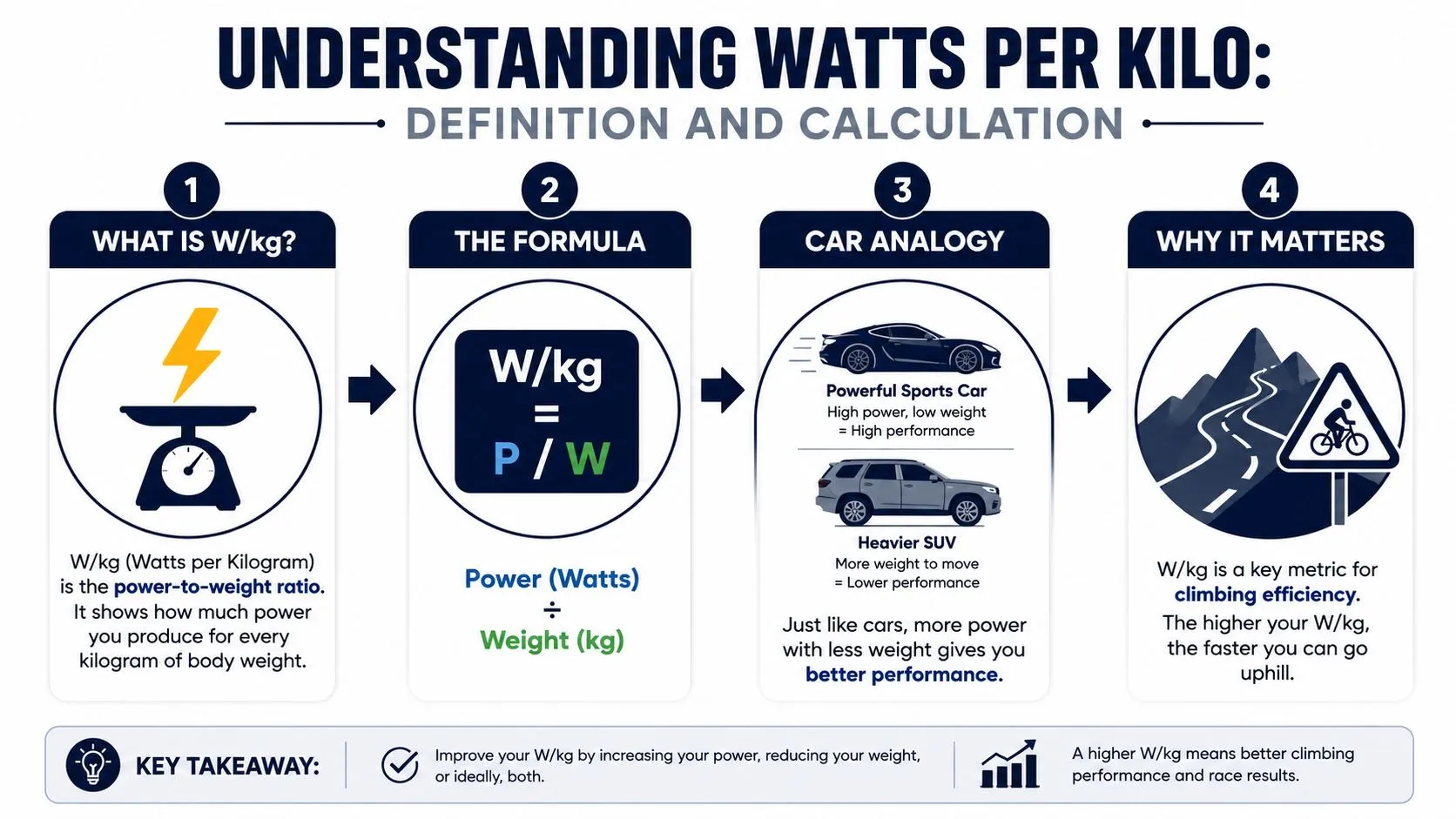
Watts per kilo is your sustainable cycling power divided by your body weight in kilograms. That’s it. If an 80 kg rider sustains 280 watts, that equals 3.5 W/kg, as explained in Wattbike’s guide to watts per kilo.
The easiest way to understand it
Use a car analogy. A strong engine matters, but so does how much weight that engine has to move. A lighter car with enough power can feel quicker and climb better than a heavier vehicle with similar output. On a bike, your legs are the engine and your body is part of the load.
That’s why watt per kilo matters so much in cycling. It combines the two things that decide climbing: how much power you produce, and how much mass you carry uphill.
How to calculate your own number
You need only two inputs:
- Your power output in watts
- Your body weight in kilograms
The formula is straightforward:
| Item | Example |
|---|---|
| Power | 280 watts |
| Weight | 80 kg |
| Calculation | 280 ÷ 80 |
| Result | 3.5 W/kg |
If you ride with a power meter or smart indoor trainer, you already have the power side of the equation. Weight is even simpler. Use a reliable scale and record your current body weight in kilograms.
Which power number should you use
Many riders find this confusing. Don’t use your best sprint. Don’t use a random average from a coffee ride. You want a number that reflects maximum sustainable power.
A practical way to estimate it is a 20-minute all-out test. According to Wattbike, riders can record their average power during a 20-minute effort, and their one-hour sustainable power is typically around 5% lower. Their example shows that a 20-minute average of 275W converts to about 260W for one hour. The same source also notes that a 5-minute maximum is often roughly 10% higher than the 20-minute result. If you want a fuller walkthrough of testing protocol, this guide to a cycling FTP test lays it out clearly.
A useful habit is to test under similar conditions each time. Same trainer, similar freshness, similar fueling.
A simple worked example
Let’s say you complete a hard 20-minute test and average 275 watts. You estimate your one-hour sustainable power at roughly 260 watts. If your body weight is 80 kg, your watt per kilo is:
260 ÷ 80 = 3.25 W/kg
That number is far more useful than saying, “I can hold around the mid-200s.” It gives context. It tells you more about climbing potential and lets you compare yourself meaningfully over time.
The key is consistency. Use the same method each time so your trend means something.
W/kg Benchmarks: What Is a Good Power-to-Weight Ratio
Once you know your number, the next question is obvious. Is it good?
The honest answer is that it depends on who you are, how old you are, and what kind of rider you want to become. A beginner aiming to finish fast group rides doesn’t need the same benchmark as a racer chasing elite results. Still, broad ranges are useful because they give your training a realistic frame.
A benchmark table you can actually use
For one-hour power, benchmark ranges commonly line up like this:
| Category | W/kg |
|---|---|
| Off the couch | 1.0 |
| Beginner | 2.0 |
| Solid amateur | 3.0 |
| Strong amateur | 4.0 |
| Approaching domestic professional level | 5.0 |
| WorldTour level | Above 6.0 |
These benchmark levels are described in Bicycling’s breakdown of good watts per kilogram by age, which also notes that most casual riders tend to fall in the 2 to 3 W/kg range, while riders who train regularly often reach 3 to 3.5 W/kg.
That should reassure a lot of amateurs. If you’re around the low-to-mid threes, you’re not weak. You’re in the range many trained riders live in.
Age changes the picture
A number only becomes meaningful when it’s matched to context. Age matters a lot. The same Bicycling benchmarks note that riders in their 50s typically sustain about 3.0 to 3.5 W/kg, with 4.0+ considered top-end. Riders in their 60s commonly fall around 2.8 to 3.2 W/kg, and riders in their 70s often sit between 2.4 and 2.8 W/kg, with 3.2+ considered excellent.
That matters because many cyclists compare themselves to younger riders and conclude they’re underperforming when they’re doing well for their age group.
If you’re a masters rider, compare yourself to masters benchmarks first. That creates better goals and better decisions.
Gender matters too
Female cyclists generally sit about 0.5 to 0.7 W/kg lower than male counterparts across age groups in the same Bicycling benchmark set. That isn’t a value judgment. It’s context. If you ignore it, you’ll set targets that are unrealistic or poorly calibrated.
A strong female amateur with a lower headline number than a strong male amateur may still be performing at a similarly high level relative to her competitive field.
What number should you aim for
That depends on your ambition.
- If you’re new to structured training, focus on moving toward the solid amateur range.
- If you already ride consistently, pushing toward the strong amateur range is a meaningful goal.
- If you’re highly committed, the same source notes that riders with average genetics who train 12 to 18 hours weekly can realistically reach 4.0 to 4.5 W/kg.
The number itself isn’t the whole story. But it does give you a reliable compass. The important part is using it to set goals that fit your age, your background, and the kind of riding you do.
When W/kg Matters Most and Its Limitations
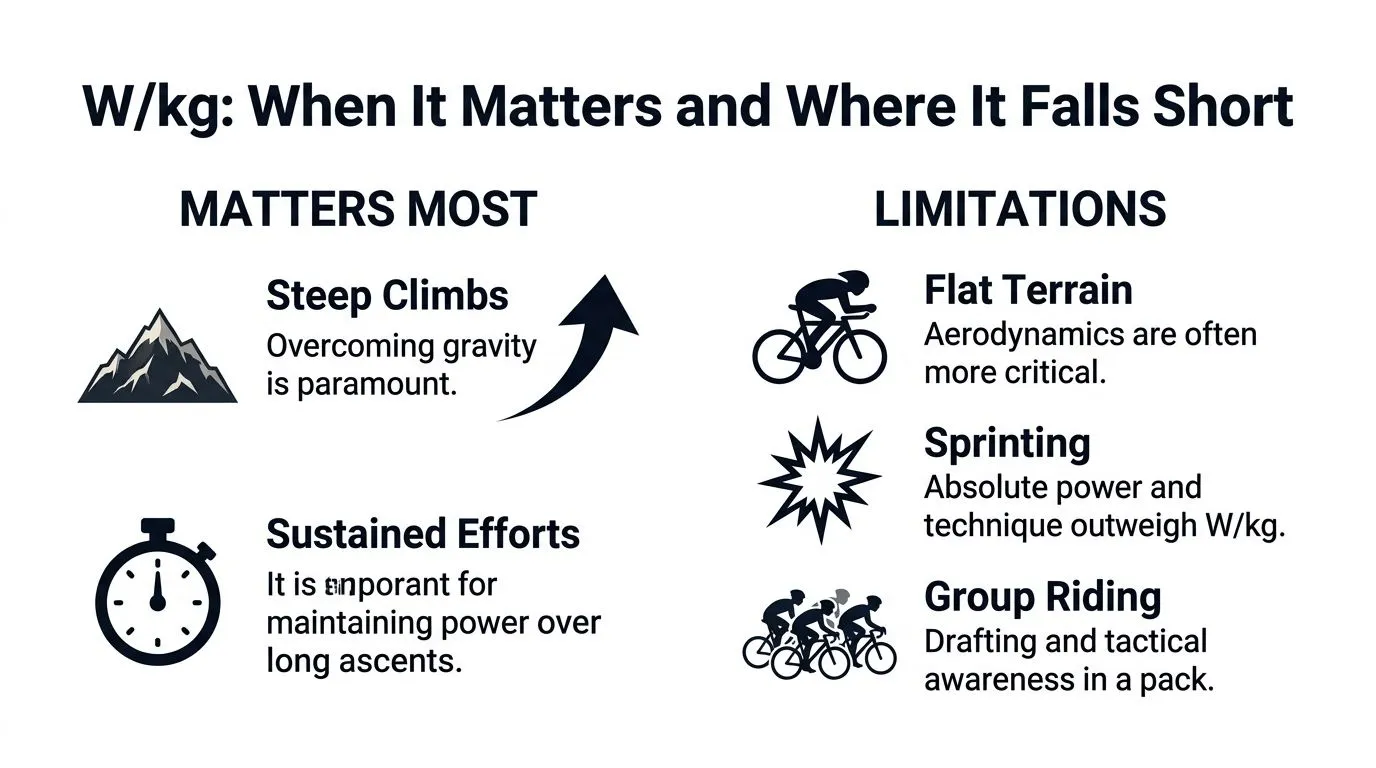
Watt per kilo deserves its reputation. On steep climbs, it’s the right metric to respect. Gravity is the main resistance there, so your ability to produce power relative to body weight directly affects how fast you go uphill.
But riders get into trouble when they turn a good metric into a universal one.
Where watt per kilo is king
Long climbs, repeated climbs, mountain sportives, and uphill finishes all reward a high power-to-weight ratio. If two riders are equally skilled and equally well-paced, the rider with the better climbing power relative to body mass usually gets to the top first.
That’s why climbers, coaches, and training plans aimed at hilly events pay close attention to it. It’s also why the number has become such a central part of cycling culture.
Where it starts to mislead riders
Take the same rider off a steep climb and put them into a flat road race, a fast solo effort, or a virtual race on mostly level terrain. Suddenly, the equation changes. Wind resistance and momentum matter more. In those situations, raw watts often matter more than watt per kilo.
A useful example comes from a discussion of a 2025 study on U23 and professional cyclists, which found that race success correlated better with a Compound Score, defined as 5-minute power multiplied by W/kg at that power, than with W/kg alone. The same source also notes that on flat terrain, a 190 lb rider needs only 4.6% more raw watts than a 150 lb rider to hold the same speed at 20 MPH. That’s a much smaller gap than many riders assume, especially compared with climbing scenarios, as discussed in this analysis of Compound Score and flat-terrain performance.
That should change how you think about performance. A heavier rider can have the same watt per kilo as a lighter rider while also producing more absolute power. On climbs, the lighter rider may still shine. On flat roads, the heavier rider’s raw power can become a real advantage.
Chasing a lower body weight without protecting power can make you a worse rider for flat events, rolling races, and many indoor sessions.
Why indoor and virtual riders get confused
Many indoor riders hear constant talk about watt per kilo and assume it should dominate every training decision. That isn’t always true. If your events aren’t decided by long climbs, reducing body mass at the expense of power can be a bad trade.
For flat racing and many virtual scenarios, a better question is not “How light can I get?” but “Can I increase power without harming durability, repeatability, or fueling?”
A better way to use the metric
Use watt per kilo as a context-specific tool.
- Climbing events: It’s central.
- Flat races and fast group rides: Raw watts and aerodynamics matter a lot.
- Short hard racing: Repeatable power and tactical timing can matter more than scale weight.
- Mixed terrain: You need both enough relative power for climbs and enough absolute power to drive speed elsewhere.
The smartest riders don’t reject watt per kilo. They stop treating it like the only number that counts.
Three Proven Strategies to Improve Your W/kg
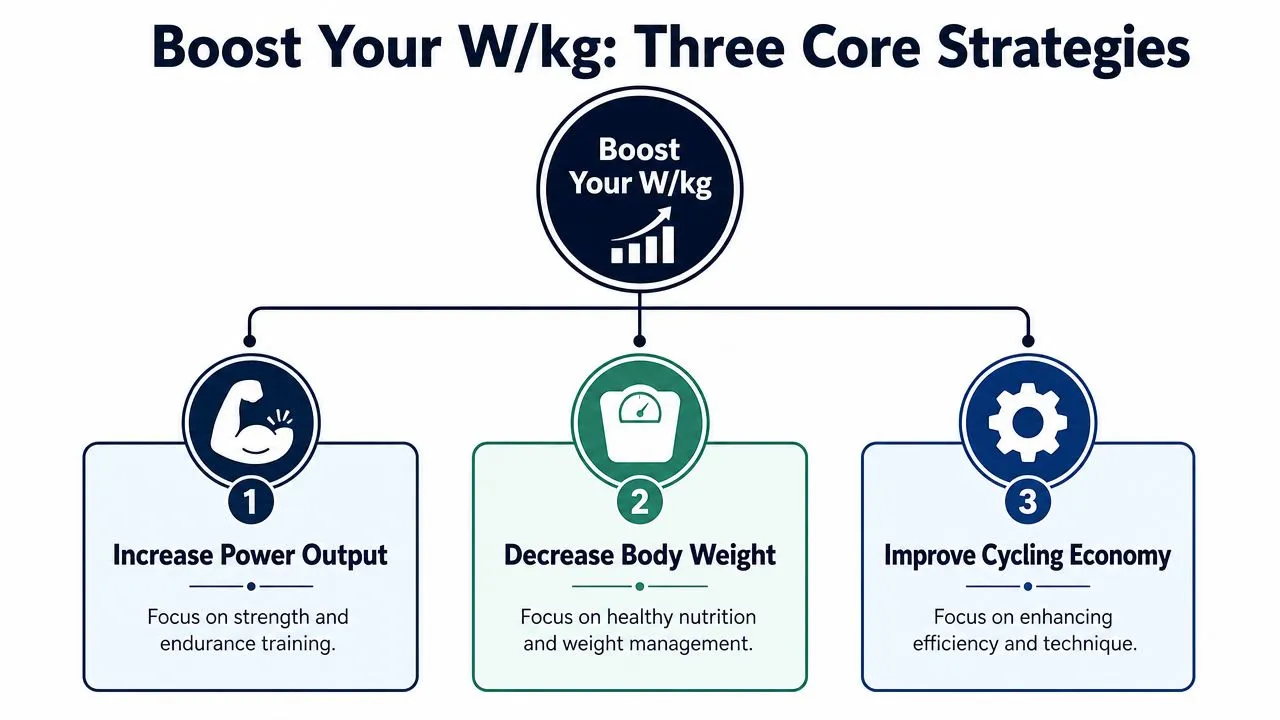
There are only three physiological pathways to improve watt per kilo: increase power while maintaining weight, decrease weight while maintaining power, or do both at the same time, according to TrainerRoad’s explanation of how to improve power-to-weight ratio for cyclists.
That simplicity is useful. It keeps you from chasing gimmicks. Every effective plan fits one of those three paths.
Increase power and hold body weight steady
This is the cleanest path for riders who are already lean or who race terrain where raw power matters a lot. You don’t chase the scale. You build the engine.
That usually means structured intervals based on your current threshold or race demands. Sustained efforts near threshold help lift your durable aerobic power. Harder efforts above threshold help you tolerate repeated surges and steep ramps.
A practical weekly mix might include:
- Threshold intervals: Longer steady efforts to improve sustainable climbing power
- Sweet spot work: Sub-threshold training that builds a lot of fitness with manageable fatigue
- VO2-focused efforts: Harder aerobic intervals that raise your ceiling
This path suits riders who tend to underfuel or riders who already notice that weight loss quickly hurts training quality.
Decrease weight and keep power intact
This path sounds easier than it is. The trap is obvious. If you lose body weight but lose power at the same time, your watt per kilo may barely improve, or your real-world riding may get worse.
For most recreational riders, TrainerRoad notes that the most effective approach is fat loss while preserving lean muscle mass through targeted strength training and structured power-based intervals. That’s the key distinction. You’re not trying to become smaller at any cost. You’re trying to become lighter without stripping away the tissue and energy systems that make you fast.
Coaching note: If your workouts start feeling flat, your recovery worsens, and your top-end power disappears, your nutrition strategy is probably too aggressive.
Focus on habits you can repeat. Fuel demanding sessions well. Keep protein intake supportive of recovery. Use strength work to hold onto muscle and force production. Avoid the mindset that every lighter weigh-in is automatically a performance win.
Here’s a useful reminder before you change body weight on purpose:
Improve both at the same time
For many amateurs, this is the sweet spot. You aren’t trying to become a pure climber overnight. You’re trying to train well, improve sustainable power, and gradually reduce non-functional body fat.
This usually works best when the deficit is modest and training quality stays high. If the deficit is too large, interval quality falls. If training stress is too high without enough recovery, progress stalls.
A combined approach often looks like this:
- Train with purpose using structured intervals rather than random hard rides.
- Lift consistently to preserve lean tissue and support force production.
- Fuel the work so key sessions stay productive.
- Let body composition change slowly instead of forcing it.
How to choose the right strategy
Your best path depends on your current body composition, event demands, and response to training.
| Situation | Best starting focus |
|---|---|
| Already lean, targeting climbs or TTs | Increase power |
| Carrying extra body fat, power is stable | Reduce weight carefully |
| General amateur rider wanting better all-around climbing | Improve both gradually |
The mistake is picking a strategy that flatters your psychology instead of your physiology. Many riders like the feeling of “doing something” by eating less. Fewer riders are patient enough to build power over months. But power is usually the bigger prize, and when weight loss is useful, it has to protect that prize.
Tracking W/kg and Building Power-Based Workouts
Tracking watt per kilo doesn’t need to be complicated. If you use a power meter, smart trainer, Garmin device, Wahoo head unit, or training platform like Strava, you can usually monitor your power trends and pair them with body weight over time. The important part is consistency. Use the same testing method, weigh under similar conditions, and judge the trend over weeks rather than reacting to a single ride.

Turn numbers into actual sessions
A lot of riders understand the concept but never turn it into training. They know they need more sustainable power, but their workouts stay vague. “Ride hard on the climb” isn’t a plan. “Do 4x8 minutes at 95% of FTP with controlled recovery” is.
That’s where structured workouts matter. If your watt per kilo goal is tied to climbing, your sessions need repeatable targets, clear recoveries, and enough progression to move fitness forward.
You can also use a dedicated calculator when you want a quick check on the number itself. This W/kg and FTP zones calculator helps make the math practical.
Keep the feedback loop simple
A good system has only a few parts:
- Test occasionally: Use the same style of hard effort so the comparison stays meaningful.
- Record body weight sensibly: Don’t let daily fluctuations distract you from the larger trend.
- Build workouts around the limiter: If climbs are the problem, train sustained power. If repeated surges break you, train that specifically.
- Review performance on real rides: The number matters only if it improves how you ride.
You don’t need ten dashboards. You need a usable process and enough patience to let training work.
If you want to turn those numbers into sessions, TextFit does the structuring for you. Type the workout the way you’d describe it, in any language: “4 x 8 min at 95% FTP with 4 min easy”. You get a structured workout to review, then it syncs to your Garmin or Wahoo and schedules on Apple Watch. Free to start, no sign-up needed.