Triathlon Interval Training: A Practical Guide for 2026
You’re standing over a bike on a Tuesday morning, phone in one hand, watch in the other, trying to turn a coach’s note into something your Garmin will execute. The workout is clear enough in your head, but the details are scattered across a PDF, a training app, and a memory you’d rather trust less than you do. That gap is where triathlon interval training gets messy. The fitness work is only half the job. The other half is making the session real enough to follow under fatigue.
Racing soon? Two free tools cover race-day logistics: the sweat rate calculator tells you how much to drink per hour, and the fueling calculator turns your goal pace into a carbs-per-hour target and the gels to carry.
Table of Contents
- Why Triathlon Interval Training Feels Harder Than It Should
- The Three Interval Bands That Drive Triathlon Fitness
- Swim, Bike, and Run Sessions You Can Use This Week
- Designing Brick Sessions That Actually Work on Race Day
- From a Text Description to a Synced Workout
- Periodization, Frequency, and Tapering Around the Race
- Putting It All Together and Your Next Session
Why Triathlon Interval Training Feels Harder Than It Should
The hard part usually isn’t finding a workout. It’s translating a good workout from one place into another without losing the point of it. A triathlete might read a session on a coach’s PDF, scribble part of it into a calendar, then rebuild it again on a watch right before training. That’s where precision gets diluted, and precision is what interval work depends on.
The real friction is not effort, it’s format
Triathlon training is already split across swim, bike, and run, so the athlete is juggling different pacing rules, different recovery habits, and different devices. Modern coaching uses sub-threshold, threshold, and tempo bands because they map to physiological targets like FTP, lactate threshold pace, and race-pace work, not just “hard” or “easy” effort. That distinction matters because a workout that looks simple in plain text can become ambiguous when you’re trying to execute it on the fly, especially when the bike wants power targets and the run wants pace.
Practical rule: if a session can’t be executed the same way twice, it’s not a useful interval session yet.
The second friction is pacing. Coaches now specify interval length and intensity in exact terms, such as 5 to 20 minutes for sub-threshold work, 3 to 5 minutes for threshold efforts, and 10 to 30 minutes or longer for tempo blocks, with shorter VO2max-style work built around much tighter intensity bands. Those ranges aren’t decoration. They’re the difference between a session that builds the right energy system and one that only feels hard.
The third friction is device setup. Most triathletes don’t want to spend twenty minutes recreating intervals they already understand. They want the workout to appear as steps, recoveries, and repeats on the device, then get out of the way. That’s why tools that turn a plain-language workout into a structured session matter, and why interval training advantages for triathletes are mostly about removing the administrative half of the process, not replacing coaching judgment.
The Three Interval Bands That Drive Triathlon Fitness
The cleanest way to think about triathlon interval training is to stop calling everything “intervals.” Most useful sessions fall into a small number of bands, and each band has a job. If you know the job, you can write the session correctly and put the right target on the watch.
Sub-threshold, threshold, and tempo each solve a different problem
Sub-threshold work usually sits in the 5 to 20 minute range on the bike and run. It’s the kind of training that sits below the redline but still asks for control, and it maps well to FTP, lactate threshold pace, and race-pace work. Threshold efforts are shorter, usually 3 to 5 minutes, and they’re useful when you want a stronger concentration of stress without turning the workout into a sprint session. Tempo blocks are longer, often 10 to 30 minutes or longer, and they’re a staple when you want steady repeatable work rather than a lot of stop-start disruption.
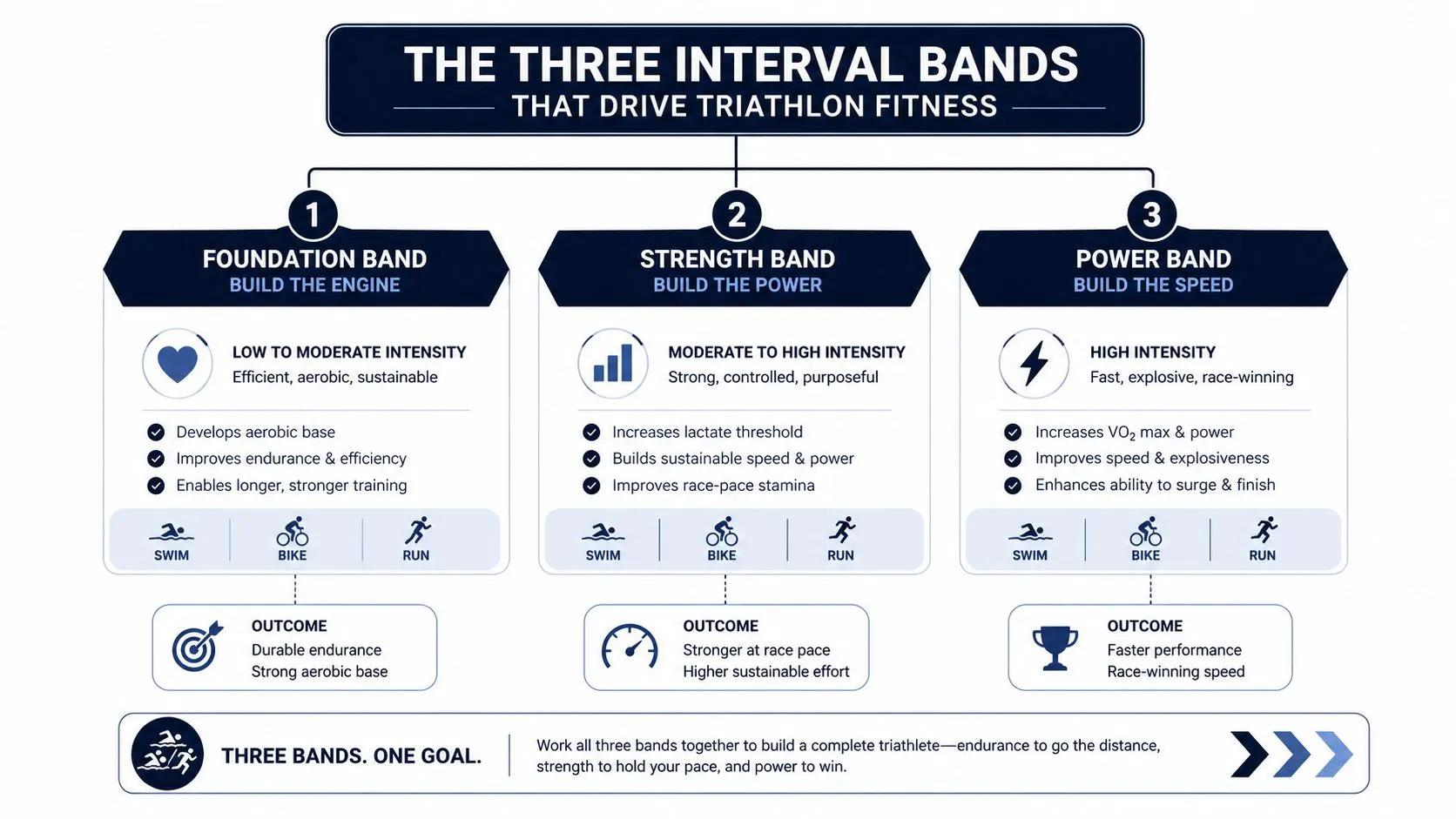
The sharper end of the spectrum is usually described by energy system, not just duration. Coaches often use long intervals of 1 to 6 minutes at about 90% to 105% of vVO2max, while shorter intervals may sit around 100% to 120% of vVO2max with active recovery. That structure matters because triathletes need aerobic durability and speed stimulus across all three disciplines, not one universal pain cave.
Work and rest have to match the goal
VO2max work is where many athletes make sessions either too soft or too chaotic. A practical benchmark is to keep long intervals at least 2 minutes and use work:rest ratios near 1:1 for VO2max development, such as 8×2 minutes on, 2 minutes off or 6×3 minutes on, 3 minutes off at about 90% to 100% of vVO2max. Shorter intervals need a larger work:rest ratio, such as 60 seconds on, 30 seconds off at roughly 100% to 120% of vVO2max with active recovery, so oxygen uptake stays high.
For triathletes, that difference isn’t a technicality. A longer repeat with equal recovery trains a different demand than a short, sharp repeat with active recovery. If the watch shows the wrong recovery length, the session changes before you even start.
Threshold workouts for triathletes are often where the most race-relevant gains get built, because they sit in the narrow space between control and overload. That’s also why a session description needs to state the target clearly enough that you don’t have to interpret it mid-workout.
Swim, Bike, and Run Sessions You Can Use This Week
The best sessions are simple enough to repeat and specific enough to matter. For triathletes, that usually means one clear purpose per session, one pace or power target, and recoveries that don’t force improvisation halfway through the set.
Swim and bike sessions reward clarity
A swim session often works best when the repeats are tidy and the intent is obvious. One useful pattern is a threshold or tempo set built as a 3x3-style structure, where the point is to stay controlled rather than chase chaos in the lane. In the pool, the write-up should be simple enough that you can glance at the pace target once and keep the set moving.
On the bike, the session library gets more specific. One classic workout is 5×60 seconds at 150% of critical power or FTP with 30 seconds recovery. Another is 6 to 8×60 seconds at 120% of CP or FTP with 30 seconds recovery for athletes with stronger aerobic profiles. There’s also a longer endurance-oriented example from a triathlon study, where bike interval intensity sat at 80% of maximal aerobic power (MAP) with 60-second recoveries, and the total interval work was 30 to 40 minutes. That range works when you want a bigger sustained load without turning the day into a pure speed session.
Coach’s note: if the recovery is so long that your breathing resets completely, the workout usually stops being the same workout.
The run needs a different rhythm
Run intervals punish sloppy pacing faster than bike work does. A practical entry point is 8×2 minutes on, 2 minutes off at about 90% to 100% of vVO2max, or 6×3 minutes on, 3 minutes off when you want the same intensity with longer concentration. Shorter and sharper work can move to 60 seconds on, 30 seconds off with active recovery, but the pace has to stay repeatable rather than heroic.
That’s the true test of whether a run set is useful. If the first two reps are too fast, the session becomes a salvage operation. The coach guidance behind these sessions is consistent: start at the pace you can hold to the end.
| Discipline | Session | Target | Recovery |
|---|---|---|---|
| Swim | 3x3-style threshold or tempo set | Controlled pace tied to the main aerobic goal | Short, structured rest between repeats |
| Bike | 5×60 seconds | 150% of CP/FTP | 30 seconds |
| Bike | 6 to 8×60 seconds | 120% of CP/FTP | 30 seconds |
| Bike | 30 to 40 minutes of interval work | 80% of MAP | 60 seconds |
| Run | 8×2 minutes | 90% to 100% of vVO2max | 2 minutes |
| Run | 6×3 minutes | 90% to 100% of vVO2max | 3 minutes |
| Run | 60 seconds on, 30 seconds off | 100% to 120% of vVO2max | 30 seconds, active recovery |
Designing Brick Sessions That Actually Work on Race Day
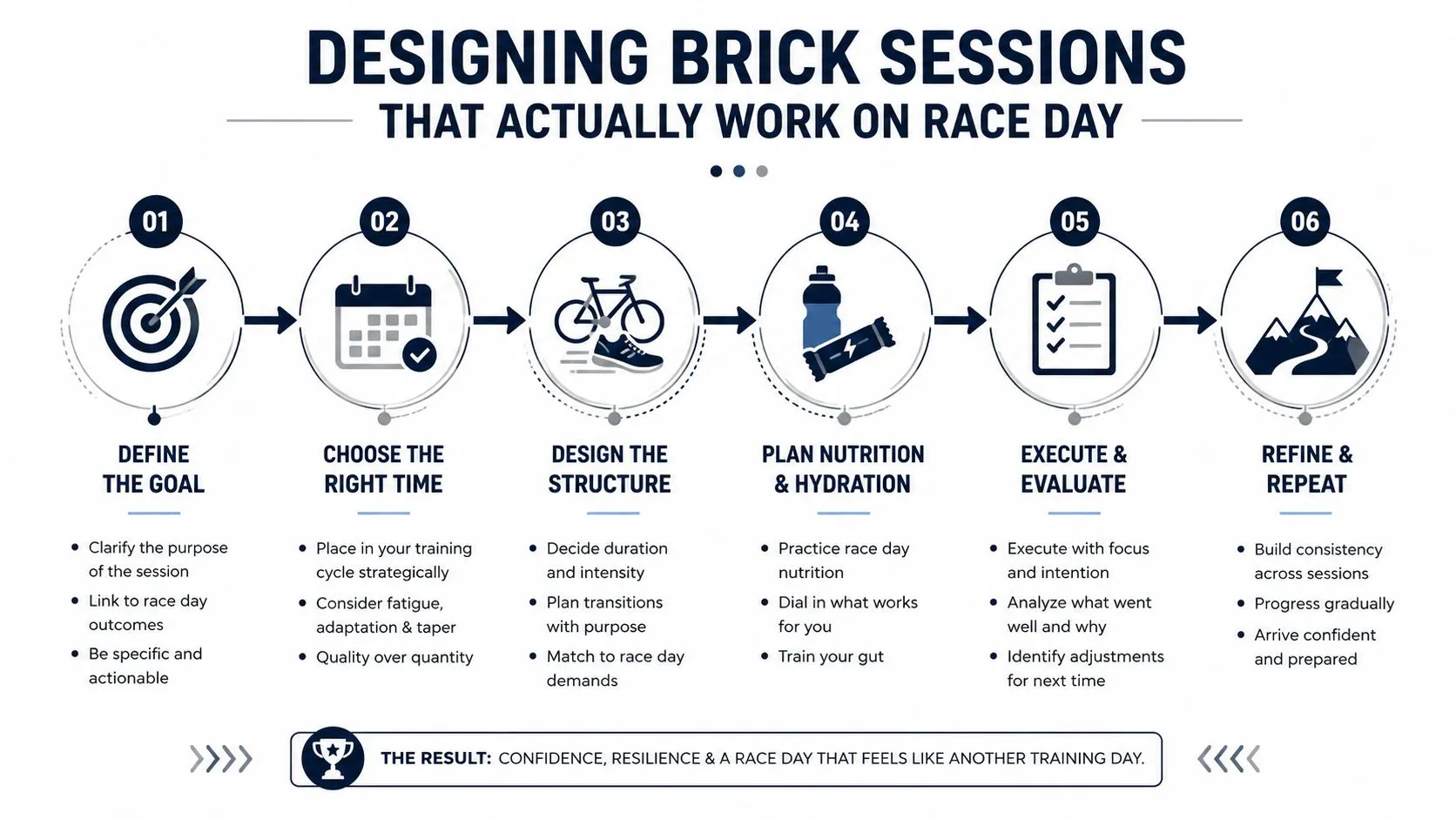
Brick sessions are where triathletes often overcomplicate things. The workout changes once two disciplines are stacked, because the run leg is no longer a fresh standalone run. It’s a controlled transition, and that changes how the intervals should be written.
Short-course and long-course bricks are not the same workout
Short-course athletes can ride close to race intensity and then move into a run that uses continuous work or short race-pace repeats. Long-course athletes usually do better with a steadier run at or slightly below race intensity after a longer ride. Both versions can work, but they solve different problems, so writing them as if they’re interchangeable is how athletes end up with a brick that looks fine on paper and feels random in execution.
The device-friendly version starts with a clear warm-up, then the bike block, then the transition, then the run block, then cooldown. That sounds basic, but basic is exactly what makes it repeatable. The coached examples behind brick sessions also lean on different recovery lengths for bike and run work, which is why a plain-text note can be surprisingly hard to execute correctly if it never gets structured.
Convert the note, not just the intent
A coach-style brick note has to become a sequence the athlete can follow without guessing. A two-tier warm-up matters because the bike and run legs don’t ask for the same priming, and cooldowns matter because the quality of the next session depends on how cleanly this one ends. That’s especially important when the athlete is using a watch or head unit that wants discrete steps, not a paragraph.
The main trade-off is between specificity and simplicity. If the run after the bike is meant to be steady race-intensity work, keep it steady. If it’s meant to be short repeats, make the repeats visible. The session should help the athlete keep pacing consistent, not force them to interpret the meaning of every minute while already under fatigue.
From a Text Description to a Synced Workout
A useful workout builder doesn’t ask you to relearn interval design. It should take the words you already use and turn them into a session your device understands. That’s the point of a text-first workflow.
A plain sentence can become a structured session
Here’s the advantage of a natural-language workflow. A note like “10x400m at 5K pace with 90 seconds standing rest” can be parsed into steps, repeats, recoveries, and a pace target, then previewed before it goes anywhere near the wrist. That removes the need to drag blocks around in a visual builder or translate the workout into English first.
TextFit does this. You write a free-form description in any language, it turns the note into a structured workout you review and tweak, then it syncs to your Garmin or Wahoo and schedules on Apple Watch. There is no file-transfer step. The note moves from message-style input to device-ready workout with little friction.
Practical rule: the best workout input is the one you’d naturally write for a coach, not the one you had to format for software.
The multilingual part matters more than people expect. Coaches and athletes often think in their native language, but many structured workout systems still assume English or force the athlete to translate the plan first. A tool that accepts the original wording reduces both setup time and translation mistakes, which is a real advantage when the workout has multiple steps or a brick transition.
Workout plan builder guidance for structured sessions fits here because the workflow is the same whether the session is for swim, bike, or run: write it plainly, structure it once, then reuse it.
The workflow is short on purpose
| Step | Action | Output |
|---|---|---|
| 1 | Write the workout in plain language | A natural session note |
| 2 | Parse the text | Structured steps, repeats, and targets |
| 3 | Preview the workout | A quick check for pacing and recovery |
| 4 | Sync to device | Ready on Garmin or Wahoo |
| 5 | Execute the session | Fewer setup mistakes on training day |
That’s the core value. The athlete doesn’t need another planning ritual. They need the workout to stop being a paragraph and start behaving like a session.
Periodization, Frequency, and Tapering Around the Race
Even a well-built interval session fails when it’s stacked badly across a race block. The safest approach is simple: build the fast work in a short block, keep the hard stuff contained, and back off before race day so the body can use the work.
Keep the hard work contained
For newer athletes, cap true high-intensity speedwork at about one session per week. Put it inside a short build block of roughly 4 to 8 weeks before the goal race. That protects recovery, because triathletes aren’t recovering from one sport. They’re recovering across swim, bike, and run.
One coach example cited a month of weekly 8×400 m before moving to 12×400 m. Another recommended 10 to 12×1 to 2 km repeats at near-Ironman pace with short recoveries, while emphasizing that athletes shouldn’t start reps faster than the pace they can hold to the end. That last point matters more than almost any interval count on the page.
Taper with the session, not against it
The taper is not the time to invent a new kind of fitness. It’s the time to reduce interval volume and intensity in the final two to three weeks while keeping the neuromuscular signal sharp. That usually means less total work, cleaner pacing, and fewer chances to turn a sharp session into a sloppy one.
A simple race-block pattern looks like this.
- Build phase: keep one hard session as the main speed stimulus.
- Support work: let one or two additional interval sessions stay lower in intensity.
- Taper phase: reduce load, keep rhythm, and protect freshness.
- Race week: stop chasing new fitness and stick to what the body already knows.
The key trade-off is obvious but easy to ignore: more intensity is not always more readiness. For triathletes, race-day execution usually improves when the final sessions are exact rather than aggressive.
Putting It All Together and Your Next Session
Good triathlon interval training is a system, not a pile of hard workouts. The system starts with the right band: sub-threshold, threshold, tempo, or VO2max-style work. It uses the right discipline-specific session, the right recoveries, and the right brick logic, then turns the whole thing into a structured workout the device can follow.
The next move is practical. Pick one session from the bike or run examples, write it the way you’d say it to a coach, then convert it into a structured workout before your next training day. If you’re planning a brick, write the transition explicitly so the run behaves the way you expect when you step off the bike.
Keep this quick checklist nearby.
- Match the band: choose the session type that fits the goal.
- Match the discipline: swim, bike, and run don’t take the same format.
- Match the recovery: don’t guess, write it down.
- Match the device: make sure the workout appears as steps, not a paragraph.
- Match the race block: keep hard work contained and taper cleanly.
A smart session is useful only when it gets executed the same way twice. Start with the next workout you already need to do, turn it into plain text, and send it to the device before you leave for training.
If turning written sessions into device-ready workouts is your bottleneck, try TextFit. Type the session the way you’d text it to a coach, in any language: “6 x 3 min hard with 3 min easy”. You get a structured workout to review and tweak, then it syncs to your Garmin or Wahoo and schedules on Apple Watch. Free to start, no sign-up needed.